




A cricketer hits a sixer. The cricket ball moves up with a velocity of 2 \[m{{s}^{-1}}\]and falls down. Its initial velocity while falling down will be
A. 1 \[m{{s}^{-1}}\]
B. 1 \[m{{s}^{-2}}\]
C. 0 \[m{{s}^{-1}}\]
D. 2 \[m{{s}^{-1}}\]
Answer
 Verified
584.4k+ views
Hint: The ball will keep climbing against gravity till its velocity zero. After that point, it will start its free fall under the acceleration of gravity. Between the climbing and fall of the ball, there is a point when the ball is momentarily at rest.
Complete answer:
Any body that goes up and then falls freely experiences three steps of motion. First, it moves up with some velocity and its velocity is retarded by gravity. The body loses velocity till it becomes zero and then it momentarily comes to rest. When the body comes to rest that is its velocity equals zero then the acceleration due to gravity is still acting on the body and it starts free fall under the acceleration due to gravity, with an initial velocity equal to zero.
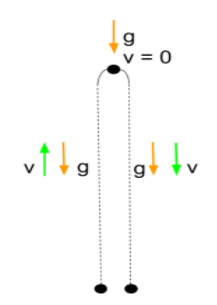
Coming back to our question. The cricket hit the sixer and the ball moved up with velocity 2 \[m{{s}^{-1}}\]. The ball climbs against gravity till its velocity equals zero and it momentarily comes to rest. After that, it starts falling down under the influence of gravity with an initial velocity equal to zero. That means the initial velocity of the ball was 0 \[m{{s}^{-1}}\] .
So, Option C is the correct one.
Note:
Anybody going up or down freely or having components of its velocity in either direction encounters an acceleration due to gravity. The magnitude of that acceleration is 9.8\[m{{s}^{-2}}\] and is directed towards the earth. So a body going up will lose its velocity at a rate of 9.8\[m{{s}^{-2}}\]while a falling body will gain velocity at the rate of 9.8\[m{{s}^{-2}}\].
Complete answer:
Any body that goes up and then falls freely experiences three steps of motion. First, it moves up with some velocity and its velocity is retarded by gravity. The body loses velocity till it becomes zero and then it momentarily comes to rest. When the body comes to rest that is its velocity equals zero then the acceleration due to gravity is still acting on the body and it starts free fall under the acceleration due to gravity, with an initial velocity equal to zero.
Coming back to our question. The cricket hit the sixer and the ball moved up with velocity 2 \[m{{s}^{-1}}\]. The ball climbs against gravity till its velocity equals zero and it momentarily comes to rest. After that, it starts falling down under the influence of gravity with an initial velocity equal to zero. That means the initial velocity of the ball was 0 \[m{{s}^{-1}}\] .
So, Option C is the correct one.
Note:
Anybody going up or down freely or having components of its velocity in either direction encounters an acceleration due to gravity. The magnitude of that acceleration is 9.8\[m{{s}^{-2}}\] and is directed towards the earth. So a body going up will lose its velocity at a rate of 9.8\[m{{s}^{-2}}\]while a falling body will gain velocity at the rate of 9.8\[m{{s}^{-2}}\].
Recently Updated Pages
Master Class 11 Computer Science: Engaging Questions & Answers for Success

Master Class 11 Business Studies: Engaging Questions & Answers for Success
Master Class 11 Economics: Engaging Questions & Answers for Success
Master Class 11 English: Engaging Questions & Answers for Success
Master Class 11 Maths: Engaging Questions & Answers for Success
Master Class 11 Biology: Engaging Questions & Answers for Success
Trending doubts
One Metric ton is equal to kg A 10000 B 1000 C 100 class 11 physics CBSE
There are 720 permutations of the digits 1 2 3 4 5 class 11 maths CBSE
Discuss the various forms of bacteria class 11 biology CBSE
Draw a diagram of a plant cell and label at least eight class 11 biology CBSE
State the laws of reflection of light
Explain zero factorial class 11 maths CBSE