




A corn cob, shaped somewhat like a cone, has the radius of it'd broadest end as 2.1cm and length as 20cm. If each 1cm sq. of the surface of the cob carries an average of four grains, find how many grains you would find on the entire cob?
Answer
 Verified
624k+ views
Hint: It is given that the corn cob is in the shape of a cone, we have to find the number of grains in the entire cob. On a corn cob, the grains are structured on the outer surface. Since the grains of corn are found on the curved surface of the corn cob. So to find the total number of grains we first find the total surface area of this cone shape and then use the information in the question to perform basic arithmetic operations to get the required answer.
Formula used:
The curved surface area of the cone \[ = \pi rl\]; where $r$ is the radius of the base of the cone, $l$ is the slant height of the cone and $\pi$ is a constant.
Complete step by step solution:
It is given that the corn cub is in the shape of a cone with radius 2.1cm and height 20cm.
That is\[r = 2.1{\rm{ }}cm\] and \[h = 20{\rm{ }}cm\]
Also given that 1cm sq. of the surface of the cob carries an average of four grains.
We have to find the total number of grains in the field for that we will find the curved surface area of the cone.
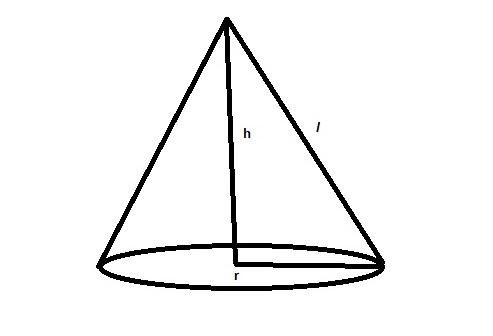
The curved surface area requires the slant height, let \[l\] be the slant height of the corn cob. Then,
From the above given diagram r, h and l form a right angles triangle since we know the values of r and h we will use Pythagoras theorem to find l.
\[l = \sqrt {{r^2} + {h^2}} \]
Let us substitute r and h in the above formula we get,
$\Rightarrow$\[l = \sqrt {{{\left( {2.1} \right)}^2} + {{\left( {20} \right)}^2}} \]
On squaring the values inside the root we get
$\Rightarrow$\[l = \sqrt {4.41 + 400} \]
On further solving we have found the value of l as
$\Rightarrow$\[l = 20.11{\rm{ }}cm\]
Now let us find the curved surface area of the field by substituting the values of r and l in the formula given below, we get,
Curved surface area of cone \[ = \pi rl\], on substituting the corresponding values we get,
$\Rightarrow$\[ \dfrac{{22}}{7} \times 2.1 \times 20.11\]
Hence we get the curved surface area of the field \[ = 132.726{\rm{ }}c{m^2}\]
Next we find the total number of grains using the following formula.
Total number of grains on the corn cob = Curved surface area of the corn cob \[ \times \] Number of grains of corn on \[1{\rm{ }}c{m^2}\]
Total number of grains on the corn cob \[ = 132.726 \times 4\]
Hence the total number of grains \[ = 530.92 = 531\left( {approx} \right)\]
$\therefore$ There would be approximately 531 grains of corn on the cob.
Note:
The Pythagoras theorem is used in the problem, it states that “the sum of squares of adjacent and opposite sides of a triangle is equal to the square of the hypotenuse”. This plays a major role in finding the slant height of the cone. We need to take care of simplifications and substitutions in the calculation part.
Formula used:
The curved surface area of the cone \[ = \pi rl\]; where $r$ is the radius of the base of the cone, $l$ is the slant height of the cone and $\pi$ is a constant.
Complete step by step solution:
It is given that the corn cub is in the shape of a cone with radius 2.1cm and height 20cm.
That is\[r = 2.1{\rm{ }}cm\] and \[h = 20{\rm{ }}cm\]
Also given that 1cm sq. of the surface of the cob carries an average of four grains.
We have to find the total number of grains in the field for that we will find the curved surface area of the cone.
The curved surface area requires the slant height, let \[l\] be the slant height of the corn cob. Then,
From the above given diagram r, h and l form a right angles triangle since we know the values of r and h we will use Pythagoras theorem to find l.
\[l = \sqrt {{r^2} + {h^2}} \]
Let us substitute r and h in the above formula we get,
$\Rightarrow$\[l = \sqrt {{{\left( {2.1} \right)}^2} + {{\left( {20} \right)}^2}} \]
On squaring the values inside the root we get
$\Rightarrow$\[l = \sqrt {4.41 + 400} \]
On further solving we have found the value of l as
$\Rightarrow$\[l = 20.11{\rm{ }}cm\]
Now let us find the curved surface area of the field by substituting the values of r and l in the formula given below, we get,
Curved surface area of cone \[ = \pi rl\], on substituting the corresponding values we get,
$\Rightarrow$\[ \dfrac{{22}}{7} \times 2.1 \times 20.11\]
Hence we get the curved surface area of the field \[ = 132.726{\rm{ }}c{m^2}\]
Next we find the total number of grains using the following formula.
Total number of grains on the corn cob = Curved surface area of the corn cob \[ \times \] Number of grains of corn on \[1{\rm{ }}c{m^2}\]
Total number of grains on the corn cob \[ = 132.726 \times 4\]
Hence the total number of grains \[ = 530.92 = 531\left( {approx} \right)\]
$\therefore$ There would be approximately 531 grains of corn on the cob.
Note:
The Pythagoras theorem is used in the problem, it states that “the sum of squares of adjacent and opposite sides of a triangle is equal to the square of the hypotenuse”. This plays a major role in finding the slant height of the cone. We need to take care of simplifications and substitutions in the calculation part.
Recently Updated Pages
Master Class 9 General Knowledge: Engaging Questions & Answers for Success

Master Class 9 Maths: Engaging Questions & Answers for Success
Master Class 9 Science: Engaging Questions & Answers for Success
Master Class 9 English: Engaging Questions & Answers for Success
Master Class 9 Social Science: Engaging Questions & Answers for Success
Class 9 Question and Answer - Your Ultimate Solutions Guide
Trending doubts
What is the situation called when no party gets the class 9 social science CBSE
Find the sum of series 1 + 2 + 3 + 4 + 5 + + 100 class 9 maths CBSE
Difference Between Plant Cell and Animal Cell
Fill the blanks with the suitable prepositions 1 The class 9 english CBSE
What is pollution? How many types of pollution? Define it
What is the Full Form of ICSE / ISC ?