




A copper sphere of diameter 18 cm is drawn into a wire of diameter 4 mm. Find the length of the wire
A) 374.95 m
B) 243 m
C) 18 m
D) 325 m
Answer
 Verified
633.3k+ views
Hint: In this question it is given that a copper sphere of diameter 18 cm is drawn into a wire of diameter 4 mm. So we have to find the length of the wire. So to understand this problem in better way we have ro draw the diagram,
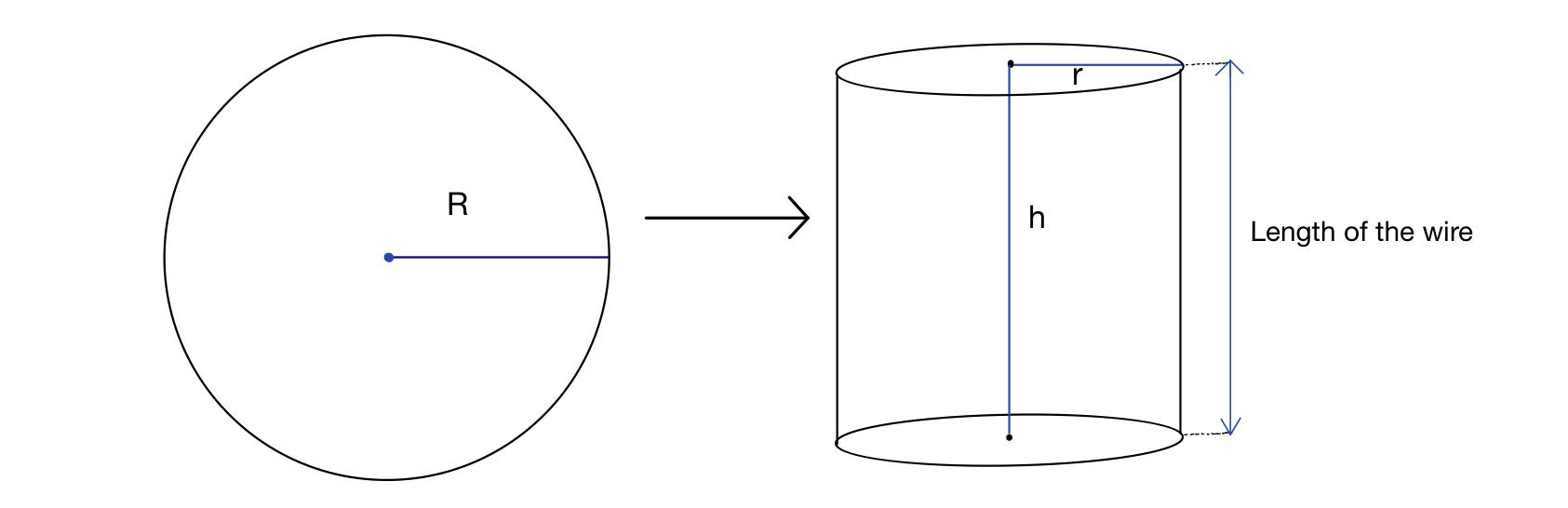
Since the copper sphere is drawn into a cylindrical wire, we can say that the volume of those shapes are equal.
i.e, Volume of sphere = Volume of cylindrical wire.
So from here we can find the height of the cylinder or the length of the cylindrical wire.
Complete step-by-step solution:
It is given that the diameter of the sphere is 18 cm.
Then the radius R= $$\dfrac{diameter}{2} =\dfrac{18}{2}$$ cm =9 cm.
Now as we know that if the radius of a sphere be R then the formula of volume $$V_{1}=\dfrac{4}{3} \pi r^{3}$$.
So by the above formula we can write the volume of given sphere,
$$V_{1}=\dfrac{4}{3} \pi \times \left( 9\right)^{3} \ cm^{3}$$ ……....(1)
Now the diameter the cylindrical wire = 4 mm = $$\dfrac{4}{10}$$ cm = 0.4 cm [ $$\because 1\ mm=\dfrac{1}{10} \ cm$$]
Then the radius of cylinder r = $$\dfrac{diameter}{2} =\dfrac{0.4}{2}$$ cm =0.2 cm.
Now let the length( height) of the wire h cm.
Before finding the volume of cylindrical wire we have to know that if the radius of a cylinder be r and the height be h then the volume,
$$V_{2}=\pi r^{2}h$$
So by the above formula we can write the volume of cylindrical wire,
$$V_{2}=\pi \left( 0.2\right)^{2} h$$..............(2)
Now since the volume of these shapes are equal, then from (1) and (2) we can write,
$$V_{1}=V_{2}$$
$$\Rightarrow \dfrac{4}{3} \pi \times 9^{3}=\pi \left( 0.2\right)^{2} h$$
$$\Rightarrow \dfrac{4}{3} \times 9^{3}=\left( 0.2\right)^{2} h$$ [ canceling $\pi$ from the both side]
$$\Rightarrow \left( 0.2\right)^{2} h=\dfrac{4}{3} \times 9^{3}$$
$$\Rightarrow 0.2\times 0.2h=\dfrac{4}{3} \times 9\times 9\times 9$$
$$\Rightarrow 0.04h=4\times 3\times 9\times 9$$
$$\Rightarrow h=\dfrac{4\times 3\times 9\times 9}{0.04}$$
$$\Rightarrow h=24300$$
So we get the length (height) of the cylindrical wire =24300 cm =$$\dfrac{24300}{100}$$ m =243 m.
[ since 1cm=$$\dfrac{1}{100}$$ m]
Hence the correct option is option B.
Note: So to solve this you have to know that when you melted one shape to form another shape then the quantity of the material on both the shapes are the same and quantity of material is equivalent to the volume. Also, Since the diameter of the wire is given so you have to consider this wire as a cylindrical shape.
Since the copper sphere is drawn into a cylindrical wire, we can say that the volume of those shapes are equal.
i.e, Volume of sphere = Volume of cylindrical wire.
So from here we can find the height of the cylinder or the length of the cylindrical wire.
Complete step-by-step solution:
It is given that the diameter of the sphere is 18 cm.
Then the radius R= $$\dfrac{diameter}{2} =\dfrac{18}{2}$$ cm =9 cm.
Now as we know that if the radius of a sphere be R then the formula of volume $$V_{1}=\dfrac{4}{3} \pi r^{3}$$.
So by the above formula we can write the volume of given sphere,
$$V_{1}=\dfrac{4}{3} \pi \times \left( 9\right)^{3} \ cm^{3}$$ ……....(1)
Now the diameter the cylindrical wire = 4 mm = $$\dfrac{4}{10}$$ cm = 0.4 cm [ $$\because 1\ mm=\dfrac{1}{10} \ cm$$]
Then the radius of cylinder r = $$\dfrac{diameter}{2} =\dfrac{0.4}{2}$$ cm =0.2 cm.
Now let the length( height) of the wire h cm.
Before finding the volume of cylindrical wire we have to know that if the radius of a cylinder be r and the height be h then the volume,
$$V_{2}=\pi r^{2}h$$
So by the above formula we can write the volume of cylindrical wire,
$$V_{2}=\pi \left( 0.2\right)^{2} h$$..............(2)
Now since the volume of these shapes are equal, then from (1) and (2) we can write,
$$V_{1}=V_{2}$$
$$\Rightarrow \dfrac{4}{3} \pi \times 9^{3}=\pi \left( 0.2\right)^{2} h$$
$$\Rightarrow \dfrac{4}{3} \times 9^{3}=\left( 0.2\right)^{2} h$$ [ canceling $\pi$ from the both side]
$$\Rightarrow \left( 0.2\right)^{2} h=\dfrac{4}{3} \times 9^{3}$$
$$\Rightarrow 0.2\times 0.2h=\dfrac{4}{3} \times 9\times 9\times 9$$
$$\Rightarrow 0.04h=4\times 3\times 9\times 9$$
$$\Rightarrow h=\dfrac{4\times 3\times 9\times 9}{0.04}$$
$$\Rightarrow h=24300$$
So we get the length (height) of the cylindrical wire =24300 cm =$$\dfrac{24300}{100}$$ m =243 m.
[ since 1cm=$$\dfrac{1}{100}$$ m]
Hence the correct option is option B.
Note: So to solve this you have to know that when you melted one shape to form another shape then the quantity of the material on both the shapes are the same and quantity of material is equivalent to the volume. Also, Since the diameter of the wire is given so you have to consider this wire as a cylindrical shape.
Recently Updated Pages
Master Class 12 Business Studies: Engaging Questions & Answers for Success

Master Class 12 Biology: Engaging Questions & Answers for Success
Master Class 12 Chemistry: Engaging Questions & Answers for Success
Class 12 Question and Answer - Your Ultimate Solutions Guide
Master Class 11 Social Science: Engaging Questions & Answers for Success
Master Class 11 English: Engaging Questions & Answers for Success
Trending doubts
Explain the Treaty of Vienna of 1815 class 10 social science CBSE
Which Indian city is known as the "City of Victory"?
Which instrument is used to measure the Blood Pressure?
Who Won 36 Oscar Awards? Record Holder Revealed
What is the median of the first 10 natural numbers class 10 maths CBSE
Why is it 530 pm in india when it is 1200 afternoon class 10 social science CBSE