




A copper rod of length l is rotated about one end, perpendicular to the uniform magnetic field B with constant angular velocity $\omega$. The induced emf between two ends of the rod is:
A. $\dfrac{1}{2} B \omega l^2$
B. $B \omega l^2$
C. $\dfrac{3}{2} B \omega l^2$
D. $2 B \omega l^2$
Answer
 Verified
606.9k+ views
Hint: This question is from the topic motional emf. By Faraday's law when the rod will be rotated in a magnetic field, emf will be induced across its ends due to change in magnetic flux. Consider the rod to be simply a length and perform integration by considering dx of that length.
Formula used:
The emf induced due to change in magnetic flux associated with moving length l, is given as:
$e = - \dfrac{d \phi}{dt} = Blv$.
Complete answer:
We know that the magnetic flux through an area is given by:
$\phi = BA$.
But we are dealing with a rod of length l which is moving. The flux through the rod is only due to its length and change in flux is due to its velocity. So, for the entire rod, we may write the emf induced as
$e = Blv$.
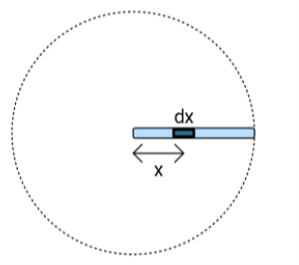
Now, this rod is rotating in the magnetic field and the flux through it will change inducing an emf. This motion is not similar to linear motion. So, we consider a small length dx of the rod which happens to be performing a circular motion with angular velocity $\omega$.
The rate of change of flux or the emf induced is:
$e_1 = B v dx$.
Now, in circular motion we know that the velocity is given as:
$ \dfrac{dx}{dt} = v = x \omega $
as, we assumed the distance of dx from the axis to be x.
The emf induced due to dx can be written as:
$e_1 = B \omega x dx$ ;
integrating this from the limits 0 to l will give us the required emf e.
$e = B \omega \int_{0}^{l}xdx = B \omega \left( \dfrac{x^2}{2} \right)_0^l = \dfrac{1}{2} B \omega l^2$.
Therefore, the correct answer is option (A).
Note:
The formula e = Blv is for the case of linear motion. Do not substitute the value of v directly into this to get the required emf as it should be understood that a rod performing circular motion has different velocity v throughout its length. The angular velocity for the entire rod is the same but the linear velocity will be different throughout the length of the rod.
Formula used:
The emf induced due to change in magnetic flux associated with moving length l, is given as:
$e = - \dfrac{d \phi}{dt} = Blv$.
Complete answer:
We know that the magnetic flux through an area is given by:
$\phi = BA$.
But we are dealing with a rod of length l which is moving. The flux through the rod is only due to its length and change in flux is due to its velocity. So, for the entire rod, we may write the emf induced as
$e = Blv$.
Now, this rod is rotating in the magnetic field and the flux through it will change inducing an emf. This motion is not similar to linear motion. So, we consider a small length dx of the rod which happens to be performing a circular motion with angular velocity $\omega$.
The rate of change of flux or the emf induced is:
$e_1 = B v dx$.
Now, in circular motion we know that the velocity is given as:
$ \dfrac{dx}{dt} = v = x \omega $
as, we assumed the distance of dx from the axis to be x.
The emf induced due to dx can be written as:
$e_1 = B \omega x dx$ ;
integrating this from the limits 0 to l will give us the required emf e.
$e = B \omega \int_{0}^{l}xdx = B \omega \left( \dfrac{x^2}{2} \right)_0^l = \dfrac{1}{2} B \omega l^2$.
Therefore, the correct answer is option (A).
Note:
The formula e = Blv is for the case of linear motion. Do not substitute the value of v directly into this to get the required emf as it should be understood that a rod performing circular motion has different velocity v throughout its length. The angular velocity for the entire rod is the same but the linear velocity will be different throughout the length of the rod.
Recently Updated Pages
Master Class 11 Social Science: Engaging Questions & Answers for Success

Master Class 11 English: Engaging Questions & Answers for Success
Master Class 11 Maths: Engaging Questions & Answers for Success
Master Class 11 Chemistry: Engaging Questions & Answers for Success
Master Class 11 Biology: Engaging Questions & Answers for Success
Master Class 11 Physics: Engaging Questions & Answers for Success
Trending doubts
One Metric ton is equal to kg A 10000 B 1000 C 100 class 11 physics CBSE
Difference Between Prokaryotic Cells and Eukaryotic Cells
How many of the following diseases can be studied with class 11 biology CBSE
Which of the following enzymes is used for carboxylation class 11 biology CBSE
Two of the body parts which do not appear in MRI are class 11 biology CBSE
Draw a diagram of a plant cell and label at least eight class 11 biology CBSE