




A copper ball of density ${{\rho }_{C}}$ and diameter $d$ is immersed in oil of density ${{\rho }_{0}}$. What charge should be present on the ball, so that it could be suspended in the oil, if a homogeneous electric field $E$ is given vertically upward?
$\begin{align}
& A.Q=\dfrac{\pi {{d}^{2}}\left( {{\rho }_{C}}-{{\rho }_{0}} \right)g}{6E} \\
& B.Q=\dfrac{\pi {{d}^{3}}\left( {{\rho }_{C}}-{{\rho }_{0}} \right)g}{6E} \\
& C.Q=\dfrac{\pi {{d}^{3}}\left( {{\rho }_{C}}-{{\rho }_{0}} \right)g}{E} \\
& D.Q=\dfrac{\pi {{d}^{2}}\left( {{\rho }_{C}}-{{\rho }_{0}} \right)g}{2E} \\
\end{align}$
Answer
 Verified
585.9k+ views
Hint: The pressure applied due to electric field is determined by taking the product of height or the depth in the oil, density difference between the copper ball and oil and also the acceleration due to gravity. Substitute the values of the terms in the given equation. The charge present in the copper ball is found by dividing the pressure applied by the oil by the electric field. These will help you to solve this question.
Formula used: $P=h\rho g$
Complete step by step answer:
First of all let us look at the terms mentioned in the question.
The copper ball is having density which is given as ${{\rho }_{C}}$. This copper ball is having a diameter $d$. The density of the oil is indicated as ${{\rho }_{0}}$. And the electric field is given as $E$.
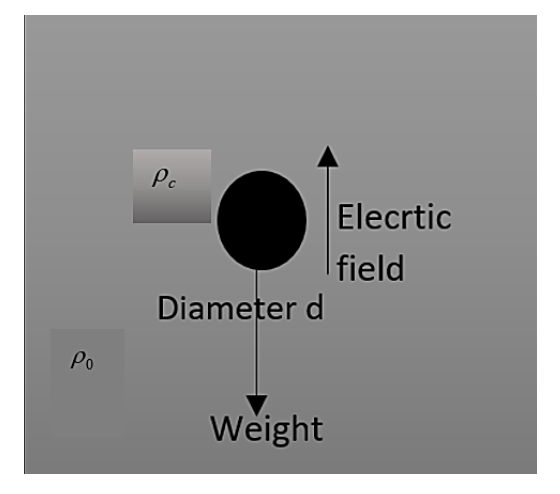
The homogeneous electric field applies a pressure on the copper ball can be found using an equation,
$P=h\rho g$
The difference in the density is given as,
$\rho ={{\rho }_{C}}-{{\rho }_{0}}$
And the value of the height is given as,
$h=\pi \dfrac{{{d}^{2}}}{6}$
Substituting this in the equation will give,
$P=\pi \dfrac{{{d}^{2}}}{6}\times \left( {{\rho }_{C}}-{{\rho }_{0}} \right)g$
And also the charge in the copper ball can be found by dividing the pressure on the ball by the electric field. Therefore we can write that,
$Q=\dfrac{P}{E}$
Substituting the values in this equation,
$Q=\dfrac{\pi \dfrac{{{d}^{2}}}{6}\times \left( {{\rho }_{C}}-{{\rho }_{0}} \right)g}{E}$
So, the correct answer is “Option A”.
Note: Fluid pressure is given as the measure of the force acting in a unit area. Fluid pressure can occur due to gravity, acceleration, or forces acting in a container. Pressure gets increased as the depth gets higher since the fluid at a lower depth should support the fluid above it also.
Formula used: $P=h\rho g$
Complete step by step answer:
First of all let us look at the terms mentioned in the question.
The copper ball is having density which is given as ${{\rho }_{C}}$. This copper ball is having a diameter $d$. The density of the oil is indicated as ${{\rho }_{0}}$. And the electric field is given as $E$.
The homogeneous electric field applies a pressure on the copper ball can be found using an equation,
$P=h\rho g$
The difference in the density is given as,
$\rho ={{\rho }_{C}}-{{\rho }_{0}}$
And the value of the height is given as,
$h=\pi \dfrac{{{d}^{2}}}{6}$
Substituting this in the equation will give,
$P=\pi \dfrac{{{d}^{2}}}{6}\times \left( {{\rho }_{C}}-{{\rho }_{0}} \right)g$
And also the charge in the copper ball can be found by dividing the pressure on the ball by the electric field. Therefore we can write that,
$Q=\dfrac{P}{E}$
Substituting the values in this equation,
$Q=\dfrac{\pi \dfrac{{{d}^{2}}}{6}\times \left( {{\rho }_{C}}-{{\rho }_{0}} \right)g}{E}$
So, the correct answer is “Option A”.
Note: Fluid pressure is given as the measure of the force acting in a unit area. Fluid pressure can occur due to gravity, acceleration, or forces acting in a container. Pressure gets increased as the depth gets higher since the fluid at a lower depth should support the fluid above it also.
Recently Updated Pages
Master Class 11 Computer Science: Engaging Questions & Answers for Success

Master Class 11 Business Studies: Engaging Questions & Answers for Success
Master Class 11 Economics: Engaging Questions & Answers for Success
Master Class 11 English: Engaging Questions & Answers for Success
Master Class 11 Maths: Engaging Questions & Answers for Success
Master Class 11 Biology: Engaging Questions & Answers for Success
Trending doubts
One Metric ton is equal to kg A 10000 B 1000 C 100 class 11 physics CBSE
There are 720 permutations of the digits 1 2 3 4 5 class 11 maths CBSE
Discuss the various forms of bacteria class 11 biology CBSE
Draw a diagram of a plant cell and label at least eight class 11 biology CBSE
State the laws of reflection of light
Explain zero factorial class 11 maths CBSE