




A coolie X is carrying a load on his head climbs up a slope and another Y carrying the identical load on his head moves the same distance on the frictionless horizontal platform. Who does more work?
A. X
B. Y
C. Both A and B.
D. Cannot say
Answer
 Verified
665.7k+ views
Hint: The amount of work done strongly depends on the angle between the force and displacement.
Complete step by step answer:
Refer to the figure below for an object moving up the inclined plane:
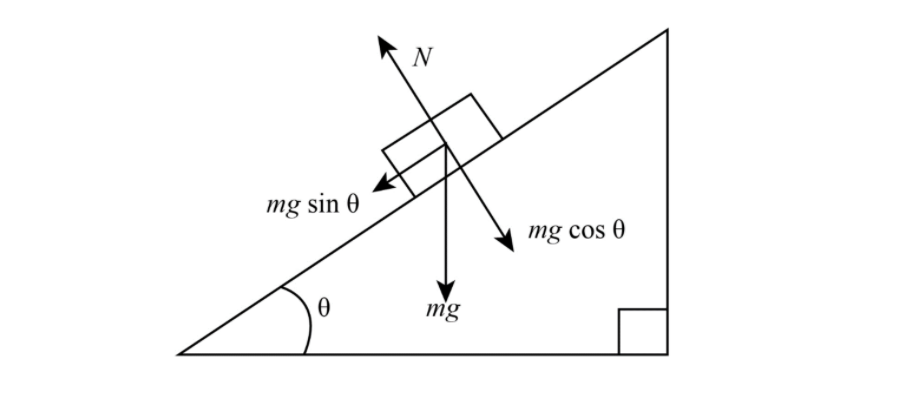
Ability to do work is called energy and the energy dissipated is equal to work done.
Express the relation for work done:
$W = F\,s\cos \theta $
Here $W$ is the work done, $F$ is the force acting on the body, $s$ is the displacement and $\theta $ is the angle between the force and the displacement.
In case of Y when it is moving on a flat surface the angle between force and displacement is $90^\circ $, and $N$ is equal to normal reaction.
Therefore, the work done in case of Y becomes,
$
W = F\,\times s \times\cos 90^\circ \\
W = m\,g\,\times s \times\cos 90^\circ \\
W = 0 \\
$
Here, $m$ is the mass of the body and $g$ is the acceleration due to gravity.
Whereas, in case of X, the force and displacement are not perpendicular. Therefore,
$W \ne 0$
Therefore, X does more work as compared to Y.
Hence the correct option is (A).
Note: Work done by X while moving up the slope is, $W = (F - mg\sin \theta ) \times s$. When X is moving up the slope, it has to encounter friction down the slope and has to work against gravity. But Y is moving on a frictionless surface.
Complete step by step answer:
Refer to the figure below for an object moving up the inclined plane:
Ability to do work is called energy and the energy dissipated is equal to work done.
Express the relation for work done:
$W = F\,s\cos \theta $
Here $W$ is the work done, $F$ is the force acting on the body, $s$ is the displacement and $\theta $ is the angle between the force and the displacement.
In case of Y when it is moving on a flat surface the angle between force and displacement is $90^\circ $, and $N$ is equal to normal reaction.
Therefore, the work done in case of Y becomes,
$
W = F\,\times s \times\cos 90^\circ \\
W = m\,g\,\times s \times\cos 90^\circ \\
W = 0 \\
$
Here, $m$ is the mass of the body and $g$ is the acceleration due to gravity.
Whereas, in case of X, the force and displacement are not perpendicular. Therefore,
$W \ne 0$
Therefore, X does more work as compared to Y.
Hence the correct option is (A).
Note: Work done by X while moving up the slope is, $W = (F - mg\sin \theta ) \times s$. When X is moving up the slope, it has to encounter friction down the slope and has to work against gravity. But Y is moving on a frictionless surface.
Recently Updated Pages
If x a + bt + ct2 where x is in meters and t is in class 11 physics CBSE

A car covers the first half distance between two places class 11 physics CBSE
The resultant of two vectors overrightarrow P and overrightarrow class 11 physics CBSE
Find the value of cos 135 class 11 maths CBSE
A mass M is held in place by an applied force F and class 11 physics CBSE
A solution of glucose in water is labelled as 10 dfracwv class 11 chemistry CBSE
Trending doubts
Find the value of the expression given below sin 30circ class 11 maths CBSE
One Metric ton is equal to kg A 10000 B 1000 C 100 class 11 physics CBSE
Draw a diagram of nephron and explain its structur class 11 biology CBSE
10 examples of friction in our daily life
Proton was discovered by A Thomson B Rutherford C Chadwick class 11 chemistry CBSE
Bond order ofO2 O2+ O2 and O22 is in order A O2 langle class 11 chemistry CBSE