




A coolie is pushing a box weighing $1500N$ up an inclined plane 7.5m long on to a platform, 2.5m above the ground.
(i) Calculate the mechanical advantage of the inclined plane.
(ii) Calculate the effort applied by the coolie.
(iii) In actual practice, the coolie needs to apply more effort than what is calculated. Give one reason why you think the coolie needs to apply more effort.
Answer
 Verified
585.9k+ views
Hint: Mechanical advantage of the inclined plane is the ratio of the length of the inclined plane and its height from the ground. Substitute the values of height and length of the inclined plane to calculate the mechanical advantage. Mechanical advantage is also defined as the ratio of the load and the effort. Substitute the obtained mechanical advantage value and the load to find the value of the effort applied by the coolie.
Complete step by step answer:
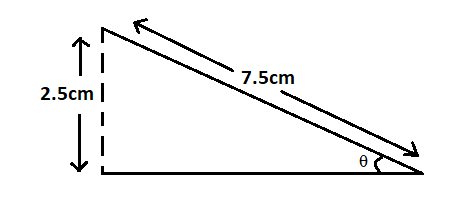
We are given that a coolie is pushing a box weighing $1500N$ up an inclined plane 7.5m long on to a platform, 2.5m above the ground.
(i) The mechanical advantage of the inclined plane.
Mechanical advantage (MA) is the ratio of the length of the inclined plane to its vertical height from the ground.
$MA = \dfrac{{length}}{{height}}$
Length of the inclined plane given is 7.5 cm.
Height of the inclined plane from the ground is 2.5 cm.
$
MA = \dfrac{l}{h} \\
l = 7.5cm,h = 2.5cm \\
MA = \dfrac{{7.5}}{{2.5}} \\
MA = 3 \\
$
The mechanical advantage of the inclined plane is 3.
(ii) The effort applied by the coolie.
Mechanical advantage can also be defined as the ratio of the weight of the load and the force (effort) applied to pull it up.
$MA = \dfrac{{load}}{{effort}}$
Effort applied is obtained by dividing the Mechanical advantage with the load.
$
MA = \dfrac{{load}}{{effort}} \\
Effort = \dfrac{{load}}{{MA}} \\
load = 1500N,MA = 3 \\
\implies Effort = \dfrac{{1500}}{3} \\
\therefore Effort = 500N \\
$
The effort applied by the coolie is 500N.
(iii) In actual practice, the coolie needs to apply more effort than what is calculated. Give one reason why you think the coolie needs to apply more effort.
In actual practice, there will be friction generated between the inclined plane and the bottom of the box which is pulled over the plane. The coolie also has to work against the frictional force generated. So, the effort needed to be applied by the coolie will be more than 500N.
Note:
Here we have calculated the effort only when gravitational force is acting upon the box. But every inclined plane generates friction with the load and therefore, the effort must also be calculated to oppose the frictional force.
Complete step by step answer:
We are given that a coolie is pushing a box weighing $1500N$ up an inclined plane 7.5m long on to a platform, 2.5m above the ground.
(i) The mechanical advantage of the inclined plane.
Mechanical advantage (MA) is the ratio of the length of the inclined plane to its vertical height from the ground.
$MA = \dfrac{{length}}{{height}}$
Length of the inclined plane given is 7.5 cm.
Height of the inclined plane from the ground is 2.5 cm.
$
MA = \dfrac{l}{h} \\
l = 7.5cm,h = 2.5cm \\
MA = \dfrac{{7.5}}{{2.5}} \\
MA = 3 \\
$
The mechanical advantage of the inclined plane is 3.
(ii) The effort applied by the coolie.
Mechanical advantage can also be defined as the ratio of the weight of the load and the force (effort) applied to pull it up.
$MA = \dfrac{{load}}{{effort}}$
Effort applied is obtained by dividing the Mechanical advantage with the load.
$
MA = \dfrac{{load}}{{effort}} \\
Effort = \dfrac{{load}}{{MA}} \\
load = 1500N,MA = 3 \\
\implies Effort = \dfrac{{1500}}{3} \\
\therefore Effort = 500N \\
$
The effort applied by the coolie is 500N.
(iii) In actual practice, the coolie needs to apply more effort than what is calculated. Give one reason why you think the coolie needs to apply more effort.
In actual practice, there will be friction generated between the inclined plane and the bottom of the box which is pulled over the plane. The coolie also has to work against the frictional force generated. So, the effort needed to be applied by the coolie will be more than 500N.
Note:
Here we have calculated the effort only when gravitational force is acting upon the box. But every inclined plane generates friction with the load and therefore, the effort must also be calculated to oppose the frictional force.
Recently Updated Pages
Master Class 11 Computer Science: Engaging Questions & Answers for Success

Master Class 11 Business Studies: Engaging Questions & Answers for Success
Master Class 11 Economics: Engaging Questions & Answers for Success
Master Class 11 English: Engaging Questions & Answers for Success
Master Class 11 Maths: Engaging Questions & Answers for Success
Master Class 11 Biology: Engaging Questions & Answers for Success
Trending doubts
One Metric ton is equal to kg A 10000 B 1000 C 100 class 11 physics CBSE
There are 720 permutations of the digits 1 2 3 4 5 class 11 maths CBSE
Discuss the various forms of bacteria class 11 biology CBSE
Draw a diagram of a plant cell and label at least eight class 11 biology CBSE
State the laws of reflection of light
Explain zero factorial class 11 maths CBSE