




A convex spherical reflecting surface with radius R separates a medium having refractive index $\dfrac{5}{2}$ from the air. As an object is moved towards the surface from far away from the surface along the principal axis, its image
A. Changes from real to virtual when it is at a distance R from the surface
B. Changes from virtual to real when it is at a distance R from the surface
C. Changes from real to virtual when it is at a distance $\dfrac{{2R}}{3}$ from the surface
D. Changes from virtual to real when it is at a distance $\dfrac{{2R}}{3}$ from the surface
Answer
 Verified
584.1k+ views
Hint: Use the Lens maker formula to find the image distance. As the refraction is taking place from a rarer to denser medium and from denser to rarer, so use the sign conventions accordingly.
Complete step by step solution:
Let \[{\mu _1}\] be the refractive index of the rarer medium around the lens. In the given problem it is air, i.e.\[{\mu _1} = 1\]
Let \[{\mu _2}\] be the refractive index of the material of the lens. Here, \[{\mu _2} = \dfrac{5}{2} = 2.5\]
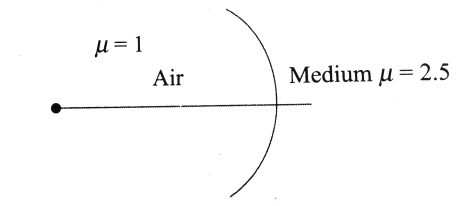
Let \[u\] be the object distance lying on the principal axis of the lens and \[v\] be the image distance from the convex refracting surface. If R is the radius of the curvature of the refracting surface, then by Lens maker formula for a convex lens, we have
\[\dfrac{{{\mu _2}}}{v} - \dfrac{{{\mu _1}}}{u} = \dfrac{{{\mu _2} - {\mu _1}}}{R}\]
Putting the given values, in the above equation, we get
\[ \Rightarrow \dfrac{{2.5}}{v} - \dfrac{1}{{ - u}} = \dfrac{{2.5 - 1}}{R}\]
\[ \Rightarrow \dfrac{{2.5}}{v} = \dfrac{{1.5}}{R} - \dfrac{1}{u} \Rightarrow \dfrac{{2.5uR}}{{1.5u - R}}\]
Image will be formed at infinity if \[1.5u - R\] will be zero. This is possible only if \[u = \dfrac{{2R}}{3}\] .
The image will be virtual if \[u < \dfrac{{2R}}{3}\] .
Hence the image will change from real to virtual when it is at a distance $\dfrac{{2R}}{3}$ from the surface.
Thus, the correct option is (C).
Note: A convex lens is made up of two convex spherical refracting surfaces. The final image will be formed after two refractions. Lens maker’s formula is a relation that connects focal length of a lens to radii of curvature of the two surfaces of the lens and the refractive index of the material of the lens. It is useful to design lenses of desired focal length using suitable material and surfaces of suitable radii of curvature.
Complete step by step solution:
Let \[{\mu _1}\] be the refractive index of the rarer medium around the lens. In the given problem it is air, i.e.\[{\mu _1} = 1\]
Let \[{\mu _2}\] be the refractive index of the material of the lens. Here, \[{\mu _2} = \dfrac{5}{2} = 2.5\]
Let \[u\] be the object distance lying on the principal axis of the lens and \[v\] be the image distance from the convex refracting surface. If R is the radius of the curvature of the refracting surface, then by Lens maker formula for a convex lens, we have
\[\dfrac{{{\mu _2}}}{v} - \dfrac{{{\mu _1}}}{u} = \dfrac{{{\mu _2} - {\mu _1}}}{R}\]
Putting the given values, in the above equation, we get
\[ \Rightarrow \dfrac{{2.5}}{v} - \dfrac{1}{{ - u}} = \dfrac{{2.5 - 1}}{R}\]
\[ \Rightarrow \dfrac{{2.5}}{v} = \dfrac{{1.5}}{R} - \dfrac{1}{u} \Rightarrow \dfrac{{2.5uR}}{{1.5u - R}}\]
Image will be formed at infinity if \[1.5u - R\] will be zero. This is possible only if \[u = \dfrac{{2R}}{3}\] .
The image will be virtual if \[u < \dfrac{{2R}}{3}\] .
Hence the image will change from real to virtual when it is at a distance $\dfrac{{2R}}{3}$ from the surface.
Thus, the correct option is (C).
Note: A convex lens is made up of two convex spherical refracting surfaces. The final image will be formed after two refractions. Lens maker’s formula is a relation that connects focal length of a lens to radii of curvature of the two surfaces of the lens and the refractive index of the material of the lens. It is useful to design lenses of desired focal length using suitable material and surfaces of suitable radii of curvature.
Recently Updated Pages
Master Class 11 Computer Science: Engaging Questions & Answers for Success

Master Class 11 Business Studies: Engaging Questions & Answers for Success
Master Class 11 Economics: Engaging Questions & Answers for Success
Master Class 11 English: Engaging Questions & Answers for Success
Master Class 11 Maths: Engaging Questions & Answers for Success
Master Class 11 Biology: Engaging Questions & Answers for Success
Trending doubts
One Metric ton is equal to kg A 10000 B 1000 C 100 class 11 physics CBSE
There are 720 permutations of the digits 1 2 3 4 5 class 11 maths CBSE
Discuss the various forms of bacteria class 11 biology CBSE
Draw a diagram of a plant cell and label at least eight class 11 biology CBSE
State the laws of reflection of light
Explain zero factorial class 11 maths CBSE