




A convex mirror has a focal length f. A real object is placed at a distance of f/2 from the pole. Find out the position, magnification and nature of the image.
Answer
 Verified
632.4k+ views
Hint: To calculate the image distance and magnification, we are using the mirror image and magnification formula. The mirror image formula gives a relation between the magnification, focal length and the distance of the object.
Formula used:
Mirror image: $\dfrac { 1 }{ f } =\dfrac { 1 }{ v } +\dfrac { 1 }{ u } $
Lateral magnification, $ m=\dfrac { -v }{ u }$
Complete step by step answer:
Focal length is the distance between the center of a convex lens and the focal point of the lens.
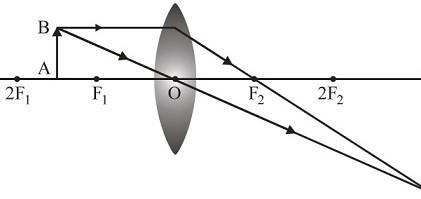
The given focal length of the mirror is ‘f’.
Given object distance from the pole, $u=\dfrac { -f }{ 2 }$
The distance between the object and the pole of mirror is called object distance (u)
For a convex lens, the virtual distance is negative and the real distance is positive.
By using mirror formula,
$\dfrac { 1 }{ f } =\dfrac { 1 }{ v } +\dfrac { 1 }{ u }$
We shall substitute the value of ‘u’ in the above formula. On solving, we get
$\dfrac { 1 }{ v } +\dfrac { 1 }{ -\left( \dfrac { f }{ 2 } \right) } =\dfrac { 1 }{ f }$
$\dfrac { 1 }{ v } -\dfrac { 2 }{ f } =\dfrac { 1 }{ f }$
$\dfrac { 1 }{ v } =\dfrac { 1 }{ f } +\dfrac { 2 }{ f }$
$\dfrac { 1 }{ v } =\dfrac { 3 }{ f }$
On reciprocating, it becomes $v=\dfrac { f }{ 3 }$
The distance between the image and the pole of the mirror is called image distance (v).
Using magnification formula and applying the values of ‘u’ and ‘v’, we get
$m=\dfrac { -v }{ u }$
$m=\dfrac { -\left( \dfrac { f }{ 3 } \right) }{ -\left( \dfrac { f }{ 2 } \right) }$
$m=\dfrac { f }{ 3 } \times \dfrac { 2 }{ f }$
$m=\dfrac { 2 }{ 3 }$
Therefore, the image formed is virtual, upright and diminished.
Note: It is important to remember the formulas in optics because only with that, the nature and position of the objects can be determined. It is also to be noted that for a convex mirror, ‘u’ is always negative and ‘f’ is always positive.
Formula used:
Mirror image: $\dfrac { 1 }{ f } =\dfrac { 1 }{ v } +\dfrac { 1 }{ u } $
Lateral magnification, $ m=\dfrac { -v }{ u }$
Complete step by step answer:
Focal length is the distance between the center of a convex lens and the focal point of the lens.
The given focal length of the mirror is ‘f’.
Given object distance from the pole, $u=\dfrac { -f }{ 2 }$
The distance between the object and the pole of mirror is called object distance (u)
For a convex lens, the virtual distance is negative and the real distance is positive.
By using mirror formula,
$\dfrac { 1 }{ f } =\dfrac { 1 }{ v } +\dfrac { 1 }{ u }$
We shall substitute the value of ‘u’ in the above formula. On solving, we get
$\dfrac { 1 }{ v } +\dfrac { 1 }{ -\left( \dfrac { f }{ 2 } \right) } =\dfrac { 1 }{ f }$
$\dfrac { 1 }{ v } -\dfrac { 2 }{ f } =\dfrac { 1 }{ f }$
$\dfrac { 1 }{ v } =\dfrac { 1 }{ f } +\dfrac { 2 }{ f }$
$\dfrac { 1 }{ v } =\dfrac { 3 }{ f }$
On reciprocating, it becomes $v=\dfrac { f }{ 3 }$
The distance between the image and the pole of the mirror is called image distance (v).
Using magnification formula and applying the values of ‘u’ and ‘v’, we get
$m=\dfrac { -v }{ u }$
$m=\dfrac { -\left( \dfrac { f }{ 3 } \right) }{ -\left( \dfrac { f }{ 2 } \right) }$
$m=\dfrac { f }{ 3 } \times \dfrac { 2 }{ f }$
$m=\dfrac { 2 }{ 3 }$
Therefore, the image formed is virtual, upright and diminished.
Note: It is important to remember the formulas in optics because only with that, the nature and position of the objects can be determined. It is also to be noted that for a convex mirror, ‘u’ is always negative and ‘f’ is always positive.
Recently Updated Pages
Master Class 12 Economics: Engaging Questions & Answers for Success

Master Class 12 English: Engaging Questions & Answers for Success
Master Class 12 Social Science: Engaging Questions & Answers for Success
Master Class 12 Maths: Engaging Questions & Answers for Success
Master Class 12 Physics: Engaging Questions & Answers for Success
Master Class 10 English: Engaging Questions & Answers for Success
Trending doubts
Explain the Treaty of Vienna of 1815 class 10 social science CBSE
Why is it 530 pm in india when it is 1200 afternoon class 10 social science CBSE
What is the full form of POSCO class 10 social science CBSE
Define Potential, Developed, Stock and Reserved resources
Which Country Has the Largest Border with India?
Complete the sentence with the most appropriate word class 10 english CBSE