




A convex lens is put $10\,cm$from a light source and it makes a sharp image on a screen, kept $10\,cm$ from the lens. Now a glass block (refractive index 1.5) of $1.5\,cm$ thickness is placed in contact with the light source. To get the sharp image again, by what distance the screen must be shifted?
A. $0.55\,cm$ away from the lens
B. $1.1\,cm$ away from the lens
C. $0.55\,cm$ towards from the lens
D. 0
Answer
 Verified
598.8k+ views
Hint: Use lens formula to obtain focal length of the convex lens. When a glass slab is inserted between the path of light rays and convex lens, the object for convex lens appears to be shifted by a distance equal to lateral shift. Again use lens formula to obtain image distance. Take the difference between the newer and earlier position of the image. This is the distance the screen must be shifted to get the sharp image again.
Formula used:
Lens formula, $\dfrac{1}{f}=\dfrac{1}{v}-\dfrac{1}{u}$; Lateral shift due to a slab, $s=t\left( 1-\dfrac{1}{\mu } \right)$
Complete step by step answer:
Initially, light source is at distance $u=-10cm$ from convex lens and image distance $v=10cm$. We use lens formula to obtain focal length of the convex lens. Lens formula is
$\dfrac{1}{f}=\dfrac{1}{v}-\dfrac{1}{u}$ where $f,v$ and $u$ denotes focal length, image distance and object distance respectively.
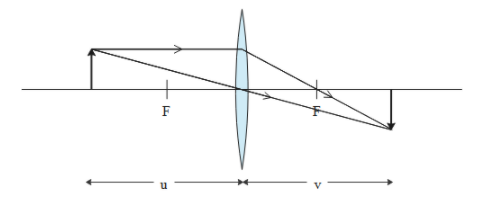
Fig: Formation of image, initial condition
$\dfrac{1}{f}=\dfrac{1}{10}-\dfrac{1}{-10}=\dfrac{2}{10}$
This implies that, $f=5\,cm$
When a glass slab is inserted between the path of light rays and convex lens, the object for convex lens appears to be shifted by a distance equal to lateral shift.
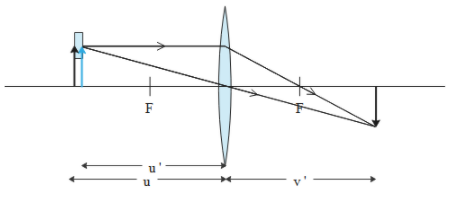
Fig: Formation of image, Final condition
Lateral shift, $s=t\left( 1-\dfrac{1}{\mu } \right)$ where $t$ and $\mu$ is the thickness and refractive index of glass slab.
Substituting $t=1.5\,cm$ and $\mu =1.5$, we get
$s=1.5\left( 1-\dfrac{1}{1.5} \right)=0.5cm$
Then, new object distance,
$u'=-10+0.5=-9.5cm$
Using lens formula
$\dfrac{1}{f}=\dfrac{1}{v'}-\dfrac{1}{u'}$
$\Rightarrow \dfrac{1}{5}=\dfrac{1}{v'}-\dfrac{1}{-9.5}\Rightarrow \dfrac{1}{v'}=\dfrac{1}{5}-\dfrac{1}{9.5}$
From this we get
$v=\dfrac{47.5}{4.5}=10.55cm$
Therefore shift in image is
$10.55-10=0.55cm$
Therefore, we need to shift the screen by $0.55\,cm$ away from the convex lens to obtain a sharp image again.
Hence, A is the correct option.
Note:
In mirror as well as optical lens problems, the most important thing to consider is sign conventions. Therefore, students should understand the sign conventions properly and then proceed with the solution. Diagrams are very helpful in understanding the sign conventions.
Focal length of a convex lens is always taken to be positive.
Formula used:
Lens formula, $\dfrac{1}{f}=\dfrac{1}{v}-\dfrac{1}{u}$; Lateral shift due to a slab, $s=t\left( 1-\dfrac{1}{\mu } \right)$
Complete step by step answer:
Initially, light source is at distance $u=-10cm$ from convex lens and image distance $v=10cm$. We use lens formula to obtain focal length of the convex lens. Lens formula is
$\dfrac{1}{f}=\dfrac{1}{v}-\dfrac{1}{u}$ where $f,v$ and $u$ denotes focal length, image distance and object distance respectively.
Fig: Formation of image, initial condition
$\dfrac{1}{f}=\dfrac{1}{10}-\dfrac{1}{-10}=\dfrac{2}{10}$
This implies that, $f=5\,cm$
When a glass slab is inserted between the path of light rays and convex lens, the object for convex lens appears to be shifted by a distance equal to lateral shift.
Fig: Formation of image, Final condition
Lateral shift, $s=t\left( 1-\dfrac{1}{\mu } \right)$ where $t$ and $\mu$ is the thickness and refractive index of glass slab.
Substituting $t=1.5\,cm$ and $\mu =1.5$, we get
$s=1.5\left( 1-\dfrac{1}{1.5} \right)=0.5cm$
Then, new object distance,
$u'=-10+0.5=-9.5cm$
Using lens formula
$\dfrac{1}{f}=\dfrac{1}{v'}-\dfrac{1}{u'}$
$\Rightarrow \dfrac{1}{5}=\dfrac{1}{v'}-\dfrac{1}{-9.5}\Rightarrow \dfrac{1}{v'}=\dfrac{1}{5}-\dfrac{1}{9.5}$
From this we get
$v=\dfrac{47.5}{4.5}=10.55cm$
Therefore shift in image is
$10.55-10=0.55cm$
Therefore, we need to shift the screen by $0.55\,cm$ away from the convex lens to obtain a sharp image again.
Hence, A is the correct option.
Note:
In mirror as well as optical lens problems, the most important thing to consider is sign conventions. Therefore, students should understand the sign conventions properly and then proceed with the solution. Diagrams are very helpful in understanding the sign conventions.
Focal length of a convex lens is always taken to be positive.
Recently Updated Pages
Master Class 12 Social Science: Engaging Questions & Answers for Success

Master Class 12 Physics: Engaging Questions & Answers for Success
Master Class 12 Maths: Engaging Questions & Answers for Success
Master Class 12 Economics: Engaging Questions & Answers for Success
Master Class 12 Chemistry: Engaging Questions & Answers for Success
Master Class 12 Business Studies: Engaging Questions & Answers for Success
Trending doubts
Which are the Top 10 Largest Countries of the World?
Draw a labelled sketch of the human eye class 12 physics CBSE
Explain the structure of megasporangium class 12 biology CBSE
What are the major means of transport Explain each class 12 social science CBSE
How many chromosomes are found in human ovum a 46 b class 12 biology CBSE
The diagram of the section of a maize grain is given class 12 biology CBSE