




Why is a convex lens called a converging lens?
Answer
 Verified
598.2k+ views
Hint:Convex lens is a spherical lens that is pointed towards the end (it is circumference) and it bulges outwards at the middle. When the rays of light coming from an object placed at infinite distance (very far) from the lens, pass through the convex lens they converge at a point after they are refracted.
Complete step by step answer:
A lens is a material of some refractive index, which helps in refracting the rays of light that pass through it. If we place an object in front of a lens, then the rays of light coming from the object refract when they pass through the lens. As a result, the original path of the light rays changes and the appear to be originating from a different point other than the position of the object.
Hence, we say that an image is formed at that point.
Convex lens is a type of lens that is pointed towards the end (it is circumference) and it bulges outwards at the middle (as shown the figure). Both the surfaces of a convex lens is spherical.
Let us understand the features or properties of a convex lens.
When the rays of light coming from an object placed at infinite distance (very far) from the lens, pass through the convex lens they converge at a point after they are refracted. As a result, the image is formed on the side of the lens.
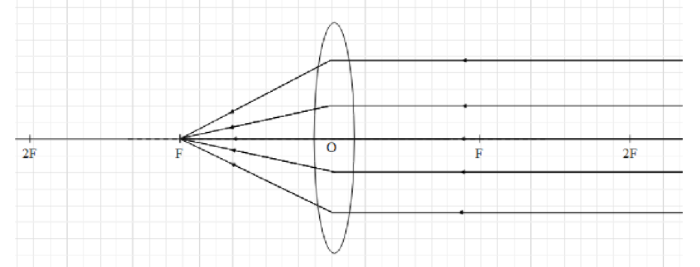
Since a convex lens converges the lights rays passing through, at a point, it is called a converging lens.
Note:There exist another type of spherical lens called concave lens. We can say that a concave lens is opposite to a convex lens. It widens towards the end and shrinks in the middle.
When parallel light rays pass through a concave lens, they diverge in all directions and appear to be originating from a point on the side of the lens. Hence, a concave lens is called a diverging lens.
Complete step by step answer:
A lens is a material of some refractive index, which helps in refracting the rays of light that pass through it. If we place an object in front of a lens, then the rays of light coming from the object refract when they pass through the lens. As a result, the original path of the light rays changes and the appear to be originating from a different point other than the position of the object.
Hence, we say that an image is formed at that point.
Convex lens is a type of lens that is pointed towards the end (it is circumference) and it bulges outwards at the middle (as shown the figure). Both the surfaces of a convex lens is spherical.
Let us understand the features or properties of a convex lens.
When the rays of light coming from an object placed at infinite distance (very far) from the lens, pass through the convex lens they converge at a point after they are refracted. As a result, the image is formed on the side of the lens.
Since a convex lens converges the lights rays passing through, at a point, it is called a converging lens.
Note:There exist another type of spherical lens called concave lens. We can say that a concave lens is opposite to a convex lens. It widens towards the end and shrinks in the middle.
When parallel light rays pass through a concave lens, they diverge in all directions and appear to be originating from a point on the side of the lens. Hence, a concave lens is called a diverging lens.
Recently Updated Pages
Master Class 12 Economics: Engaging Questions & Answers for Success

Master Class 12 English: Engaging Questions & Answers for Success
Master Class 12 Social Science: Engaging Questions & Answers for Success
Master Class 12 Maths: Engaging Questions & Answers for Success
Master Class 12 Physics: Engaging Questions & Answers for Success
Master Class 9 General Knowledge: Engaging Questions & Answers for Success
Trending doubts
One Metric ton is equal to kg A 10000 B 1000 C 100 class 11 physics CBSE
Difference Between Prokaryotic Cells and Eukaryotic Cells
Find the value of the expression given below sin 30circ class 11 maths CBSE
Two of the body parts which do not appear in MRI are class 11 biology CBSE
Draw a diagram of nephron and explain its structur class 11 biology CBSE
10 examples of friction in our daily life