




A container opened at the top and made up of a metal sheet, is in the form of a frustum of a cone of height $16$ cm with radii of its lower and upper ends as $8$ cm and $20$ cm respectively. find the cost of milk which can completely fill the container, at the rate of ₹ $50$ per litre. Also find the cost of the metal sheet used to make the container, if it costs ₹ $10$ per $100c{{m}^{2}}$. (Take $\pi =3.14$)
Answer
 Verified
510.6k+ views
Hint: In this question we have been given with a word problem which we will solve by converting it into a mathematical problem. We will use the details given to find the cost of milk and the cost of the metal sheet used to make the container. We will use the formulas relating frustum which are $V=\dfrac{\pi h}{3}\left( {{R}^{2}}+Rr+{{r}^{2}} \right)$ and $SA=\pi \left( R+r \right)l+\pi {{R}^{2}}$ where $r$ and $R$ are the radii of the bases of the frustum and $l$ is the slant height which is found by the formula $l=\sqrt{{{\left( R-r \right)}^{2}}+{{h}^{2}}}$.
Complete step-by-step solution:
We know that a frustum cone is a cone when cut horizontally across a plane. We have the frustum as:
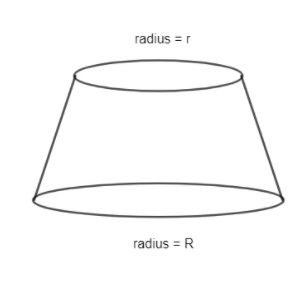
Now we have the details from the question as:
$h=16cm$
$r=8cm$
$R=20cm$
Now we have to find the cost of milk given that it fills the entire frustum. We will do so by finding the volume of the frustum. We have the formula as $V=\dfrac{\pi h}{3}\left( {{R}^{2}}+Rr+{{r}^{2}} \right)$.
On substituting the values in the formula, we get:
$\Rightarrow V=\dfrac{3.14\times 16}{3}\left( {{20}^{2}}+20\times 8+{{8}^{2}} \right)$
On multiplying, we get:
$\Rightarrow V=\dfrac{3.14\times 16}{3}\left( 400+160+64 \right)$
On simplifying, we get:
$\Rightarrow V=\dfrac{3.14\times 16\times 624}{3}$
On dividing the terms, we get:
$\Rightarrow V=10449.92c{{m}^{3}}$
We will round the value, on rounding, we get:
$\Rightarrow V=10450c{{m}^{3}}$
Now we know that $1c{{m}^{3}}=0.001l$
$\Rightarrow V=10.45l$
Now the cost of milk is ₹ $50$ per litre therefore, we get:
$\Rightarrow 10.45\times 50$
On multiplying the terms, we get:
$\Rightarrow 522.5$, which is the required cost.
Now we have to find the cost of the metal plate. To find this, we will find the surface area of the frustum and since there is no top, we don’t include $r$ in the formula. We have the formula as $SA=\pi \left( R+r \right)l+\pi {{R}^{2}}$.
On substituting the values in the formula, we get:
$\Rightarrow SA=3.14\left( 20+8 \right)l+3.14\times {{20}^{2}}\to \left( 1 \right)$
Now we need to find $l$ which is the slant height using the formula $l=\sqrt{{{\left( R-r \right)}^{2}}+{{h}^{2}}}$
On substituting the values, we get:
$\Rightarrow l=\sqrt{{{\left( 20-8 \right)}^{2}}+{{16}^{2}}}$
On subtracting the terms, we get:
$\Rightarrow l=\sqrt{{{12}^{2}}+{{16}^{2}}}$
On squaring, we get:
$\Rightarrow l=\sqrt{144+256}$
On adding the terms, we get:
$\Rightarrow l=\sqrt{400}$
On taking the square root, we get:
$\Rightarrow l=20$
On substituting the value of $l$ in equation $\left( 1 \right)$, we get:
$\Rightarrow SA=3.14\left( 20+8 \right)20+3.14\times {{20}^{2}}$
On simplifying, we get:
$\Rightarrow SA=3.14\left( 28 \right)20+3.14\times 400$
On multiplying and adding, we get:
$\Rightarrow SA=1758.4c{{m}^{2}}$
Now the cost is ₹ $10$ per $100c{{m}^{2}}$ therefore, we have:
$\Rightarrow 17.58\times 10$
On multiplying, we get:
$\Rightarrow 175.8$, which is the required cost.
Note:It is to be noted that we didn’t consider the top of the frustum as it is an open surface given that the shape is a container. Otherwise, to calculate the surface area of a frustum the formula $SA=\pi \left( R+r \right)l+\pi {{R}^{2}}$ should be used. It is to be noted that the volume of the frustum is not dependent on the open surface.
Complete step-by-step solution:
We know that a frustum cone is a cone when cut horizontally across a plane. We have the frustum as:
Now we have the details from the question as:
$h=16cm$
$r=8cm$
$R=20cm$
Now we have to find the cost of milk given that it fills the entire frustum. We will do so by finding the volume of the frustum. We have the formula as $V=\dfrac{\pi h}{3}\left( {{R}^{2}}+Rr+{{r}^{2}} \right)$.
On substituting the values in the formula, we get:
$\Rightarrow V=\dfrac{3.14\times 16}{3}\left( {{20}^{2}}+20\times 8+{{8}^{2}} \right)$
On multiplying, we get:
$\Rightarrow V=\dfrac{3.14\times 16}{3}\left( 400+160+64 \right)$
On simplifying, we get:
$\Rightarrow V=\dfrac{3.14\times 16\times 624}{3}$
On dividing the terms, we get:
$\Rightarrow V=10449.92c{{m}^{3}}$
We will round the value, on rounding, we get:
$\Rightarrow V=10450c{{m}^{3}}$
Now we know that $1c{{m}^{3}}=0.001l$
$\Rightarrow V=10.45l$
Now the cost of milk is ₹ $50$ per litre therefore, we get:
$\Rightarrow 10.45\times 50$
On multiplying the terms, we get:
$\Rightarrow 522.5$, which is the required cost.
Now we have to find the cost of the metal plate. To find this, we will find the surface area of the frustum and since there is no top, we don’t include $r$ in the formula. We have the formula as $SA=\pi \left( R+r \right)l+\pi {{R}^{2}}$.
On substituting the values in the formula, we get:
$\Rightarrow SA=3.14\left( 20+8 \right)l+3.14\times {{20}^{2}}\to \left( 1 \right)$
Now we need to find $l$ which is the slant height using the formula $l=\sqrt{{{\left( R-r \right)}^{2}}+{{h}^{2}}}$
On substituting the values, we get:
$\Rightarrow l=\sqrt{{{\left( 20-8 \right)}^{2}}+{{16}^{2}}}$
On subtracting the terms, we get:
$\Rightarrow l=\sqrt{{{12}^{2}}+{{16}^{2}}}$
On squaring, we get:
$\Rightarrow l=\sqrt{144+256}$
On adding the terms, we get:
$\Rightarrow l=\sqrt{400}$
On taking the square root, we get:
$\Rightarrow l=20$
On substituting the value of $l$ in equation $\left( 1 \right)$, we get:
$\Rightarrow SA=3.14\left( 20+8 \right)20+3.14\times {{20}^{2}}$
On simplifying, we get:
$\Rightarrow SA=3.14\left( 28 \right)20+3.14\times 400$
On multiplying and adding, we get:
$\Rightarrow SA=1758.4c{{m}^{2}}$
Now the cost is ₹ $10$ per $100c{{m}^{2}}$ therefore, we have:
$\Rightarrow 17.58\times 10$
On multiplying, we get:
$\Rightarrow 175.8$, which is the required cost.
Note:It is to be noted that we didn’t consider the top of the frustum as it is an open surface given that the shape is a container. Otherwise, to calculate the surface area of a frustum the formula $SA=\pi \left( R+r \right)l+\pi {{R}^{2}}$ should be used. It is to be noted that the volume of the frustum is not dependent on the open surface.
Recently Updated Pages
Master Class 10 English: Engaging Questions & Answers for Success

Master Class 10 Social Science: Engaging Questions & Answers for Success
Master Class 10 Computer Science: Engaging Questions & Answers for Success
Class 10 Question and Answer - Your Ultimate Solutions Guide
Master Class 10 General Knowledge: Engaging Questions & Answers for Success
Master Class 10 Maths: Engaging Questions & Answers for Success
Trending doubts
A boat goes 24 km upstream and 28 km downstream in class 10 maths CBSE
State and explain Ohms law class 10 physics CBSE
Write a letter to the editor of a newspaper explaining class 10 english CBSE
Distinguish between soap and detergent class 10 chemistry CBSE
a Why did Mendel choose pea plants for his experiments class 10 biology CBSE
What is a "free hit" awarded for in limited-overs cricket?