




A container is having a liquid of density $ \rho $ up to height $ h $ . If the vessel is given an upward acceleration equal to $ g $ , the pressure at the bottom of the vessel will be: ( $ {P_0} $ : atmospheric pressure)
(A) $ {P_0} + 2\rho gh $
(B) $ {P_0} + \rho gh $
(C) $ {P_0} $
(D) Zero
Answer
 Verified
598.8k+ views
Hint:
An upward acceleration of a body increases the perceived weight of the body. The total pressure in a liquid is the sum of the atmospheric pressure and that the pressure due to the weight of the liquid.
Formula used: $ P = {P_0} + \rho gh $ , where $ {P_0} $ is atmospheric pressure, $ \rho $ is density, $ g $ is acceleration due to gravity and $ h $ is height of the water.
Complete step by step answer:
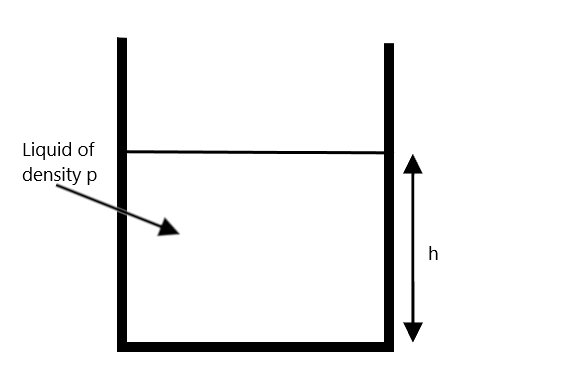
Formula for pressure in a liquid of density $ \rho $ open to the atmosphere in a planet of acceleration due to gravity $ g $ is given as
$ P = {P_0} + \rho gh $ where $ {P_0} $ is atmospheric pressure and $ \rho gh $ is the pressure due to the weight of the liquid above the point being considered.
Now the weight of a liquid in a container of cross sectional area $ A $ and height $ h $ is $ W = mg = \rho Vg = \rho Ahg $
We know that mass is density time volume, and volume is cross sectional area times the height.
When a body is accelerating upward or downward, there’s an additional term due to the non-inertial nature of the body. Depending on whether it accelerates upward or downward there’s a pseudo weight gain or loss. In this cases, the equation of the weight becomes
$ W' = m(g + a) = \rho Ah(g + a) $ for upward acceleration or
$ W' = m(g - a) = \rho Ah(g - a) $ for downward acceleration, where $ W' $ is pseudo-weight, to be separated from the proper weight, and $ a $ is the acceleration of the body.
In our case, the vessel is accelerating upwards with an acceleration equal to $ g $ i.e. $ a = g $ .
Therefore, the corrected weight of the liquid is
$ {W_c} = \rho Ah(g + g) = 2\rho gAh $ (replacing $ a $ with $ g $ )
Recall that
$ P = \dfrac{F}{A} = \dfrac{W}{A} $
$ F $ is force and $ W $ is weight which is our force in this case.
Therefore,
Pressure due to weight $ {P_w} $ is
$ {P_w} = \dfrac{{{W_c}}}{A} = \dfrac{{2\rho gAh}}{A} $
$ A $ cancels out, which gives
$ {P_w} = 2\rho gh $
Now, the total pressure is the atmospheric pressure plus the pressure due to the corrected weight
$ P = {P_0} + {P_w} = {P_0} + 2\rho gh $
$ \therefore P = {P_0} + 2\rho gh $
Hence, the correct option is A.
Note:
This question is similar to the very common problem where the reading of a scale in a lift is supposed to be calculated for a person, when the lift is accelerating upwards or/and downwards. You only go one step further by calculating pressure. In both these cases, the recurrent problem encountered is whether to use $ W' = m(g + a) $ or $ W' = m(g - a) $ . You can remember easily by tying it to the concept of weightlessness. When a body is weightless (weight equals to zero), it means the body is falling at acceleration due to gravity i.e. $ a = g $ (but $ a $ is downward). If you insert $ a = g $ into $ W' = m(g - a) $ you get zero which is weightlessness. Thus, downward has the negative sign, then upward must have the positive sign.
An upward acceleration of a body increases the perceived weight of the body. The total pressure in a liquid is the sum of the atmospheric pressure and that the pressure due to the weight of the liquid.
Formula used: $ P = {P_0} + \rho gh $ , where $ {P_0} $ is atmospheric pressure, $ \rho $ is density, $ g $ is acceleration due to gravity and $ h $ is height of the water.
Complete step by step answer:
Formula for pressure in a liquid of density $ \rho $ open to the atmosphere in a planet of acceleration due to gravity $ g $ is given as
$ P = {P_0} + \rho gh $ where $ {P_0} $ is atmospheric pressure and $ \rho gh $ is the pressure due to the weight of the liquid above the point being considered.
Now the weight of a liquid in a container of cross sectional area $ A $ and height $ h $ is $ W = mg = \rho Vg = \rho Ahg $
We know that mass is density time volume, and volume is cross sectional area times the height.
When a body is accelerating upward or downward, there’s an additional term due to the non-inertial nature of the body. Depending on whether it accelerates upward or downward there’s a pseudo weight gain or loss. In this cases, the equation of the weight becomes
$ W' = m(g + a) = \rho Ah(g + a) $ for upward acceleration or
$ W' = m(g - a) = \rho Ah(g - a) $ for downward acceleration, where $ W' $ is pseudo-weight, to be separated from the proper weight, and $ a $ is the acceleration of the body.
In our case, the vessel is accelerating upwards with an acceleration equal to $ g $ i.e. $ a = g $ .
Therefore, the corrected weight of the liquid is
$ {W_c} = \rho Ah(g + g) = 2\rho gAh $ (replacing $ a $ with $ g $ )
Recall that
$ P = \dfrac{F}{A} = \dfrac{W}{A} $
$ F $ is force and $ W $ is weight which is our force in this case.
Therefore,
Pressure due to weight $ {P_w} $ is
$ {P_w} = \dfrac{{{W_c}}}{A} = \dfrac{{2\rho gAh}}{A} $
$ A $ cancels out, which gives
$ {P_w} = 2\rho gh $
Now, the total pressure is the atmospheric pressure plus the pressure due to the corrected weight
$ P = {P_0} + {P_w} = {P_0} + 2\rho gh $
$ \therefore P = {P_0} + 2\rho gh $
Hence, the correct option is A.
Note:
This question is similar to the very common problem where the reading of a scale in a lift is supposed to be calculated for a person, when the lift is accelerating upwards or/and downwards. You only go one step further by calculating pressure. In both these cases, the recurrent problem encountered is whether to use $ W' = m(g + a) $ or $ W' = m(g - a) $ . You can remember easily by tying it to the concept of weightlessness. When a body is weightless (weight equals to zero), it means the body is falling at acceleration due to gravity i.e. $ a = g $ (but $ a $ is downward). If you insert $ a = g $ into $ W' = m(g - a) $ you get zero which is weightlessness. Thus, downward has the negative sign, then upward must have the positive sign.
Recently Updated Pages
Master Class 11 Social Science: Engaging Questions & Answers for Success

Master Class 11 Chemistry: Engaging Questions & Answers for Success
Master Class 9 General Knowledge: Engaging Questions & Answers for Success
Master Class 9 Maths: Engaging Questions & Answers for Success
Master Class 9 Science: Engaging Questions & Answers for Success
Master Class 9 English: Engaging Questions & Answers for Success
Trending doubts
One Metric ton is equal to kg A 10000 B 1000 C 100 class 11 physics CBSE
Difference Between Prokaryotic Cells and Eukaryotic Cells
Two of the body parts which do not appear in MRI are class 11 biology CBSE
1 ton equals to A 100 kg B 1000 kg C 10 kg D 10000 class 11 physics CBSE
10 examples of friction in our daily life
Name the Largest and the Smallest Cell in the Human Body ?