




A cone of radius 4cm is divided into two parts by drawing a plane through the midpoint of its axis and parallel to its base, comparing the volume of the two parts.
Answer
 Verified
623.1k+ views
Hint:In this problem of dividing the cone into two pieces by drawing a plane through the midpoint of its axis and parallel to its base, we get a cone at top and a frustum at bottom. With the help of the Angle-Angle-Angle similarity theorem we find the new radius of the top cone.
Complete step-by-step answer:
Given:-Radius of cone=4cm
Let the height of the original cone be h cm.
If it is divided into two parts through the midpoint of its axis and parallel to its base. Then a cone ADE at top and a frustum DGCE are formed. Height of both the formed parts is the same $\dfrac{{\text{h}}}{2}$cm.
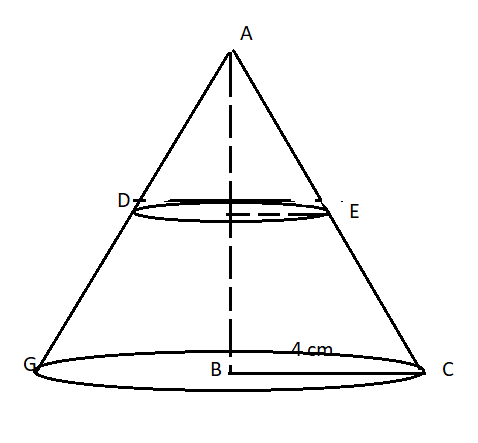
Consider the $\Delta {\text{AFE and }}\Delta {\text{ABC,}}$
$
\angle {\text{AFE = }}\angle {\text{ABC = }}{90^ \circ } \\
\angle {\text{FAE = }}\angle {\text{BAC (same angle)}} \\
\angle {\text{AEF = }}\angle {\text{ACB (}}\because {\text{DE||GC}}\therefore {\text{corresponding angles)}} \\
\\
$
Hence $\Delta {\text{AFE}} \sim \Delta ABC$
Therefore, the ratio of their corresponding sides are equal
$
\Rightarrow \dfrac{{\dfrac{{\text{h}}}{2}}}{{\text{h}}} = \dfrac{{{\text{FE}}}}{{{\text{BC}}}} \\
\Rightarrow \dfrac{1}{2} = \dfrac{{{\text{FE}}}}{4}{\text{ (}}\therefore BC = 4cm) \\
\Rightarrow {\text{FE = 2cm eq}}{\text{.1}} \\
$
Now, the volume of cone=$\dfrac{1}{3}\pi {r^2}h$
Then, Volume of cone AGC=
$
= \dfrac{1}{3}\pi {(2)^2}{\text{h}} \\
= \dfrac{4}{3}\pi {\text{h eq}}{\text{.2}} \\
$
Now Volume of frustum=$\dfrac{{\pi h}}{3}({r_1}^2 + {r_2}^2 + {r_1}{r_2})$
Then, for Volume of frustum GCED , ${r_1} = 2cm{\text{ and }}{r_1} = 4cm{\text{ }}$
Volume of frustum GCDE=
$ = $$
= \dfrac{{\pi {\text{h}}}}{3}\{ {(2)^2} + {(4)^2} + 2 \times 4)\} \\
= \dfrac{{28\pi {\text{h}}}}{3}{\text{ eq}}{\text{.3}} \\
$
Now to compare the volume of two parts. We have to find ratio of two of them
Ratio of two part=$\dfrac{{{\text{Volume of cone ADE}}}}{{{\text{Volume of frustum GCDE}}}}$
$
= \dfrac{{\dfrac{4}{3}\pi {\text{h}}}}{{\dfrac{{28\pi {\text{h}}}}{3}}} \\
= \dfrac{1}{7} \\
$
Note: Whenever you get this type of question the key concept of solving this is to have knowledge about how different shapes are formed from different shapes on cutting and their formulas too. And you should have knowledge about different similarity theorems like Angle-Angle-Angle(AAA) etc.
Complete step-by-step answer:
Given:-Radius of cone=4cm
Let the height of the original cone be h cm.
If it is divided into two parts through the midpoint of its axis and parallel to its base. Then a cone ADE at top and a frustum DGCE are formed. Height of both the formed parts is the same $\dfrac{{\text{h}}}{2}$cm.
Consider the $\Delta {\text{AFE and }}\Delta {\text{ABC,}}$
$
\angle {\text{AFE = }}\angle {\text{ABC = }}{90^ \circ } \\
\angle {\text{FAE = }}\angle {\text{BAC (same angle)}} \\
\angle {\text{AEF = }}\angle {\text{ACB (}}\because {\text{DE||GC}}\therefore {\text{corresponding angles)}} \\
\\
$
Hence $\Delta {\text{AFE}} \sim \Delta ABC$
Therefore, the ratio of their corresponding sides are equal
$
\Rightarrow \dfrac{{\dfrac{{\text{h}}}{2}}}{{\text{h}}} = \dfrac{{{\text{FE}}}}{{{\text{BC}}}} \\
\Rightarrow \dfrac{1}{2} = \dfrac{{{\text{FE}}}}{4}{\text{ (}}\therefore BC = 4cm) \\
\Rightarrow {\text{FE = 2cm eq}}{\text{.1}} \\
$
Now, the volume of cone=$\dfrac{1}{3}\pi {r^2}h$
Then, Volume of cone AGC=
$
= \dfrac{1}{3}\pi {(2)^2}{\text{h}} \\
= \dfrac{4}{3}\pi {\text{h eq}}{\text{.2}} \\
$
Now Volume of frustum=$\dfrac{{\pi h}}{3}({r_1}^2 + {r_2}^2 + {r_1}{r_2})$
Then, for Volume of frustum GCED , ${r_1} = 2cm{\text{ and }}{r_1} = 4cm{\text{ }}$
Volume of frustum GCDE=
$ = $$
= \dfrac{{\pi {\text{h}}}}{3}\{ {(2)^2} + {(4)^2} + 2 \times 4)\} \\
= \dfrac{{28\pi {\text{h}}}}{3}{\text{ eq}}{\text{.3}} \\
$
Now to compare the volume of two parts. We have to find ratio of two of them
Ratio of two part=$\dfrac{{{\text{Volume of cone ADE}}}}{{{\text{Volume of frustum GCDE}}}}$
$
= \dfrac{{\dfrac{4}{3}\pi {\text{h}}}}{{\dfrac{{28\pi {\text{h}}}}{3}}} \\
= \dfrac{1}{7} \\
$
Note: Whenever you get this type of question the key concept of solving this is to have knowledge about how different shapes are formed from different shapes on cutting and their formulas too. And you should have knowledge about different similarity theorems like Angle-Angle-Angle(AAA) etc.
Recently Updated Pages
Master Class 10 English: Engaging Questions & Answers for Success

Master Class 10 Social Science: Engaging Questions & Answers for Success
Master Class 10 Computer Science: Engaging Questions & Answers for Success
Class 10 Question and Answer - Your Ultimate Solutions Guide
Master Class 10 General Knowledge: Engaging Questions & Answers for Success
Master Class 10 Maths: Engaging Questions & Answers for Success
Trending doubts
A boat goes 24 km upstream and 28 km downstream in class 10 maths CBSE
State and explain Ohms law class 10 physics CBSE
Distinguish between soap and detergent class 10 chemistry CBSE
a Why did Mendel choose pea plants for his experiments class 10 biology CBSE
What is a "free hit" awarded for in limited-overs cricket?
Draw the diagram of the sectional view of the human class 10 biology CBSE