




A cone of height 10 cm and radius 10 cm is to be divided into two parts by cutting through the midpoint of the vertical axis. Then the volume of the conical part is
$
(a){\text{ }}\dfrac{{100}}{3}\pi c{m^3} \\
(b){\text{ }}\dfrac{{500}}{3}\pi c{m^3} \\
(c){\text{ }}\dfrac{{250}}{3}\pi c{m^3} \\
(d){\text{ }}\dfrac{{125}}{3}\pi c{m^3} \\
$
Answer
 Verified
627k+ views
Hint: In this question use the concept that overall height of the cone will be divided into two equal parts. Concepts of triangle congruence will help finding the radius at the point where the vertical cut is made. Use the direct formula for the volume of cones to get the answer.
Complete step-by-step answer:
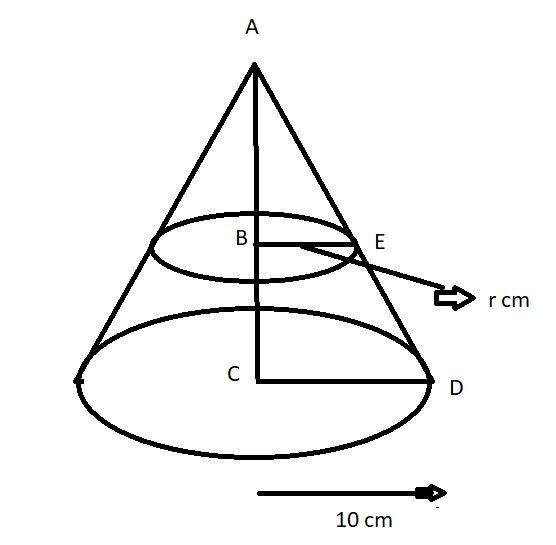
Let us consider the cone as shown in figure the base radius (R) of the cone is 10 cm (see figure.)
Now the cone cut into two parts through the midpoint of its height (at point B see figure).
It is given that the height (h) of the cone is 10 cm
$ \Rightarrow AB = BC = \dfrac{h}{2} = \dfrac{{10}}{2} = 5$ cm.
Let the base radius of the smaller cone is r cm.
$ \Rightarrow BE = r$cm (see figure).
Now the triangle ABE and the triangle ACD is concurrent by the property of angle-angle-angle (AAA).
$ \Rightarrow \dfrac{{AB}}{{AC}} = \dfrac{{BE}}{{CD}}$
Now substitute the values in above equation we have,
$ \Rightarrow \dfrac{{\dfrac{h}{2}}}{h} = \dfrac{r}{{10}}$
On simplifying we get.
$ \Rightarrow r = 5$ cm.
As we know that the volume of the cone is $ = \dfrac{1}{3}\pi {\left( {{\text{radius}}} \right)^2}\left( {{\text{height}}} \right)$
So the volume (${V_1}$) of the upper part of the bigger cone which is also a cone is
$ \Rightarrow {V_1} = \dfrac{1}{3}\pi {\left( {BE} \right)^2}\left( {AB} \right) = \dfrac{1}{3}\pi {\left( r \right)^2}\left( {\dfrac{h}{2}} \right)$…………………. (1)
Now substitute the value in this equation we have,
$ \Rightarrow {V_1} = = \dfrac{1}{3} \times \pi \times {\left( 5 \right)^2}\left( {10} \right)$
Now on simplifying we get,
$ \Rightarrow {V_1} = \dfrac{1}{3} \times \pi \times {\left( 5 \right)^2}\left( {10} \right) = \dfrac{{250}}{3}\pi cm^3$.
So, this is the required answer.
Hence option (C) is correct.
Note: In the lower bottom part which is left after the cutting the midpoint of the vertical axis is the frustum. Congruence of triangle plays a vital role in applying CPCT (corresponding parts of congruent triangles), that helps establishing relations between other sides of the two similar triangles.
Complete step-by-step answer:
Let us consider the cone as shown in figure the base radius (R) of the cone is 10 cm (see figure.)
Now the cone cut into two parts through the midpoint of its height (at point B see figure).
It is given that the height (h) of the cone is 10 cm
$ \Rightarrow AB = BC = \dfrac{h}{2} = \dfrac{{10}}{2} = 5$ cm.
Let the base radius of the smaller cone is r cm.
$ \Rightarrow BE = r$cm (see figure).
Now the triangle ABE and the triangle ACD is concurrent by the property of angle-angle-angle (AAA).
$ \Rightarrow \dfrac{{AB}}{{AC}} = \dfrac{{BE}}{{CD}}$
Now substitute the values in above equation we have,
$ \Rightarrow \dfrac{{\dfrac{h}{2}}}{h} = \dfrac{r}{{10}}$
On simplifying we get.
$ \Rightarrow r = 5$ cm.
As we know that the volume of the cone is $ = \dfrac{1}{3}\pi {\left( {{\text{radius}}} \right)^2}\left( {{\text{height}}} \right)$
So the volume (${V_1}$) of the upper part of the bigger cone which is also a cone is
$ \Rightarrow {V_1} = \dfrac{1}{3}\pi {\left( {BE} \right)^2}\left( {AB} \right) = \dfrac{1}{3}\pi {\left( r \right)^2}\left( {\dfrac{h}{2}} \right)$…………………. (1)
Now substitute the value in this equation we have,
$ \Rightarrow {V_1} = = \dfrac{1}{3} \times \pi \times {\left( 5 \right)^2}\left( {10} \right)$
Now on simplifying we get,
$ \Rightarrow {V_1} = \dfrac{1}{3} \times \pi \times {\left( 5 \right)^2}\left( {10} \right) = \dfrac{{250}}{3}\pi cm^3$.
So, this is the required answer.
Hence option (C) is correct.
Note: In the lower bottom part which is left after the cutting the midpoint of the vertical axis is the frustum. Congruence of triangle plays a vital role in applying CPCT (corresponding parts of congruent triangles), that helps establishing relations between other sides of the two similar triangles.
Recently Updated Pages
Basicity of sulphurous acid and sulphuric acid are

Master Class 10 English: Engaging Questions & Answers for Success
Master Class 10 Social Science: Engaging Questions & Answers for Success
Master Class 10 Computer Science: Engaging Questions & Answers for Success
Class 10 Question and Answer - Your Ultimate Solutions Guide
Master Class 10 General Knowledge: Engaging Questions & Answers for Success
Trending doubts
Which country won the ICC Men's ODI World Cup in 2023?
What is the full form of PNG A Petrol Natural Gas B class 10 chemistry CBSE
In cricket, how many legal balls are there in a standard over?
Explain the Treaty of Vienna of 1815 class 10 social science CBSE
What does "powerplay" mean in limited-overs cricket?
What is the "Powerplay" in T20 cricket?