




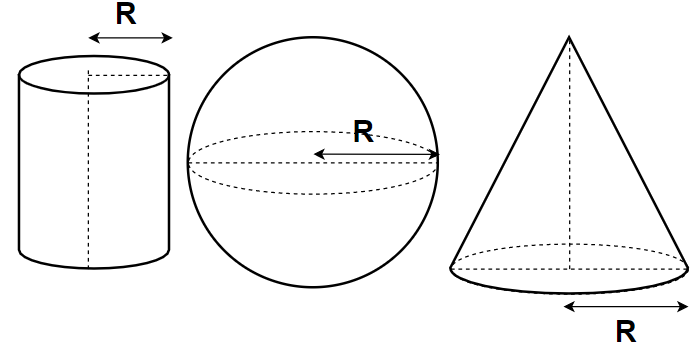
A cone, a hemisphere and a cylinder stand on equal bases of radius R and have the same heights H. The whole surface area in the ratio ?
A. $(\sqrt 3 + 1):3:4$
B. $(\sqrt 2 + 1):7:8$
C. $(\sqrt 2 + 1):3:4$
D. none of these
Answer
 Verified
586.2k+ views
Hint: In this problem we will use the equation as the radius and height of the hemisphere are equal to each other, so we can measure the total surface area of a cone, a hemisphere and a cylinder separately and eventually find the ratio.
Complete step by step answer:
Since the argument that a circle, a globe, and a cylinder stand on equal R-radius bases and have the same H-heights.
Here it can be observed that the radius and height of a hemisphere are equal,
so, $R = H - (1)$
This means that the circle, hemisphere and ring are equal in height and radius.
Now we'll measure the total cone, hemisphere and cylinder surface area
Height of slant= $\sqrt {{H^2} + {R^2}} = \sqrt 2 R$
As we know the total cone surface area is given as =
$\pi R(L + R) = \pi R(\sqrt {2R} + R) = (\sqrt 2 + 1)\pi {R^2}$
For hemisphere , total surface area is given as $3\pi {R^2}$
From equation 1 we will substitute the value of H
$2\pi R(R + H) = 2\pi R(2R) = 4\pi {R^2}$
Now for cylinder, total surface area is given as
$4\pi {R^2}$
Now we will calculate the ratio, so we get
Total surface area of cone : total surface area of hemisphere : total surface area of cylinder
$ $$(\sqrt 2 + 1)\pi {R^2}:3\pi {R^2}:4\pi {R^2}$
By solving it we get
$(\sqrt 2 + 1):3:4$
Hence the correct answer is option C.
Note:
A cone is a three-dimensional geometric shape that smoothly tapers from a flat base to a point called the apex or vertex. A cylinder has historically been a three-dimensional solid, one of the most fundamental of curvilinear geometric shapes.
Complete step by step answer:
Since the argument that a circle, a globe, and a cylinder stand on equal R-radius bases and have the same H-heights.
Here it can be observed that the radius and height of a hemisphere are equal,
so, $R = H - (1)$
This means that the circle, hemisphere and ring are equal in height and radius.
Now we'll measure the total cone, hemisphere and cylinder surface area
Height of slant= $\sqrt {{H^2} + {R^2}} = \sqrt 2 R$
As we know the total cone surface area is given as =
$\pi R(L + R) = \pi R(\sqrt {2R} + R) = (\sqrt 2 + 1)\pi {R^2}$
For hemisphere , total surface area is given as $3\pi {R^2}$
From equation 1 we will substitute the value of H
$2\pi R(R + H) = 2\pi R(2R) = 4\pi {R^2}$
Now for cylinder, total surface area is given as
$4\pi {R^2}$
Now we will calculate the ratio, so we get
Total surface area of cone : total surface area of hemisphere : total surface area of cylinder
$ $$(\sqrt 2 + 1)\pi {R^2}:3\pi {R^2}:4\pi {R^2}$
By solving it we get
$(\sqrt 2 + 1):3:4$
Hence the correct answer is option C.
Note:
A cone is a three-dimensional geometric shape that smoothly tapers from a flat base to a point called the apex or vertex. A cylinder has historically been a three-dimensional solid, one of the most fundamental of curvilinear geometric shapes.
Recently Updated Pages
Master Class 10 Computer Science: Engaging Questions & Answers for Success

Master Class 10 General Knowledge: Engaging Questions & Answers for Success
Master Class 10 English: Engaging Questions & Answers for Success
Master Class 10 Social Science: Engaging Questions & Answers for Success
Master Class 10 Maths: Engaging Questions & Answers for Success
Master Class 10 Science: Engaging Questions & Answers for Success
Trending doubts
What is the median of the first 10 natural numbers class 10 maths CBSE
Which women's tennis player has 24 Grand Slam singles titles?
Who is the Brand Ambassador of Incredible India?
Why is there a time difference of about 5 hours between class 10 social science CBSE
Write a letter to the principal requesting him to grant class 10 english CBSE
A moving boat is observed from the top of a 150 m high class 10 maths CBSE