




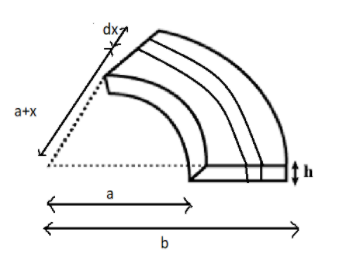
A conductor is in the shape of a quarter of annulus (angular ring) of inner and outer radii $a$and $b$, and thickness $h$. Resistance between the two curved surfaces would be ( $\sigma $= conductance)
Answer
 Verified
594k+ views
Hint: The concept to be used is to find resistance of continuous bodies.
First find the resistance of the Infinite small strip located at $a+x$ distance from the formula of resistance.
Then integrate that infinitesimal strip resistance for the whole body as infinite of such strips can be cut from the given body and all such resistances are arranged in a parallel connection.
Complete step by step answer:
The resistance of a body is obstruction it offers in the path of current.
Resistance of the body in terms of length $l$ ,$A$ area of cross section and $\sigma $ conductance of the body is formulated as
$R=\dfrac{l}{\sigma A}$
also $\rho =\dfrac{1}{\sigma }$where$\rho $ is resistivity of the body
Such infinite resistances actually make up the above annular ring so we need to integrate the resistances to find the total resistance.
So, take a strip of length $\partial x$ at a distance $a+x$ from the center.
$\partial R=\dfrac{\partial x}{\sigma A}$
Where area of cross section of strip of width $h$ and length$\dfrac{\pi }{2}\left( a+x \right)$ is $h\dfrac{\pi }{2}\left( a+x \right)$ where $a+x$ is distance of the strip from the centre.
Assuming it subtends $\dfrac{\pi }{2}$ angle at the centre which is constant
Now integrating the equation,
$\Rightarrow \int{\partial R=\int\limits_{a}^{b}{\dfrac{2\partial x}{\sigma \pi \left( a+x \right)h}}}$
$\Rightarrow R=\dfrac{2}{\sigma \pi h}\int\limits_{a}^{b}{\dfrac{\partial x}{\left( a+x \right)}}$
$\Rightarrow R=\dfrac{2}{\sigma \pi h}\left( \log \left( a+x \right) \right)_{a}^{b}$
$\Rightarrow R=\dfrac{2}{\sigma \pi h}\log \left( \dfrac{a+b}{2a} \right)$
This is the total resistance of the annular ring.
Note:
There are many connections in which the resistances can be arranged but two most commonly used are series and parallel connections.
Metals generally are good conductors of current and hence have low resistance to the path of current.
Ohm’s law connecting resistance, voltage and current forms most fundamental law for solving electric circuits
First find the resistance of the Infinite small strip located at $a+x$ distance from the formula of resistance.
Then integrate that infinitesimal strip resistance for the whole body as infinite of such strips can be cut from the given body and all such resistances are arranged in a parallel connection.
Complete step by step answer:
The resistance of a body is obstruction it offers in the path of current.
Resistance of the body in terms of length $l$ ,$A$ area of cross section and $\sigma $ conductance of the body is formulated as
$R=\dfrac{l}{\sigma A}$
also $\rho =\dfrac{1}{\sigma }$where$\rho $ is resistivity of the body
Such infinite resistances actually make up the above annular ring so we need to integrate the resistances to find the total resistance.
So, take a strip of length $\partial x$ at a distance $a+x$ from the center.
$\partial R=\dfrac{\partial x}{\sigma A}$
Where area of cross section of strip of width $h$ and length$\dfrac{\pi }{2}\left( a+x \right)$ is $h\dfrac{\pi }{2}\left( a+x \right)$ where $a+x$ is distance of the strip from the centre.
Assuming it subtends $\dfrac{\pi }{2}$ angle at the centre which is constant
Now integrating the equation,
$\Rightarrow \int{\partial R=\int\limits_{a}^{b}{\dfrac{2\partial x}{\sigma \pi \left( a+x \right)h}}}$
$\Rightarrow R=\dfrac{2}{\sigma \pi h}\int\limits_{a}^{b}{\dfrac{\partial x}{\left( a+x \right)}}$
$\Rightarrow R=\dfrac{2}{\sigma \pi h}\left( \log \left( a+x \right) \right)_{a}^{b}$
$\Rightarrow R=\dfrac{2}{\sigma \pi h}\log \left( \dfrac{a+b}{2a} \right)$
This is the total resistance of the annular ring.
Note:
There are many connections in which the resistances can be arranged but two most commonly used are series and parallel connections.
Metals generally are good conductors of current and hence have low resistance to the path of current.
Ohm’s law connecting resistance, voltage and current forms most fundamental law for solving electric circuits
Recently Updated Pages
Master Class 11 Social Science: Engaging Questions & Answers for Success

Master Class 11 English: Engaging Questions & Answers for Success
Master Class 11 Maths: Engaging Questions & Answers for Success
Master Class 11 Chemistry: Engaging Questions & Answers for Success
Master Class 11 Biology: Engaging Questions & Answers for Success
Master Class 11 Physics: Engaging Questions & Answers for Success
Trending doubts
Differentiate between an exothermic and an endothermic class 11 chemistry CBSE
One Metric ton is equal to kg A 10000 B 1000 C 100 class 11 physics CBSE
Difference Between Prokaryotic Cells and Eukaryotic Cells
There are 720 permutations of the digits 1 2 3 4 5 class 11 maths CBSE
Two of the body parts which do not appear in MRI are class 11 biology CBSE
Which gas is abundant in air class 11 chemistry CBSE