




A concave mirror is used for image formation for different positions of an object. What inference can be drawn about the following when an object is placed at a distance of 10 cm from the pole of the concave mirror of focal length 15 cm?
A. Position of the image
B. Size of the image
C. Nature of the image
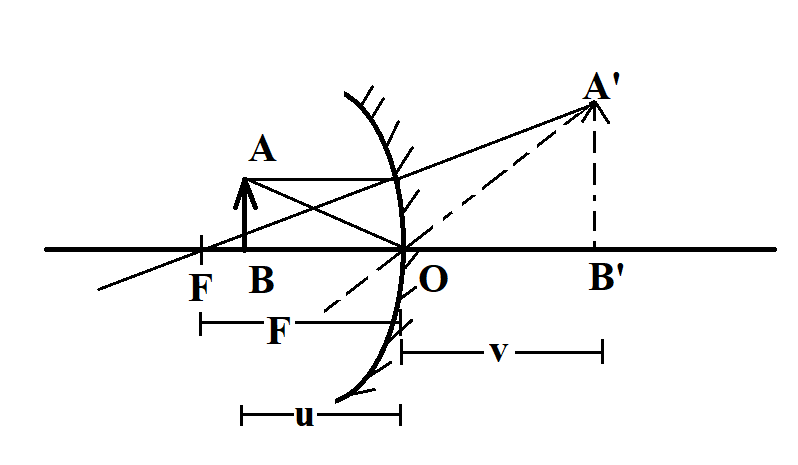
Draw a labelled ray diagram to justify your inference
Answer
 Verified
554.3k+ views
Hint: This question can easily be solved using the mirror formula. As the given mirror is a concave mirror, the focal length will be taken negative. Also, the object distance will be negative.
Formula used:
For solving the above given question, we will be using the image formula, i.e.,
$\dfrac{1}{f}=\dfrac{1}{v}+\dfrac{1}{u}$
Complete answer:
Before we start solving the question, let us take a look at all the given parameters
f = -15 cm
Negative sign as the mirror is a concave mirror
u = -10 cm
Now, for the Part A
By using the image formula
$\dfrac{1}{f}=\dfrac{1}{v}+\dfrac{1}{u}$
By using the given values
$\Rightarrow \dfrac{1}{-15}=\dfrac{1}{v}+\dfrac{1}{-10}$
$\Rightarrow \dfrac{1}{v}=\dfrac{1}{10}-\dfrac{1}{15}$
$\Rightarrow \dfrac{1}{v}=\dfrac{1}{30}$
So,
v = 30 cm
Now, for the Part B
By using the formula for the magnification of the image
We have
$m=\dfrac{v}{u}$
$\Rightarrow m=\dfrac{30}{10}$
$\Rightarrow m=3$
So, the image will be highly magnified in size.
Part C
The image will be Virtual and Erect in nature as v is positive
Note:
Sign Convention Rule:
1. Objects are always located to the left of the mirror
2. From the pole of the mirror, all lengths are determined.
3. The distances measured are positive in the direction of the incident ray, and the distances measured are negative in the direction opposite to that of the incident ray.
4. Distances measured above the main axis along the y-axis are positive, and those measured below the main axis along the y-axis are negative.
5. Note: It is possible to reverse the sign convention and it would always provide the right results.
Formula used:
For solving the above given question, we will be using the image formula, i.e.,
$\dfrac{1}{f}=\dfrac{1}{v}+\dfrac{1}{u}$
Complete answer:
Before we start solving the question, let us take a look at all the given parameters
f = -15 cm
Negative sign as the mirror is a concave mirror
u = -10 cm
Now, for the Part A
By using the image formula
$\dfrac{1}{f}=\dfrac{1}{v}+\dfrac{1}{u}$
By using the given values
$\Rightarrow \dfrac{1}{-15}=\dfrac{1}{v}+\dfrac{1}{-10}$
$\Rightarrow \dfrac{1}{v}=\dfrac{1}{10}-\dfrac{1}{15}$
$\Rightarrow \dfrac{1}{v}=\dfrac{1}{30}$
So,
v = 30 cm
Now, for the Part B
By using the formula for the magnification of the image
We have
$m=\dfrac{v}{u}$
$\Rightarrow m=\dfrac{30}{10}$
$\Rightarrow m=3$
So, the image will be highly magnified in size.
Part C
The image will be Virtual and Erect in nature as v is positive
Note:
Sign Convention Rule:
1. Objects are always located to the left of the mirror
2. From the pole of the mirror, all lengths are determined.
3. The distances measured are positive in the direction of the incident ray, and the distances measured are negative in the direction opposite to that of the incident ray.
4. Distances measured above the main axis along the y-axis are positive, and those measured below the main axis along the y-axis are negative.
5. Note: It is possible to reverse the sign convention and it would always provide the right results.
Recently Updated Pages
Master Class 12 Economics: Engaging Questions & Answers for Success

Master Class 12 English: Engaging Questions & Answers for Success
Master Class 12 Social Science: Engaging Questions & Answers for Success
Master Class 12 Maths: Engaging Questions & Answers for Success
Master Class 12 Physics: Engaging Questions & Answers for Success
Master Class 9 General Knowledge: Engaging Questions & Answers for Success
Trending doubts
Explain the Treaty of Vienna of 1815 class 10 social science CBSE
Who Won 36 Oscar Awards? Record Holder Revealed
Why is it 530 pm in india when it is 1200 afternoon class 10 social science CBSE
Make a sketch of the human nerve cell What function class 10 biology CBSE
What is the full form of POSCO class 10 social science CBSE
Define Potential, Developed, Stock and Reserved resources