




A concave mirror is made by cutting a portion of a hollow glass sphere of radius 24 cm. Find the focal length of the mirror.
A) 24 cm
B) 12 cm
C) 6 cm
D) 18 cm
Answer
 Verified
616.2k+ views
Hint: Focal length of a mirror is the distance between pole and focal point of mirror.
Focal point is the point where all parallel rays converge or appear to converge.
As we know that for a small size spherical mirror the focal length is equal to half the radius of curvature.
So, we can write $f = R/2$
Where
$f$ = focal length
$R$ = Radius of sphere or sometimes known as radius of curvature
Complete step by step answer:
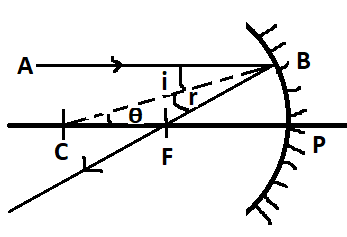
Consider a concave mirror as shown in figure
According to the second law of reflection i.e. angle of reflection is always equal to angle of incidence.
So, we can write
$\angle r = \angle i$
Where,
$\angle i = $ angle of incidence
$\angle r = $angle of reflection
We know that AB is parallel to the principal axis, $\angle i$ and $\angle \theta $ are alternate angles. So, they must be equal
$\because \angle i = \angle \theta - - - (1)$
We know in a triangle sides opposite to equal angles are equal.
So, In $\vartriangle CFB$
$FC = FB - - - (2)$
Since we know that the mirror is small and focused, it is very near to the principal axis.
So, we can write
$FB = FP - - - (3)$
Form (2) & (3) we get
$FC = FB = FP - - - (4)$
From figure we can see
$CP = FC + FP - - - (5)$
Further substituting the $FC = FP$ from (4)
$
CP = FP + FP \\
CP = 2FP \\
$
We know $CP = R$ and $FP = f$
$
R = 2f \\
f = R/2 \\
$
So,
$f = R/2 = 24/2 = 12$ cm
Note: $f = R/2$ is true even when the mirror is immersed in liquid as focal length doesn’t depend on the medium in which it is kept but, when $R$ is large enough then this formula is not valid.
Using this relation and triangle properties, we can also derive formula
$\dfrac{1}{f} = \dfrac{1}{u} + \dfrac{1}{v}$
Where,
$f = $ focal length of mirror
$u = $ position of object from pole
$v = $position of image from pole
Above formula is known as mirror formula
Focal point is the point where all parallel rays converge or appear to converge.
As we know that for a small size spherical mirror the focal length is equal to half the radius of curvature.
So, we can write $f = R/2$
Where
$f$ = focal length
$R$ = Radius of sphere or sometimes known as radius of curvature
Complete step by step answer:
Consider a concave mirror as shown in figure
According to the second law of reflection i.e. angle of reflection is always equal to angle of incidence.
So, we can write
$\angle r = \angle i$
Where,
$\angle i = $ angle of incidence
$\angle r = $angle of reflection
We know that AB is parallel to the principal axis, $\angle i$ and $\angle \theta $ are alternate angles. So, they must be equal
$\because \angle i = \angle \theta - - - (1)$
We know in a triangle sides opposite to equal angles are equal.
So, In $\vartriangle CFB$
$FC = FB - - - (2)$
Since we know that the mirror is small and focused, it is very near to the principal axis.
So, we can write
$FB = FP - - - (3)$
Form (2) & (3) we get
$FC = FB = FP - - - (4)$
From figure we can see
$CP = FC + FP - - - (5)$
Further substituting the $FC = FP$ from (4)
$
CP = FP + FP \\
CP = 2FP \\
$
We know $CP = R$ and $FP = f$
$
R = 2f \\
f = R/2 \\
$
So,
$f = R/2 = 24/2 = 12$ cm
Note: $f = R/2$ is true even when the mirror is immersed in liquid as focal length doesn’t depend on the medium in which it is kept but, when $R$ is large enough then this formula is not valid.
Using this relation and triangle properties, we can also derive formula
$\dfrac{1}{f} = \dfrac{1}{u} + \dfrac{1}{v}$
Where,
$f = $ focal length of mirror
$u = $ position of object from pole
$v = $position of image from pole
Above formula is known as mirror formula
Recently Updated Pages
Master Class 12 Economics: Engaging Questions & Answers for Success

Master Class 12 English: Engaging Questions & Answers for Success
Master Class 12 Social Science: Engaging Questions & Answers for Success
Master Class 12 Maths: Engaging Questions & Answers for Success
Master Class 12 Physics: Engaging Questions & Answers for Success
Master Class 9 General Knowledge: Engaging Questions & Answers for Success
Trending doubts
Explain the Treaty of Vienna of 1815 class 10 social science CBSE
Who Won 36 Oscar Awards? Record Holder Revealed
Why is it 530 pm in india when it is 1200 afternoon class 10 social science CBSE
Make a sketch of the human nerve cell What function class 10 biology CBSE
What is the full form of POSCO class 10 social science CBSE
Define Potential, Developed, Stock and Reserved resources