




A compound is made up of atoms A and B. Atoms A are present at the corners of the cube as well as at the center of each face while atoms B are present at \[50%\] of octahedral voids and \[~25%\] tetrahedral voids. If the crystal cuts in such a way that all face centered atoms from one of the axes are removed the new formula of the compound is:
A.\[AB\]
B.${{A}_{4}}{{B}_{3}}$
C.${{A}_{2}}{{B}_{4}}$
D.${{A}_{2}}{{B}_{3}}$
Answer
 Verified
508.5k+ views
Hint: We know that the relation between the tetrahedral void and octahedral void is that the tetrahedral void is two times of octahedral void. The simplest formula of the compound in the given crystal is determined by calculating the ratio of $\alpha :\beta .$
Complete answer:
As we know that the solid crystal is arranged in a three-dimensional order where each atom which is considered as a sphere is packed and voids are formed. Two types of voids are formed, tetrahedral and octahedral. The tetrahedral voids are formed when four atoms are arranged in tetrahedral like shape, the void or we can say the space between them is tetrahedral void while when atoms are arranged in octahedral order they form an octahedral void. A unit cell is a small portion of crystal lattice, like as we have in a rhombic cube. In a rhombic cube one small colored portion can be considered as a unit cell. So, there are some modes in which atoms are arranged in a unit cell, SCC BCC and FCC. In a simple cubic cell eight atoms are present at the corners while in the other two there are some extra atoms. In BCC eight atoms are at the corner and one atom is present at the center. In FCC there are eight atoms at the corners and one at each face.
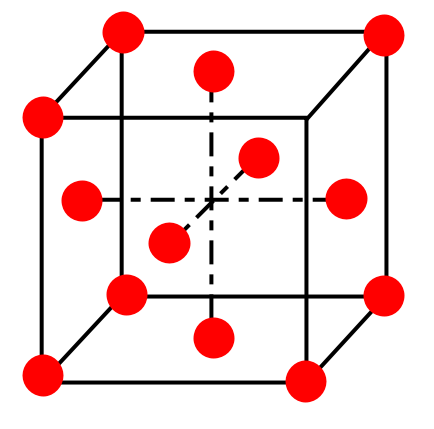
The face centered cube which has a present at corners and at each face. The total number of atoms contributed by corners $=\dfrac{8}{8}\alpha =\alpha ,$ and F.C.C. total number of atoms contributed by faces $=\dfrac{6}{2}\alpha =3\alpha .$
$\therefore $ The total number of ‘A’ atoms $=\alpha +3\alpha \Rightarrow 4\alpha .$
Likewise, the number of octahedral voids $N=4,$ and the number of tetrahedral voids $=2N=2\times 4=8$ where N is the number of atoms present per unit cell.
Since $50%$ of octahedral voids $4\times \dfrac{50}{100}=2\beta ,$ and $25%$of tetrahedral voids $8\times \dfrac{25}{100}=2\beta .$
$\therefore $ The total number of ‘B’ atoms \[=2\beta +2\beta \Rightarrow 4\beta .\]
Thus, the new formula of the compound is $4\alpha +4\beta \Rightarrow 4\alpha \beta \approx \alpha \beta $
Therefore, the correct answer is option A.
Note:
Remember that the type of arrangement will decide the number of voids in a unit cell. As we have FCC face centered unit cells. In this unit cell we have overall four atoms, which means there will be four octahedral voids while the tetrahedral voids are doubled in number.
Complete answer:
As we know that the solid crystal is arranged in a three-dimensional order where each atom which is considered as a sphere is packed and voids are formed. Two types of voids are formed, tetrahedral and octahedral. The tetrahedral voids are formed when four atoms are arranged in tetrahedral like shape, the void or we can say the space between them is tetrahedral void while when atoms are arranged in octahedral order they form an octahedral void. A unit cell is a small portion of crystal lattice, like as we have in a rhombic cube. In a rhombic cube one small colored portion can be considered as a unit cell. So, there are some modes in which atoms are arranged in a unit cell, SCC BCC and FCC. In a simple cubic cell eight atoms are present at the corners while in the other two there are some extra atoms. In BCC eight atoms are at the corner and one atom is present at the center. In FCC there are eight atoms at the corners and one at each face.
The face centered cube which has a present at corners and at each face. The total number of atoms contributed by corners $=\dfrac{8}{8}\alpha =\alpha ,$ and F.C.C. total number of atoms contributed by faces $=\dfrac{6}{2}\alpha =3\alpha .$
$\therefore $ The total number of ‘A’ atoms $=\alpha +3\alpha \Rightarrow 4\alpha .$
Likewise, the number of octahedral voids $N=4,$ and the number of tetrahedral voids $=2N=2\times 4=8$ where N is the number of atoms present per unit cell.
Since $50%$ of octahedral voids $4\times \dfrac{50}{100}=2\beta ,$ and $25%$of tetrahedral voids $8\times \dfrac{25}{100}=2\beta .$
$\therefore $ The total number of ‘B’ atoms \[=2\beta +2\beta \Rightarrow 4\beta .\]
Thus, the new formula of the compound is $4\alpha +4\beta \Rightarrow 4\alpha \beta \approx \alpha \beta $
Therefore, the correct answer is option A.
Note:
Remember that the type of arrangement will decide the number of voids in a unit cell. As we have FCC face centered unit cells. In this unit cell we have overall four atoms, which means there will be four octahedral voids while the tetrahedral voids are doubled in number.
Recently Updated Pages
Master Class 12 Economics: Engaging Questions & Answers for Success

Master Class 12 Physics: Engaging Questions & Answers for Success
Master Class 12 English: Engaging Questions & Answers for Success
Master Class 12 Social Science: Engaging Questions & Answers for Success
Master Class 12 Maths: Engaging Questions & Answers for Success
Master Class 12 Business Studies: Engaging Questions & Answers for Success
Trending doubts
Which are the Top 10 Largest Countries of the World?
What are the major means of transport Explain each class 12 social science CBSE
Draw a labelled sketch of the human eye class 12 physics CBSE
Differentiate between insitu conservation and exsitu class 12 biology CBSE
Draw a neat and well labeled diagram of TS of ovary class 12 biology CBSE
Differentiate between homogeneous and heterogeneous class 12 chemistry CBSE