




a. Complete the following chemical equations:
i. ${\text{Xe}}{{\text{F}}_{\text{4}}} + {\text{Sb}}{{\text{F}}_{\text{6}}} \to $
ii. ${\text{C}}{{\text{l}}_{\text{2}}} + {{\text{F}}_{\text{2}}}{\text{(excess)}} \to $
b. Explain each of the following:
i. Nitrogen is much less reactive than phosphorus.
ii. The stability of +5 oxidation state decreases down group 15.
ii. The bond angles $\left( {{\text{O}} - {\text{N}} - {\text{O}}} \right)$ are not of the same value in ${\text{NO}}_2^ - $ and ${\text{NO}}_2^ + $.
Answer
 Verified
578.4k+ views
Hint: During the reaction of ${\text{Xe}}{{\text{F}}_{\text{4}}}$ with ${\text{Sb}}{{\text{F}}_{\text{5}}}$, migration of one fluorine ion takes place. The group 15 elements are nitrogen, phosphorus, arsenic, antimony and bismuth. The bond angle differs due to the presence of lone pairs of electrons.
Complete step by step solution:
a. i. When ${\text{Xe}}{{\text{F}}_{\text{4}}}$ reacts with ${\text{Sb}}{{\text{F}}_{\text{5}}}$ one fluorine atom from ${\text{Xe}}{{\text{F}}_{\text{4}}}$ migrates to ${\text{Sb}}{{\text{F}}_{\text{5}}}$. Thus, ${\text{Xe}}{{\text{F}}_{\text{4}}}$ is converted to ${\text{Xe}}{{\text{F}}_{\text{3}}}$ and ${\text{Sb}}{{\text{F}}_{\text{5}}}$ is converted to ${\text{Sb}}{{\text{F}}_{\text{6}}}$.
The reaction is as follows:
${\text{Xe}}{{\text{F}}_{\text{4}}} + {\text{Sb}}{{\text{F}}_{\text{5}}} \to {\text{Xe}}{{\text{F}}_{\text{3}}} + {\text{Sb}}{{\text{F}}_{\text{6}}}$
Thus, when ${\text{Xe}}{{\text{F}}_{\text{4}}}$ reacts with ${\text{Sb}}{{\text{F}}_{\text{5}}}$, ${\text{Xe}}{{\text{F}}_{\text{3}}}$ and ${\text{Sb}}{{\text{F}}_{\text{6}}}$ are formed.
ii. When ${\text{C}}{{\text{l}}_{\text{2}}}$ reacts with excess of ${{\text{F}}_{\text{2}}}$, ${\text{Cl}}{{\text{F}}_{\text{3}}}$ is formed.
The reaction is as follows:
${\text{C}}{{\text{l}}_{\text{2}}} + {{\text{F}}_{\text{2}}}{\text{(excess)}} \to {\text{Cl}}{{\text{F}}_{\text{3}}}$
Thus, when ${\text{C}}{{\text{l}}_{\text{2}}}$ reacts with ${{\text{F}}_{\text{2}}}$, ${\text{Cl}}{{\text{F}}_{\text{3}}}$ is formed.
b. i. Nitrogen is a diatomic molecule. The two nitrogen atoms are bonded by a triple bond $\left( {{\text{N}} \equiv {\text{N}}} \right)$.
Phosphorus is a tetratomic molecule. The four phosphorous atoms are bonded by single bonds.
It is difficult to cleave the nitrogen-nitrogen triple bond and more energy is required to break the bond.
Thus, nitrogen is much less reactive than phosphorus.
ii. The group 15 elements are nitrogen, phosphorus, arsenic, antimony and bismuth.
As we move down the group 15 of the periodic table, the tendency of the s-block electrons to participate in the chemical bonding decreases. This effect is known as inert pair effect.
The general electronic configuration for group 15 elements is \[n{s^2}n{p^3}\]. The oxidation state exhibited by the group 15 elements is +3 and +5.
The stability of +5 oxidation state decreases down the group due to the inert pair effect and the stability of +3 oxidation state increases.
This is because the $n{s^2}$ electrons are poorly shielded by the d- and f- electrons.
iii.The structures of ${\text{NO}}_2^ - $ and ${\text{NO}}_2^ + $ are as follows:
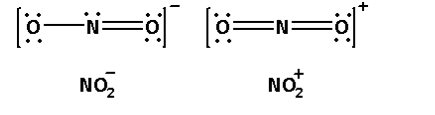
From the structures we can see that ${\text{NO}}_2^ - $ has one lone pair of electrons and ${\text{NO}}_2^ + $ has no lone pair. Thus, the repulsion is higher in the case of ${\text{NO}}_2^ - $ and thus, its bond angle is lower than that of ${\text{NO}}_2^ + $.
Thus, the bond angles $\left( {{\text{O}} - {\text{N}} - {\text{O}}} \right)$ are not of the same value in ${\text{NO}}_2^ - $ and ${\text{NO}}_2^ + $ due to the presence of lone pair of electron in ${\text{NO}}_2^ - $.
Note:
${\text{Xe}}{{\text{F}}_{\text{4}}}$ is known as xenon tetrafluoride. The geometry of xenon fluoride is octahedral because it has two lone pairs around the xenon atom. The general electronic configuration for group 15 elements is \[n{s^2}n{p^3}\]. The stability of +5 oxidation state decreases due to the inert pair effect.
Complete step by step solution:
a. i. When ${\text{Xe}}{{\text{F}}_{\text{4}}}$ reacts with ${\text{Sb}}{{\text{F}}_{\text{5}}}$ one fluorine atom from ${\text{Xe}}{{\text{F}}_{\text{4}}}$ migrates to ${\text{Sb}}{{\text{F}}_{\text{5}}}$. Thus, ${\text{Xe}}{{\text{F}}_{\text{4}}}$ is converted to ${\text{Xe}}{{\text{F}}_{\text{3}}}$ and ${\text{Sb}}{{\text{F}}_{\text{5}}}$ is converted to ${\text{Sb}}{{\text{F}}_{\text{6}}}$.
The reaction is as follows:
${\text{Xe}}{{\text{F}}_{\text{4}}} + {\text{Sb}}{{\text{F}}_{\text{5}}} \to {\text{Xe}}{{\text{F}}_{\text{3}}} + {\text{Sb}}{{\text{F}}_{\text{6}}}$
Thus, when ${\text{Xe}}{{\text{F}}_{\text{4}}}$ reacts with ${\text{Sb}}{{\text{F}}_{\text{5}}}$, ${\text{Xe}}{{\text{F}}_{\text{3}}}$ and ${\text{Sb}}{{\text{F}}_{\text{6}}}$ are formed.
ii. When ${\text{C}}{{\text{l}}_{\text{2}}}$ reacts with excess of ${{\text{F}}_{\text{2}}}$, ${\text{Cl}}{{\text{F}}_{\text{3}}}$ is formed.
The reaction is as follows:
${\text{C}}{{\text{l}}_{\text{2}}} + {{\text{F}}_{\text{2}}}{\text{(excess)}} \to {\text{Cl}}{{\text{F}}_{\text{3}}}$
Thus, when ${\text{C}}{{\text{l}}_{\text{2}}}$ reacts with ${{\text{F}}_{\text{2}}}$, ${\text{Cl}}{{\text{F}}_{\text{3}}}$ is formed.
b. i. Nitrogen is a diatomic molecule. The two nitrogen atoms are bonded by a triple bond $\left( {{\text{N}} \equiv {\text{N}}} \right)$.
Phosphorus is a tetratomic molecule. The four phosphorous atoms are bonded by single bonds.
It is difficult to cleave the nitrogen-nitrogen triple bond and more energy is required to break the bond.
Thus, nitrogen is much less reactive than phosphorus.
ii. The group 15 elements are nitrogen, phosphorus, arsenic, antimony and bismuth.
As we move down the group 15 of the periodic table, the tendency of the s-block electrons to participate in the chemical bonding decreases. This effect is known as inert pair effect.
The general electronic configuration for group 15 elements is \[n{s^2}n{p^3}\]. The oxidation state exhibited by the group 15 elements is +3 and +5.
The stability of +5 oxidation state decreases down the group due to the inert pair effect and the stability of +3 oxidation state increases.
This is because the $n{s^2}$ electrons are poorly shielded by the d- and f- electrons.
iii.The structures of ${\text{NO}}_2^ - $ and ${\text{NO}}_2^ + $ are as follows:
From the structures we can see that ${\text{NO}}_2^ - $ has one lone pair of electrons and ${\text{NO}}_2^ + $ has no lone pair. Thus, the repulsion is higher in the case of ${\text{NO}}_2^ - $ and thus, its bond angle is lower than that of ${\text{NO}}_2^ + $.
Thus, the bond angles $\left( {{\text{O}} - {\text{N}} - {\text{O}}} \right)$ are not of the same value in ${\text{NO}}_2^ - $ and ${\text{NO}}_2^ + $ due to the presence of lone pair of electron in ${\text{NO}}_2^ - $.
Note:
${\text{Xe}}{{\text{F}}_{\text{4}}}$ is known as xenon tetrafluoride. The geometry of xenon fluoride is octahedral because it has two lone pairs around the xenon atom. The general electronic configuration for group 15 elements is \[n{s^2}n{p^3}\]. The stability of +5 oxidation state decreases due to the inert pair effect.
Recently Updated Pages
Master Class 11 Computer Science: Engaging Questions & Answers for Success

Master Class 11 Business Studies: Engaging Questions & Answers for Success
Master Class 11 Economics: Engaging Questions & Answers for Success
Master Class 11 English: Engaging Questions & Answers for Success
Master Class 11 Maths: Engaging Questions & Answers for Success
Master Class 11 Biology: Engaging Questions & Answers for Success
Trending doubts
One Metric ton is equal to kg A 10000 B 1000 C 100 class 11 physics CBSE
There are 720 permutations of the digits 1 2 3 4 5 class 11 maths CBSE
Discuss the various forms of bacteria class 11 biology CBSE
Draw a diagram of a plant cell and label at least eight class 11 biology CBSE
State the laws of reflection of light
Explain zero factorial class 11 maths CBSE