




A college awarded 38 medals in Football, 15 in Basketball and 20 to Cricket. If these medals went to a total of 58 men and only three men got medals in all the three sports, how many received medals in exactly two of the three sports?
Answer
 Verified
618.6k+ views
Hint: Assign the number of men winning medals in three sports into three different sets. Generate the conditions given in the question into set operations and use the formulae of set theory like \[\text{n}\left( \text{A}\bigcup{\text{B}\bigcup{\text{C}}} \right)\text{ = n}\left( \text{A} \right)\text{ + n}\left( \text{B} \right)\text{ + n}\left( \text{C} \right)\text{ }-\text{ n(A}\bigcap{\text{B) }-\text{ n}\left( \text{B}\bigcap{\text{C}} \right)\text{ }-\text{ n}\left( \text{C}\bigcap{\text{A}} \right)\text{ + n}\left( \text{A}\bigcap{\text{B}\bigcap{\text{C}}} \right)}\]to find out the actual answer. Here, $\text{n}\left( \cdot \right)$represents the number of elements in a set.
Complete step by step answer:
Let, the men winning medals in Football constitute the set F, those winning medals in Basketball constitute set B and those winning in Cricket constitute the set C.
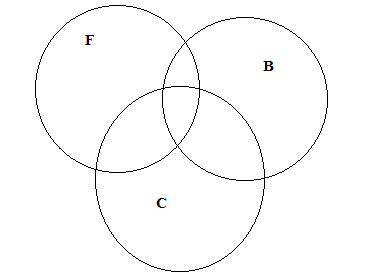
It is given that, n(F) = 38, n(B) = 15 and n(C) = 20.
Now, there are a total number of 58 men who received combinedly in the three sports.
Hence, we can write $\text{n}\left( \text{F}\bigcup{\text{B}\bigcup{\text{C}}} \right)\text{ = 58}$. 3 men won simultaneously in all the three sports. Thus, it can be expressed as $\text{n}\left( \text{F}\bigcap{\text{B}\bigcap{\text{C}}} \right)\text{ = 3}$.
Now putting these values in the formula,
\[\begin{align}
& \text{n}\left( \text{F}\bigcup{\text{B}\bigcup{\text{C}}} \right)\text{ = n}\left( \text{F} \right)\text{ + n}\left( \text{B} \right)\text{ + n}\left( \text{C} \right)\text{ }-\text{ n(F}\bigcap{\text{B) }-\text{ n}\left( \text{B}\bigcap{\text{C}} \right)\text{ }-\text{ n}\left( \text{C}\bigcap{\text{F}} \right)\text{ + n}\left( \text{F}\bigcap{\text{B}\bigcap{\text{C}}} \right)} \\
& \Rightarrow \text{ 58 = 38 + 15 +20 }-\text{ n(F}\bigcap{\text{B) }-\text{ n}\left( \text{B}\bigcap{\text{C}} \right)\text{ }-\text{ n}\left( \text{C}\bigcap{\text{F}} \right)\text{ +}}\text{ 3} \\
& \Rightarrow \text{ n(F}\bigcap{\text{B) + n}\left( \text{B}\bigcap{\text{C}} \right)\text{ + n}\left( \text{C}\bigcap{\text{F}} \right)\text{ = 76 - 58 = 18 }....\text{(i)}} \\
\end{align}\]
To find out the number of men winning medals in exactly two of the three sports, we need to find out $\text{n}\left( \text{F}\bigcap{\text{B}\bigcap{{{\text{C}}^{c}}}} \right)\text{ + n}\left( \text{F}\bigcap{{{\text{B}}^{c}}\bigcap{\text{C}}} \right)\text{ + n}\left( {{\text{F}}^{c}}\bigcap{\text{B}\bigcap{\text{C}}} \right)$.
We know the formula,
$\text{n}\left( \text{A}\bigcap{\text{B}} \right)\text{ = n}\left( \text{A}\bigcap{\text{B}\bigcap{\text{C}}} \right)\text{ + n}\left( \text{A}{{\bigcap{\text{B}\bigcap{\text{C}}}}^{c}} \right)$
Applying this formula in equation (i), we get,
$\begin{align}
& \text{n}\left( \text{F}\bigcap{\text{B}} \right)\text{ + n}\left( \text{B}\bigcap{\text{C}} \right)\text{ + n}\left( \text{C}\bigcap{\text{F}} \right)\text{ = 18} \\
& \Rightarrow \text{ n}\left( \text{F}\bigcap{\text{B}\bigcap{\text{C}}} \right)\text{ + n}\left( \text{F}\bigcap{\text{B}\bigcap{{{\text{C}}^{c}}}} \right)\text{ + n}\left( \text{F}\bigcap{\text{B}\bigcap{\text{C}}} \right)\text{ + n}\left( {{\text{F}}^{c}}\bigcap{\text{B}\bigcap{\text{C}}} \right)\text{ + n}\left( \text{F}\bigcap{\text{B}\bigcap{\text{C}}} \right)\text{ + n}\left( \text{F}\bigcap{{{\text{B}}^{c}}\bigcap{\text{C}}} \right)\text{ = 18} \\
& \Rightarrow \text{ n}\left( \text{F}\bigcap{\text{B}\bigcap{{{\text{C}}^{c}}}} \right)\text{ + n}\left( \text{F}\bigcap{{{\text{B}}^{c}}\bigcap{\text{C}}} \right)\text{ + n}\left( {{\text{F}}^{c}}\bigcap{\text{B}\bigcap{\text{C}}} \right)\text{ + 3*n}\left( \text{F}\bigcap{\text{B}\bigcap{\text{C}}} \right)\text{ = 18} \\
\end{align}$Putting $\text{n}\left( \text{F}\bigcap{\text{B}\bigcap{\text{C}}} \right)\text{ = 3}$in the above equation, we get,
$\begin{align}
& \text{ n}\left( \text{F}\bigcap{\text{B}\bigcap{{{\text{C}}^{c}}}} \right)\text{ + n}\left( \text{F}\bigcap{{{\text{B}}^{c}}\bigcap{\text{C}}} \right)\text{ + n}\left( {{\text{F}}^{c}}\bigcap{\text{B}\bigcap{\text{C}}} \right)\text{ + 9 = 18} \\
& \therefore \text{ n}\left( \text{F}\bigcap{\text{B}\bigcap{{{\text{C}}^{c}}}} \right)\text{ + n}\left( \text{F}\bigcap{{{\text{B}}^{c}}\bigcap{\text{C}}} \right)\text{ + n}\left( {{\text{F}}^{c}}\bigcap{\text{B}\bigcap{\text{C}}} \right)\text{ }=\text{ 9} \\
\end{align}$
Thus, 9 men have won medals in exactly two of the three sports in the college.
Note: If n(A) is the number of elements in the set A, then $\text{n}\left( {{\text{A}}^{c}} \right)$is the number of elements in the universal set, other than those elements present in set A. It is also important to remember the various formulae about the union and intersection of sets. Otherwise, the equations become unsolvable.
Complete step by step answer:
Let, the men winning medals in Football constitute the set F, those winning medals in Basketball constitute set B and those winning in Cricket constitute the set C.
It is given that, n(F) = 38, n(B) = 15 and n(C) = 20.
Now, there are a total number of 58 men who received combinedly in the three sports.
Hence, we can write $\text{n}\left( \text{F}\bigcup{\text{B}\bigcup{\text{C}}} \right)\text{ = 58}$. 3 men won simultaneously in all the three sports. Thus, it can be expressed as $\text{n}\left( \text{F}\bigcap{\text{B}\bigcap{\text{C}}} \right)\text{ = 3}$.
Now putting these values in the formula,
\[\begin{align}
& \text{n}\left( \text{F}\bigcup{\text{B}\bigcup{\text{C}}} \right)\text{ = n}\left( \text{F} \right)\text{ + n}\left( \text{B} \right)\text{ + n}\left( \text{C} \right)\text{ }-\text{ n(F}\bigcap{\text{B) }-\text{ n}\left( \text{B}\bigcap{\text{C}} \right)\text{ }-\text{ n}\left( \text{C}\bigcap{\text{F}} \right)\text{ + n}\left( \text{F}\bigcap{\text{B}\bigcap{\text{C}}} \right)} \\
& \Rightarrow \text{ 58 = 38 + 15 +20 }-\text{ n(F}\bigcap{\text{B) }-\text{ n}\left( \text{B}\bigcap{\text{C}} \right)\text{ }-\text{ n}\left( \text{C}\bigcap{\text{F}} \right)\text{ +}}\text{ 3} \\
& \Rightarrow \text{ n(F}\bigcap{\text{B) + n}\left( \text{B}\bigcap{\text{C}} \right)\text{ + n}\left( \text{C}\bigcap{\text{F}} \right)\text{ = 76 - 58 = 18 }....\text{(i)}} \\
\end{align}\]
To find out the number of men winning medals in exactly two of the three sports, we need to find out $\text{n}\left( \text{F}\bigcap{\text{B}\bigcap{{{\text{C}}^{c}}}} \right)\text{ + n}\left( \text{F}\bigcap{{{\text{B}}^{c}}\bigcap{\text{C}}} \right)\text{ + n}\left( {{\text{F}}^{c}}\bigcap{\text{B}\bigcap{\text{C}}} \right)$.
We know the formula,
$\text{n}\left( \text{A}\bigcap{\text{B}} \right)\text{ = n}\left( \text{A}\bigcap{\text{B}\bigcap{\text{C}}} \right)\text{ + n}\left( \text{A}{{\bigcap{\text{B}\bigcap{\text{C}}}}^{c}} \right)$
Applying this formula in equation (i), we get,
$\begin{align}
& \text{n}\left( \text{F}\bigcap{\text{B}} \right)\text{ + n}\left( \text{B}\bigcap{\text{C}} \right)\text{ + n}\left( \text{C}\bigcap{\text{F}} \right)\text{ = 18} \\
& \Rightarrow \text{ n}\left( \text{F}\bigcap{\text{B}\bigcap{\text{C}}} \right)\text{ + n}\left( \text{F}\bigcap{\text{B}\bigcap{{{\text{C}}^{c}}}} \right)\text{ + n}\left( \text{F}\bigcap{\text{B}\bigcap{\text{C}}} \right)\text{ + n}\left( {{\text{F}}^{c}}\bigcap{\text{B}\bigcap{\text{C}}} \right)\text{ + n}\left( \text{F}\bigcap{\text{B}\bigcap{\text{C}}} \right)\text{ + n}\left( \text{F}\bigcap{{{\text{B}}^{c}}\bigcap{\text{C}}} \right)\text{ = 18} \\
& \Rightarrow \text{ n}\left( \text{F}\bigcap{\text{B}\bigcap{{{\text{C}}^{c}}}} \right)\text{ + n}\left( \text{F}\bigcap{{{\text{B}}^{c}}\bigcap{\text{C}}} \right)\text{ + n}\left( {{\text{F}}^{c}}\bigcap{\text{B}\bigcap{\text{C}}} \right)\text{ + 3*n}\left( \text{F}\bigcap{\text{B}\bigcap{\text{C}}} \right)\text{ = 18} \\
\end{align}$Putting $\text{n}\left( \text{F}\bigcap{\text{B}\bigcap{\text{C}}} \right)\text{ = 3}$in the above equation, we get,
$\begin{align}
& \text{ n}\left( \text{F}\bigcap{\text{B}\bigcap{{{\text{C}}^{c}}}} \right)\text{ + n}\left( \text{F}\bigcap{{{\text{B}}^{c}}\bigcap{\text{C}}} \right)\text{ + n}\left( {{\text{F}}^{c}}\bigcap{\text{B}\bigcap{\text{C}}} \right)\text{ + 9 = 18} \\
& \therefore \text{ n}\left( \text{F}\bigcap{\text{B}\bigcap{{{\text{C}}^{c}}}} \right)\text{ + n}\left( \text{F}\bigcap{{{\text{B}}^{c}}\bigcap{\text{C}}} \right)\text{ + n}\left( {{\text{F}}^{c}}\bigcap{\text{B}\bigcap{\text{C}}} \right)\text{ }=\text{ 9} \\
\end{align}$
Thus, 9 men have won medals in exactly two of the three sports in the college.
Note: If n(A) is the number of elements in the set A, then $\text{n}\left( {{\text{A}}^{c}} \right)$is the number of elements in the universal set, other than those elements present in set A. It is also important to remember the various formulae about the union and intersection of sets. Otherwise, the equations become unsolvable.
Recently Updated Pages
Master Class 10 Computer Science: Engaging Questions & Answers for Success

Master Class 10 General Knowledge: Engaging Questions & Answers for Success
Master Class 10 English: Engaging Questions & Answers for Success
Master Class 10 Social Science: Engaging Questions & Answers for Success
Master Class 10 Maths: Engaging Questions & Answers for Success
Master Class 10 Science: Engaging Questions & Answers for Success
Trending doubts
What is the median of the first 10 natural numbers class 10 maths CBSE
Which women's tennis player has 24 Grand Slam singles titles?
Who is the Brand Ambassador of Incredible India?
Why is there a time difference of about 5 hours between class 10 social science CBSE
Write a letter to the principal requesting him to grant class 10 english CBSE
A moving boat is observed from the top of a 150 m high class 10 maths CBSE