




A coil of $N$ turns and area $A$ is rotated at the rate of $n$rotations per second in a magnetic field of intensity $B$, the magnitude of maximum flux will be
(A). $NAB$
(B). $nAB$
(C). $NnAB$
(D). $2\pi nNAB$
Answer
 Verified
598.5k+ views
Hint: The magnetic flux is the magnetic lines of forces passing through the unit area. It depends on the number of turns in the coil, area of cross section, magnetic field intensity and the angle between magnetic field vector and area vector, substituting corresponding values and setting the variable parameter to its maximum value, we can determine magnetic flux.
Formulas used:
$\phi =NAB\cos \theta $
Complete answer:
The magnetic flux is defined as the number of magnetic lines of forces passing per unit area. It is given by-
$\phi =NAB\cos \theta $ - (1)
Here, $\phi $ is the flux passing through an area
$N$ is the number of turns in the coil
$A$ is the area of cross-section
$B$ is the magnetic field intensity
$\theta $ is the angle between area and magnetic field
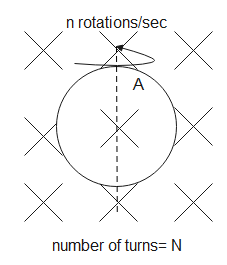
According to the question, the coil is continuously rotating at a rate of $n$rotations per second. So, the angle between area vector and magnetic field, $\theta $ is continuously changing
From eq (1), for maximum flux $\cos \theta $ must be maximum and its maximum value is $\cos \theta =1$
Substituting maximum value of $\cos \theta $ in eq (1), we get,
$\begin{align}
& \phi =NAB(1) \\
& \therefore {{\phi }_{\max }}=NAB \\
\end{align}$
Therefore, the maximum value of flux is $NAB$.
Hence, the correct option is (A).
Additional Information:
When a conductor is kept in a varying magnetic field or moved in a uniform magnetic field such that the area vector is perpendicular to the magnetic field vector then emf is induced in a coil. According to Faraday’s law of electromagnetic induction, the emf induced is equal to the rate of change of flux through the coil.
Note:
The magnetic flux through the rotating coil does not depend on the rate of rotation of the coil. The emf induced in the coil depends on the number of turns, rate of rotation, area of cross section, magnetic field intensity and the angle between area vector and magnetic field vector.
Formulas used:
$\phi =NAB\cos \theta $
Complete answer:
The magnetic flux is defined as the number of magnetic lines of forces passing per unit area. It is given by-
$\phi =NAB\cos \theta $ - (1)
Here, $\phi $ is the flux passing through an area
$N$ is the number of turns in the coil
$A$ is the area of cross-section
$B$ is the magnetic field intensity
$\theta $ is the angle between area and magnetic field
According to the question, the coil is continuously rotating at a rate of $n$rotations per second. So, the angle between area vector and magnetic field, $\theta $ is continuously changing
From eq (1), for maximum flux $\cos \theta $ must be maximum and its maximum value is $\cos \theta =1$
Substituting maximum value of $\cos \theta $ in eq (1), we get,
$\begin{align}
& \phi =NAB(1) \\
& \therefore {{\phi }_{\max }}=NAB \\
\end{align}$
Therefore, the maximum value of flux is $NAB$.
Hence, the correct option is (A).
Additional Information:
When a conductor is kept in a varying magnetic field or moved in a uniform magnetic field such that the area vector is perpendicular to the magnetic field vector then emf is induced in a coil. According to Faraday’s law of electromagnetic induction, the emf induced is equal to the rate of change of flux through the coil.
Note:
The magnetic flux through the rotating coil does not depend on the rate of rotation of the coil. The emf induced in the coil depends on the number of turns, rate of rotation, area of cross section, magnetic field intensity and the angle between area vector and magnetic field vector.
Recently Updated Pages
Master Class 11 English: Engaging Questions & Answers for Success

Master Class 11 Social Science: Engaging Questions & Answers for Success
Master Class 11 Maths: Engaging Questions & Answers for Success
Master Class 11 Biology: Engaging Questions & Answers for Success
Master Class 11 Physics: Engaging Questions & Answers for Success
Master Class 11 Chemistry: Engaging Questions & Answers for Success
Trending doubts
One Metric ton is equal to kg A 10000 B 1000 C 100 class 11 physics CBSE
Difference Between Prokaryotic Cells and Eukaryotic Cells
Find the value of the expression given below sin 30circ class 11 maths CBSE
Difference between physical and chemical change class 11 chemistry CBSE
Two of the body parts which do not appear in MRI are class 11 biology CBSE
Draw a diagram of a plant cell and label at least eight class 11 biology CBSE