




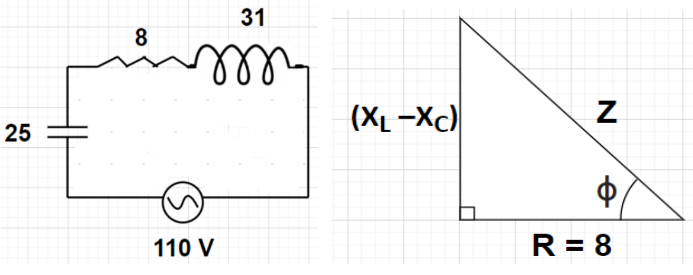
A coil of inductive reactance 31 has a resistance of 8. It is placed in series with a condenser of capacitive reactance 25. The combination is connected to an alternative current source of 110 V. What is the power factor of the circuit?
${\text{A}}{\text{.}}$ 0.64
${\text{B}}{\text{.}}$ 0.75
${\text{C}}{\text{.}}$ 0.80
${\text{D}}{\text{.}}$ 0.56
Answer
 Verified
683.1k+ views
Hint- Here, we will proceed by finding the net impedance in the given series circuit of given resistance, given inductive and capacitive reactance. Then, we will draw the impedance triangle in order to find the power factor (i.e., $\cos \phi $) for the given circuit.
Formulas Used- ${\text{Z}} = \sqrt {{{\text{R}}^2} + {{\left( {{{\text{X}}_{\text{L}}} - {{\text{X}}_{\text{C}}}} \right)}^2}} $ and $\cos \phi = \dfrac{{\text{R}}}{{\text{Z}}}$.
Complete step-by-step solution -
Given, Inductive reactance of the coil, ${{\text{X}}_{\text{L}}}$ = 31 $\Omega $
Resistance of the coil, R = 8 $\Omega $
Capacitive reactance of condenser, ${{\text{X}}_{\text{C}}}$ = 25 $\Omega $
Voltage of the alternative current source, V = 110 volts
It is given that both the coil and the condenser are connected in series with each other.
Since, we know that the net impedance Z of the circuit having resistance R, inductive reactance $X_L$ and capacitive reactance $X_C$ all connected in series is given by
${\text{Z}} = \sqrt {{{\text{R}}^2} + {{\left( {{{\text{X}}_{\text{L}}} - {{\text{X}}_{\text{C}}}} \right)}^2}} $
By substituting${{\text{X}}_{\text{L}}}$ = 31, ${{\text{X}}_{\text{C}}}$ = 25 and V = 110 in the above formula, we get
Impedance of the circuit, ${\text{Z}} = \sqrt {{{\text{8}}^2} + {{\left( {31 - 25} \right)}^2}} = \sqrt {64 + 36} = \sqrt {100} = 10{\text{ }}\Omega $
Power factor of any circuit can be given by $\cos \phi $ where angle $\phi $ is shown in the figure of the impedance triangle drawn.
According to the impedance triangle shown in the figure, we can write
$\cos \phi = \dfrac{{\text{R}}}{{\text{Z}}}$
By substituting R = 8 and Z = 10 in the above equation, we have
$
\Rightarrow \cos \phi = \dfrac{{\text{8}}}{{{\text{10}}}} \\
\Rightarrow \cos \phi = {\text{0}}{\text{.80}} \\
$
Therefore, the power factor of the given circuit is equal to 0.80.
Hence, option C is correct.
Note- According to Pythagoras Theorem, ${\left( {{\text{Hypotenuse}}} \right)^2} = {\left( {{\text{Perpendicular}}} \right)^2} + {\left( {{\text{Base}}} \right)^2}$. By applying Pythagoras Theorem in the impedance triangle, we get ${\left( {\text{Z}} \right)^2} = {\left( {{{\text{X}}_{\text{L}}} - {{\text{X}}_{\text{C}}}} \right)^2} + {\left( {\text{R}} \right)^2} \Rightarrow {\text{Z}} = \sqrt {{{\left( {{{\text{X}}_{\text{L}}} - {{\text{X}}_{\text{C}}}} \right)}^2} + {{\left( {\text{R}} \right)}^2}} $ which is the same formula as used directly in the problem. Here, ${{\text{X}}_{\text{C}}} < {{\text{X}}_{\text{L}}}$ that’s why everywhere we have used $\left( {{{\text{X}}_{\text{L}}} - {{\text{X}}_{\text{C}}}} \right)$ but for ${{\text{X}}_{\text{C}}} > {{\text{X}}_{\text{L}}}$, we use $\left( {{{\text{X}}_{\text{C}}} - {{\text{X}}_{\text{L}}}} \right)$ instead of $\left( {{{\text{X}}_{\text{L}}} - {{\text{X}}_{\text{C}}}} \right)$.
Formulas Used- ${\text{Z}} = \sqrt {{{\text{R}}^2} + {{\left( {{{\text{X}}_{\text{L}}} - {{\text{X}}_{\text{C}}}} \right)}^2}} $ and $\cos \phi = \dfrac{{\text{R}}}{{\text{Z}}}$.
Complete step-by-step solution -
Given, Inductive reactance of the coil, ${{\text{X}}_{\text{L}}}$ = 31 $\Omega $
Resistance of the coil, R = 8 $\Omega $
Capacitive reactance of condenser, ${{\text{X}}_{\text{C}}}$ = 25 $\Omega $
Voltage of the alternative current source, V = 110 volts
It is given that both the coil and the condenser are connected in series with each other.
Since, we know that the net impedance Z of the circuit having resistance R, inductive reactance $X_L$ and capacitive reactance $X_C$ all connected in series is given by
${\text{Z}} = \sqrt {{{\text{R}}^2} + {{\left( {{{\text{X}}_{\text{L}}} - {{\text{X}}_{\text{C}}}} \right)}^2}} $
By substituting${{\text{X}}_{\text{L}}}$ = 31, ${{\text{X}}_{\text{C}}}$ = 25 and V = 110 in the above formula, we get
Impedance of the circuit, ${\text{Z}} = \sqrt {{{\text{8}}^2} + {{\left( {31 - 25} \right)}^2}} = \sqrt {64 + 36} = \sqrt {100} = 10{\text{ }}\Omega $
Power factor of any circuit can be given by $\cos \phi $ where angle $\phi $ is shown in the figure of the impedance triangle drawn.
According to the impedance triangle shown in the figure, we can write
$\cos \phi = \dfrac{{\text{R}}}{{\text{Z}}}$
By substituting R = 8 and Z = 10 in the above equation, we have
$
\Rightarrow \cos \phi = \dfrac{{\text{8}}}{{{\text{10}}}} \\
\Rightarrow \cos \phi = {\text{0}}{\text{.80}} \\
$
Therefore, the power factor of the given circuit is equal to 0.80.
Hence, option C is correct.
Note- According to Pythagoras Theorem, ${\left( {{\text{Hypotenuse}}} \right)^2} = {\left( {{\text{Perpendicular}}} \right)^2} + {\left( {{\text{Base}}} \right)^2}$. By applying Pythagoras Theorem in the impedance triangle, we get ${\left( {\text{Z}} \right)^2} = {\left( {{{\text{X}}_{\text{L}}} - {{\text{X}}_{\text{C}}}} \right)^2} + {\left( {\text{R}} \right)^2} \Rightarrow {\text{Z}} = \sqrt {{{\left( {{{\text{X}}_{\text{L}}} - {{\text{X}}_{\text{C}}}} \right)}^2} + {{\left( {\text{R}} \right)}^2}} $ which is the same formula as used directly in the problem. Here, ${{\text{X}}_{\text{C}}} < {{\text{X}}_{\text{L}}}$ that’s why everywhere we have used $\left( {{{\text{X}}_{\text{L}}} - {{\text{X}}_{\text{C}}}} \right)$ but for ${{\text{X}}_{\text{C}}} > {{\text{X}}_{\text{L}}}$, we use $\left( {{{\text{X}}_{\text{C}}} - {{\text{X}}_{\text{L}}}} \right)$ instead of $\left( {{{\text{X}}_{\text{L}}} - {{\text{X}}_{\text{C}}}} \right)$.
Recently Updated Pages
Master Class 12 Physics: Engaging Questions & Answers for Success

Master Class 12 Social Science: Engaging Questions & Answers for Success
Master Class 12 English: Engaging Questions & Answers for Success
Master Class 12 Maths: Engaging Questions & Answers for Success
Master Class 12 Business Studies: Engaging Questions & Answers for Success
Master Class 12 Chemistry: Engaging Questions & Answers for Success
Trending doubts
Draw a labelled sketch of the human eye class 12 physics CBSE
Which are the Top 10 Largest Countries of the World?
Draw ray diagrams each showing i myopic eye and ii class 12 physics CBSE
One megawatt is equal to how many units of electri class 12 physics CBSE
Which is the correct genotypic ratio of mendel dihybrid class 12 biology CBSE
Give 10 examples of unisexual and bisexual flowers