




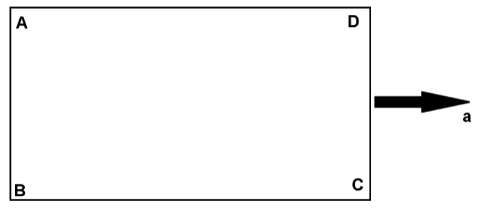
A closed rectangular tank is completely filled with water and is accelerated horizontally with an acceleration towards the right. Pressure is (i) maximum at, and (ii) minimum at
A. (i)B (ii)D
B. (i)C (ii)D
C. (i)B (ii)C
D. (i)B (ii)A
Answer
 Verified
497.1k+ views
Hint:Here it is given that the tank is completely filled with water and is accelerated horizontally, and we must find that at what point pressure will be minimum and maximum. Here we will get the answer by using the basic formula of pressure in fluid let us see.
Formula used:
$P = \rho gh$
Where, $P$ is the pressure, $\rho $ is the density of the fluid, $g$ is the acceleration of gravity and $h$ is the height of the fluid.
Complete step by step answer:
Let, $h$ be the distance between $A$ and $B$. $l$ be the distance between $A$ and $D$.Now, we know that the pressure increases in vertical direction by $\rho gh$.So, the pressure at $B$ will be,
${P_B} = {P_A} + \rho gh$ ----(1)
Pressure at $C$ will be,
${P_C} = {P_D} + \rho gh$
And we know that when any body accelerates in the opposite direction, we experience pressure and are given by, $\rho al$.So, pressure at $A$ will be,
${P_A} = {P_D} + \rho al$
And Pressure at $B$ will be,
${P_B} = {P_C} + \rho al$
Putting value of pressure of $A$ in equation (1) we get,
${P_B} = {P_D} + \rho gh + \rho al$
Here we see that after adding the pressure of $D$ only there is something in all the points so we can conclude that the minimum pressure at $D$.And after adding ${P_D} + \rho gh$ on $B$ only we get the pressure of $B$ so we can say that the pressure at $B$ is the maximum.
Hence, the correct option is A.
Note:Pascal's law (also Pascal's principle or the principle of transmission of fluid-pressure) is a principle in fluid mechanics given by Blaise Pascal that states that a pressure change at any point in a confined incompressible fluid is transmitted throughout the fluid such that the same change occurs everywhere.
Formula used:
$P = \rho gh$
Where, $P$ is the pressure, $\rho $ is the density of the fluid, $g$ is the acceleration of gravity and $h$ is the height of the fluid.
Complete step by step answer:
Let, $h$ be the distance between $A$ and $B$. $l$ be the distance between $A$ and $D$.Now, we know that the pressure increases in vertical direction by $\rho gh$.So, the pressure at $B$ will be,
${P_B} = {P_A} + \rho gh$ ----(1)
Pressure at $C$ will be,
${P_C} = {P_D} + \rho gh$
And we know that when any body accelerates in the opposite direction, we experience pressure and are given by, $\rho al$.So, pressure at $A$ will be,
${P_A} = {P_D} + \rho al$
And Pressure at $B$ will be,
${P_B} = {P_C} + \rho al$
Putting value of pressure of $A$ in equation (1) we get,
${P_B} = {P_D} + \rho gh + \rho al$
Here we see that after adding the pressure of $D$ only there is something in all the points so we can conclude that the minimum pressure at $D$.And after adding ${P_D} + \rho gh$ on $B$ only we get the pressure of $B$ so we can say that the pressure at $B$ is the maximum.
Hence, the correct option is A.
Note:Pascal's law (also Pascal's principle or the principle of transmission of fluid-pressure) is a principle in fluid mechanics given by Blaise Pascal that states that a pressure change at any point in a confined incompressible fluid is transmitted throughout the fluid such that the same change occurs everywhere.
Recently Updated Pages
Master Class 11 Computer Science: Engaging Questions & Answers for Success

Master Class 11 Business Studies: Engaging Questions & Answers for Success
Master Class 11 Economics: Engaging Questions & Answers for Success
Master Class 11 English: Engaging Questions & Answers for Success
Master Class 11 Maths: Engaging Questions & Answers for Success
Master Class 11 Biology: Engaging Questions & Answers for Success
Trending doubts
One Metric ton is equal to kg A 10000 B 1000 C 100 class 11 physics CBSE
There are 720 permutations of the digits 1 2 3 4 5 class 11 maths CBSE
Discuss the various forms of bacteria class 11 biology CBSE
Draw a diagram of a plant cell and label at least eight class 11 biology CBSE
State the laws of reflection of light
Explain zero factorial class 11 maths CBSE