




A cistern, internally measuring 150cm x 120cm x 110cm has 129600$c{m^3}$ of water in it. Porous bricks are placed in the water until the cistern is full to the brim. Each brick absorbs one seventeenth of its own volume of water. How many bricks can be put in without the water overflowing, each brick being 22.5cm x 7.5cm x 6, 5cm?
Answer
 Verified
655.2k+ views
Hint- In this question the first thing needed to be calculated is volume of one brick and the volume of water absorbed by the brick. Let $n$be the no. of bricks to be placed in the water. Add the volume of bricks to the initial volume in cistern and equate it to the total volume of cistern. Remember porous bricks absorb water, it will reduce the amount of water present in cistern.
Complete step-by-step answer:
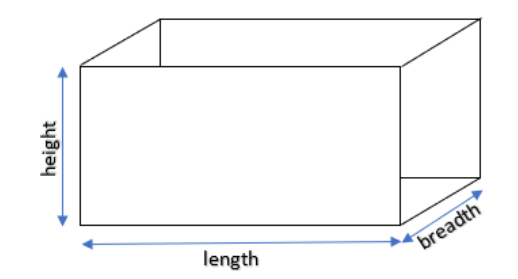
As the brick is in cuboidal form, by using formula of volume of cuboid Volume of Brick Volume of Brick$ = length \times breadth \times height$
Therefore, Volume of one brick
$
= 22.5 \times 7.5 \times 6.5 \\
= 1096.875c{m^3} \\
$
Volume of water absorbed by one brick
$
= \dfrac{1}{{17}} \times ({\text{Volume of one brick)}} \\
{\text{ = }}\dfrac{1}{{17}} \times 1096.875 \\
= \dfrac{{1096.875}}{{17}}c{m^3} \\
$
Let $n$be the number of bricks to be placed in water to fill cistern up to the brim
Volume of $n$bricks $ = 1096.875 \times n{\text{ }}c{m^3}$
Volume absorbed by $n$bricks $ = \dfrac{{n \times 1096.875}}{{17}}c{m^3}$
Now, cistern is to be fully filled
$ \Rightarrow $Volume of water in cistern $ + $Volume of bricks$ - $Volume of water absorbed by bricks $ = $Volume of cistern
$
\Rightarrow 129600 + 1096.875 \times n - \dfrac{{n \times 1096.875}}{{17}} = 150 \times 120 \times 110 \\
\Rightarrow 129600 + (n - \dfrac{n}{{17}}) \times 1096.875 = 1980000 \\
\Rightarrow \dfrac{{17n - n}}{{17}} \times 1096.875 = 1980000 - 129600 \\
\Rightarrow \dfrac{{16n}}{{17}} \times 1096.875 = 1850400 \\
\Rightarrow 17550n = 1850400 \times 17 \\
\Rightarrow n = \dfrac{{31456800}}{{17550}} \\
\Rightarrow n = 1792.41046 \approx 1792 \\ $
So, The number of bricks that can be placed in cistern without water overflowing is 1792.
Note- In this type of question what we have to use is the formula of mensuration to find the volume. First find the volume of the unitary item then find the volume of n items and then apply the condition given in question to find the value of n.
Complete step-by-step answer:
As the brick is in cuboidal form, by using formula of volume of cuboid Volume of Brick Volume of Brick$ = length \times breadth \times height$
Therefore, Volume of one brick
$
= 22.5 \times 7.5 \times 6.5 \\
= 1096.875c{m^3} \\
$
Volume of water absorbed by one brick
$
= \dfrac{1}{{17}} \times ({\text{Volume of one brick)}} \\
{\text{ = }}\dfrac{1}{{17}} \times 1096.875 \\
= \dfrac{{1096.875}}{{17}}c{m^3} \\
$
Let $n$be the number of bricks to be placed in water to fill cistern up to the brim
Volume of $n$bricks $ = 1096.875 \times n{\text{ }}c{m^3}$
Volume absorbed by $n$bricks $ = \dfrac{{n \times 1096.875}}{{17}}c{m^3}$
Now, cistern is to be fully filled
$ \Rightarrow $Volume of water in cistern $ + $Volume of bricks$ - $Volume of water absorbed by bricks $ = $Volume of cistern
$
\Rightarrow 129600 + 1096.875 \times n - \dfrac{{n \times 1096.875}}{{17}} = 150 \times 120 \times 110 \\
\Rightarrow 129600 + (n - \dfrac{n}{{17}}) \times 1096.875 = 1980000 \\
\Rightarrow \dfrac{{17n - n}}{{17}} \times 1096.875 = 1980000 - 129600 \\
\Rightarrow \dfrac{{16n}}{{17}} \times 1096.875 = 1850400 \\
\Rightarrow 17550n = 1850400 \times 17 \\
\Rightarrow n = \dfrac{{31456800}}{{17550}} \\
\Rightarrow n = 1792.41046 \approx 1792 \\ $
So, The number of bricks that can be placed in cistern without water overflowing is 1792.
Note- In this type of question what we have to use is the formula of mensuration to find the volume. First find the volume of the unitary item then find the volume of n items and then apply the condition given in question to find the value of n.
Recently Updated Pages
Differentiate between voluntary action and reflex class 10 biology CBSE

The uses of bleaching powder are A It is used bleaching class 10 chemistry CBSE
Fill in the blanks with abstract nouns of the words class 10 english CBSE
How many threedigit numbers are there class 10 maths CBSE
What is a reflex arc class 10 biology CBSE
Construct a square whose diagonal is 6cm Measure the class 10 maths CBSE
Trending doubts
Explain the Treaty of Vienna of 1815 class 10 social science CBSE
The slogan Jai Hind was given by A Lal Bahadur Shastri class 10 social science CBSE
10 examples of evaporation in daily life with explanations
What is the full form of POSCO class 10 social science CBSE
Identify the feminine form of noun nephew a shenephew class 10 english CBSE
CSIR full form?