




A circus artist is climbing a 20 m long rope, which is tightly stretched and tied from the top of a vertical pole to the ground. Find the height of the pole if the angle made by the rope with the ground level is 30°.
Answer
 Verified
524.5k+ views
Hint:
In this question we will use trigonometric ratios. Trigonometry is a branch of mathematics which deals with the measurement of sides and angles of a triangle and the problems based on them. Trigonometry helps us to find angles and distances, and is used a lot in science, engineering, and many more.
There are many trigonometry formulas and trigonometric identities, which are used to solve complex equations in geometry.
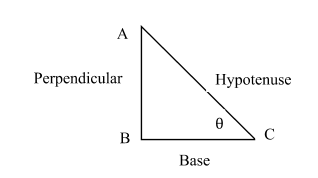
The ratios of sides of a right-angled triangle with respect to any of its acute angles are known as the trigonometric ratios of that particular angle. They are defined by parameters namely hypotenuse, base and perpendicular.
In ∆ABC
$\sin \theta = \dfrac{{Perpendicular}}{{Base}}$
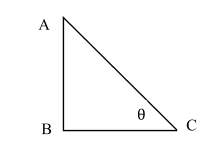
$\sin \theta = \dfrac{{AB}}{{AC}}$
And the value of \[\sin 30^\circ \] is $\dfrac{1}{2}$
Complete step by step solution:
Let the height of pole be AB = h
It is given that,
Length of the rope = 20m
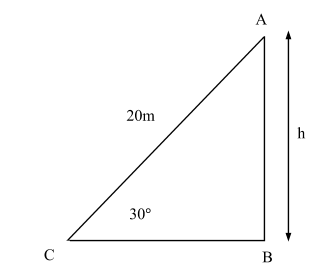
We assume that rope is tied at ground level at point C
∴AC = 20m
Angle made by rope with the ground level = 30°
\[\begin{gathered}
\therefore \angle ACB = 30^\circ \\
{\text{and }}\angle ABC = 90^\circ \\
\end{gathered} \]
We know that
$\sin \theta = \dfrac{{Perpendicular}}{{Base}}$
$\sin 30^\circ = \dfrac{{AB}}{{AC}}$
$\begin{gathered}
\dfrac{1}{2} = \dfrac{h}{{20}} \\
h = \dfrac{1}{2} \times 20 \\
h = 10m \\
\end{gathered} $
∴ Height of the pole = h = 10m
Note:
There are 6 trigonometric ratios, Sine (sin), Cosine (cos), Tangent (tan), Cosecant (cosec), Secant (sec), Cotangent (cot)
$\sin \theta = \dfrac{{Perpendicular}}{{Base}}$
$\begin{gathered}
\cos \theta = \dfrac{{Base}}{{Hypotenuse}} \\
\tan \theta = \dfrac{{Perpendicular}}{{Base}} \\
\cos ec\theta = \dfrac{{Hypotenuse}}{{Perpendicular}} \\
\sec \theta = \dfrac{{Hypotenuse}}{{Base}} \\
\cot \theta = \dfrac{{Base}}{{Perpendicular}} \\
\end{gathered} $
Some of the basic applications of trigonometry are:
Measuring the heights of towers or big mountains.
Determining the distance of the shore from the sea.
Finding the distance between two bodies.
Determining the power output of solar cell panels at different inclinations.
In this question we will use trigonometric ratios. Trigonometry is a branch of mathematics which deals with the measurement of sides and angles of a triangle and the problems based on them. Trigonometry helps us to find angles and distances, and is used a lot in science, engineering, and many more.
There are many trigonometry formulas and trigonometric identities, which are used to solve complex equations in geometry.
The ratios of sides of a right-angled triangle with respect to any of its acute angles are known as the trigonometric ratios of that particular angle. They are defined by parameters namely hypotenuse, base and perpendicular.
In ∆ABC
$\sin \theta = \dfrac{{Perpendicular}}{{Base}}$
$\sin \theta = \dfrac{{AB}}{{AC}}$
And the value of \[\sin 30^\circ \] is $\dfrac{1}{2}$
Complete step by step solution:
Let the height of pole be AB = h
It is given that,
Length of the rope = 20m
We assume that rope is tied at ground level at point C
∴AC = 20m
Angle made by rope with the ground level = 30°
\[\begin{gathered}
\therefore \angle ACB = 30^\circ \\
{\text{and }}\angle ABC = 90^\circ \\
\end{gathered} \]
We know that
$\sin \theta = \dfrac{{Perpendicular}}{{Base}}$
$\sin 30^\circ = \dfrac{{AB}}{{AC}}$
$\begin{gathered}
\dfrac{1}{2} = \dfrac{h}{{20}} \\
h = \dfrac{1}{2} \times 20 \\
h = 10m \\
\end{gathered} $
∴ Height of the pole = h = 10m
Note:
There are 6 trigonometric ratios, Sine (sin), Cosine (cos), Tangent (tan), Cosecant (cosec), Secant (sec), Cotangent (cot)
$\sin \theta = \dfrac{{Perpendicular}}{{Base}}$
$\begin{gathered}
\cos \theta = \dfrac{{Base}}{{Hypotenuse}} \\
\tan \theta = \dfrac{{Perpendicular}}{{Base}} \\
\cos ec\theta = \dfrac{{Hypotenuse}}{{Perpendicular}} \\
\sec \theta = \dfrac{{Hypotenuse}}{{Base}} \\
\cot \theta = \dfrac{{Base}}{{Perpendicular}} \\
\end{gathered} $
Some of the basic applications of trigonometry are:
Measuring the heights of towers or big mountains.
Determining the distance of the shore from the sea.
Finding the distance between two bodies.
Determining the power output of solar cell panels at different inclinations.
Recently Updated Pages
Master Class 10 Computer Science: Engaging Questions & Answers for Success

Master Class 10 General Knowledge: Engaging Questions & Answers for Success
Master Class 10 English: Engaging Questions & Answers for Success
Master Class 10 Social Science: Engaging Questions & Answers for Success
Master Class 10 Maths: Engaging Questions & Answers for Success
Master Class 10 Science: Engaging Questions & Answers for Success
Trending doubts
What is the median of the first 10 natural numbers class 10 maths CBSE
Which women's tennis player has 24 Grand Slam singles titles?
Who is the Brand Ambassador of Incredible India?
Why is there a time difference of about 5 hours between class 10 social science CBSE
Write a letter to the principal requesting him to grant class 10 english CBSE
A moving boat is observed from the top of a 150 m high class 10 maths CBSE