




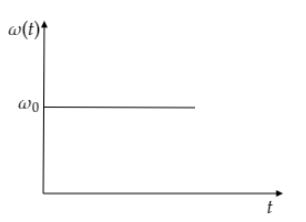
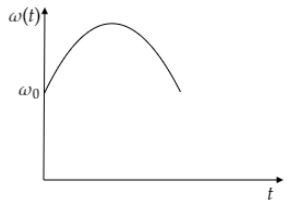
A circular platform is free to rotate in a horizontal plane about a vertical axis passing through its centre. A tortoise is sitting at the edge of the platform. Now the platform is given as angular velocity ${\omega _0}$ when a tortoise moves along a chord of the platform with a constant velocity (with respect to platform), the angular velocity of the platform $\omega \left( t \right)$ will vary with time $t$ as:
A.
B.
C.
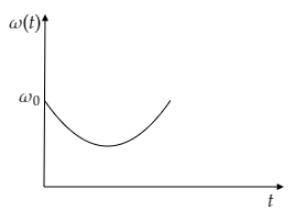
D.
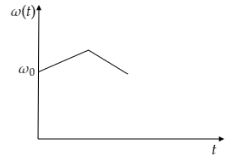
Answer
 Verified
489.6k+ views
Hint: As long as there is no external torque on the system the total angular momentum of the system is constant. i.e., total initial angular momentum of the system is equal to the total final angular momentum of the system. The angular momentum of the system will vary inversely with the square of distance between the tortoise and the center of the platform. i.e., the angular momentum of the system will increase first as the distance between the tortoise and the center of the platform decreases and then the angular momentum will decrease as the distance between the tortoise and the center of the platform increases.
Complete step by step answer:
It is given that a circular platform rotates in a horizontal plane about its axis passing through its center. A tortoise is placed at the edge of the platform. The initial angular velocity of the platform-tortoise system is ${\omega _0}$. Now the tortoise moves along a chord of the platform with a constant velocity w.r.t. the platform. Let $M$ and $m$ be the masses of the platform and the tortoise respectively. $R$ is the radius of the platform. Let’s draw the diagram which depicts the question.
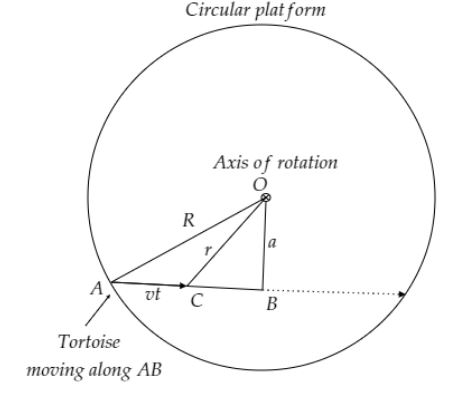
From the above diagram, the moment of inertia of the system at the point A is,
${I_A} = {I_{platform}} + {I_{A,tortoise}}$
${I_{platform}}$ is the moment of inertia of the platform about the axis passing through the center of the platform.
${I_{platform}} = \dfrac{{M{R^2}}}{2}$
${I_{A,tortoise}}$ is the moment of inertia of the tortoise at the point A about the axis passing through the center of the platform.
${I_{A,tortoise}} = m{R^2}$
Therefore, ${I_A} = \dfrac{{M{R^2}}}{2} + m{R^2}$
The total moment of inertia at the point C is,
${I_B} = {I_{platform}} + {I_{B,tortoise}}$
Where ${I_{B,tortoise}}$ is the moment of inertia of the tortoise at the point C about the axis passing through the center of the platform.
From the above diagram, we found
${I_{B,tortoise}} = m{r^2}$
Consider the right-angle triangle ABO, $AB = R$
Let $OB = a$
Therefore, $AB = \sqrt {{R^2} - {a^2}} $
Now consider the right angle-triangle CBO,
$CO = r$
$\Rightarrow CB = AB - AC$
Since the tortoise moves with uniform velocity $\overrightarrow v $, The displacement $AC = vt$. Where $t$ is the time taken by the tortoise to reach the point C.
So, $CB = \sqrt {{R^2} - {a^2}} - vt$
Now, ${\left( {CO} \right)^2} = {\left( {OB} \right)^2} + {\left( {CB} \right)^2}$
Substitute all the required values in the above formula. We got,
${r^2} = {a^2} + {\left( {\sqrt {{R^2} - {a^2}} - vt} \right)^2}$
Substitute the value of $r$ in ${I_{B,tortoise}} = m{r^2}$
${I_{B,tortoise}} = m\left[ {{a^2} + {{\left( {\sqrt {{R^2} - {a^2}} - vt} \right)}^2}} \right]$
Now calculate ${I_B}$. We got,
${I_B} = \dfrac{{M{R^2}}}{2} + m\left[ {{a^2} + {{\left( {\sqrt {{R^2} - {a^2}} - vt} \right)}^2}} \right]$
Since there is no external torque acting on the system, The total angular momentum of the system is conserved i.e., total angular momentum at point A $ = $ total angular momentum at point B.
$ \Rightarrow {I_A}{\omega _A} = {I_B}{\omega _B}$
It is given that the initial angular velocity ${\omega _A} = {\omega _0}$.
And ${\omega _B} = \omega \left( t \right)$
$ \Rightarrow \omega \left( t \right) = \dfrac{{{I_A}{\omega _0}}}{{{I_B}}}$
Substitute the value of ${I_A}$ and ${I_B}$ in the above formula.
$ \Rightarrow \omega \left( t \right) = \dfrac{{\left( {\dfrac{{M{R^2}}}{2} + m{R^2}} \right){\omega _0}}}{{\dfrac{{M{R^2}}}{2} + m\left[ {{a^2} + {{\left( {\sqrt {{R^2} - {a^2}} - vt} \right)}^2}} \right]}}$ …… (1)
At $t = 0$, $\omega \left( t \right) = {\omega _0}$
It is now clear that $\omega \left( t \right)$ varies nonlinear curve with time $t$ as from above equation we have $\omega \left( t \right) \propto \dfrac{1}{{{t^2}}}$.
To know the nature of nonlinear, replace ${a^2} + {\left( {\sqrt {{R^2} - {a^2}} - vt} \right)^2} = {r^2}$ in the equation (1). We got,
$ \Rightarrow \omega \left( t \right) = \dfrac{{\left( {\dfrac{{M{R^2}}}{2} + m{R^2}} \right){\omega _0}}}{{\dfrac{{M{R^2}}}{2} + m{r^2}}}$
$\therefore \omega \left( t \right) \propto \dfrac{1}{{{r^2}}}$
Since, the tortoise moves along the chord, the distance between the tortoise and the center of the platform $r$ decreases first till $a$ and then increases again. Hence, $\omega \left( t \right)$ first increases upto $r = a$ and then decreases. The variation of $\omega \left( t \right)$ with $t$ is as follows.
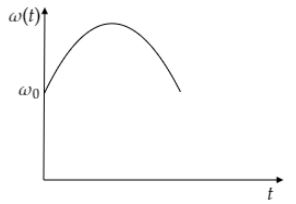
Hence, the correct option is B.
Note: The platform is a solid circular disk. Hence, its moment of inertia about the axis passing through its center is \[I = \dfrac{{M{R^2}}}{2}\]. Where, $M$ and $R$ are the mass and radius of the disk respectively. The moment of inertia of a particle of mass $m$ about an axis is $I = m{r^2}$. Where, $r$ is the distance of the particle from the axis of rotation.
Complete step by step answer:
It is given that a circular platform rotates in a horizontal plane about its axis passing through its center. A tortoise is placed at the edge of the platform. The initial angular velocity of the platform-tortoise system is ${\omega _0}$. Now the tortoise moves along a chord of the platform with a constant velocity w.r.t. the platform. Let $M$ and $m$ be the masses of the platform and the tortoise respectively. $R$ is the radius of the platform. Let’s draw the diagram which depicts the question.
From the above diagram, the moment of inertia of the system at the point A is,
${I_A} = {I_{platform}} + {I_{A,tortoise}}$
${I_{platform}}$ is the moment of inertia of the platform about the axis passing through the center of the platform.
${I_{platform}} = \dfrac{{M{R^2}}}{2}$
${I_{A,tortoise}}$ is the moment of inertia of the tortoise at the point A about the axis passing through the center of the platform.
${I_{A,tortoise}} = m{R^2}$
Therefore, ${I_A} = \dfrac{{M{R^2}}}{2} + m{R^2}$
The total moment of inertia at the point C is,
${I_B} = {I_{platform}} + {I_{B,tortoise}}$
Where ${I_{B,tortoise}}$ is the moment of inertia of the tortoise at the point C about the axis passing through the center of the platform.
From the above diagram, we found
${I_{B,tortoise}} = m{r^2}$
Consider the right-angle triangle ABO, $AB = R$
Let $OB = a$
Therefore, $AB = \sqrt {{R^2} - {a^2}} $
Now consider the right angle-triangle CBO,
$CO = r$
$\Rightarrow CB = AB - AC$
Since the tortoise moves with uniform velocity $\overrightarrow v $, The displacement $AC = vt$. Where $t$ is the time taken by the tortoise to reach the point C.
So, $CB = \sqrt {{R^2} - {a^2}} - vt$
Now, ${\left( {CO} \right)^2} = {\left( {OB} \right)^2} + {\left( {CB} \right)^2}$
Substitute all the required values in the above formula. We got,
${r^2} = {a^2} + {\left( {\sqrt {{R^2} - {a^2}} - vt} \right)^2}$
Substitute the value of $r$ in ${I_{B,tortoise}} = m{r^2}$
${I_{B,tortoise}} = m\left[ {{a^2} + {{\left( {\sqrt {{R^2} - {a^2}} - vt} \right)}^2}} \right]$
Now calculate ${I_B}$. We got,
${I_B} = \dfrac{{M{R^2}}}{2} + m\left[ {{a^2} + {{\left( {\sqrt {{R^2} - {a^2}} - vt} \right)}^2}} \right]$
Since there is no external torque acting on the system, The total angular momentum of the system is conserved i.e., total angular momentum at point A $ = $ total angular momentum at point B.
$ \Rightarrow {I_A}{\omega _A} = {I_B}{\omega _B}$
It is given that the initial angular velocity ${\omega _A} = {\omega _0}$.
And ${\omega _B} = \omega \left( t \right)$
$ \Rightarrow \omega \left( t \right) = \dfrac{{{I_A}{\omega _0}}}{{{I_B}}}$
Substitute the value of ${I_A}$ and ${I_B}$ in the above formula.
$ \Rightarrow \omega \left( t \right) = \dfrac{{\left( {\dfrac{{M{R^2}}}{2} + m{R^2}} \right){\omega _0}}}{{\dfrac{{M{R^2}}}{2} + m\left[ {{a^2} + {{\left( {\sqrt {{R^2} - {a^2}} - vt} \right)}^2}} \right]}}$ …… (1)
At $t = 0$, $\omega \left( t \right) = {\omega _0}$
It is now clear that $\omega \left( t \right)$ varies nonlinear curve with time $t$ as from above equation we have $\omega \left( t \right) \propto \dfrac{1}{{{t^2}}}$.
To know the nature of nonlinear, replace ${a^2} + {\left( {\sqrt {{R^2} - {a^2}} - vt} \right)^2} = {r^2}$ in the equation (1). We got,
$ \Rightarrow \omega \left( t \right) = \dfrac{{\left( {\dfrac{{M{R^2}}}{2} + m{R^2}} \right){\omega _0}}}{{\dfrac{{M{R^2}}}{2} + m{r^2}}}$
$\therefore \omega \left( t \right) \propto \dfrac{1}{{{r^2}}}$
Since, the tortoise moves along the chord, the distance between the tortoise and the center of the platform $r$ decreases first till $a$ and then increases again. Hence, $\omega \left( t \right)$ first increases upto $r = a$ and then decreases. The variation of $\omega \left( t \right)$ with $t$ is as follows.
Hence, the correct option is B.
Note: The platform is a solid circular disk. Hence, its moment of inertia about the axis passing through its center is \[I = \dfrac{{M{R^2}}}{2}\]. Where, $M$ and $R$ are the mass and radius of the disk respectively. The moment of inertia of a particle of mass $m$ about an axis is $I = m{r^2}$. Where, $r$ is the distance of the particle from the axis of rotation.
Recently Updated Pages
Master Class 11 Computer Science: Engaging Questions & Answers for Success

Master Class 11 Business Studies: Engaging Questions & Answers for Success
Master Class 11 Economics: Engaging Questions & Answers for Success
Master Class 11 English: Engaging Questions & Answers for Success
Master Class 11 Maths: Engaging Questions & Answers for Success
Master Class 11 Biology: Engaging Questions & Answers for Success
Trending doubts
One Metric ton is equal to kg A 10000 B 1000 C 100 class 11 physics CBSE
There are 720 permutations of the digits 1 2 3 4 5 class 11 maths CBSE
Discuss the various forms of bacteria class 11 biology CBSE
Draw a diagram of a plant cell and label at least eight class 11 biology CBSE
State the laws of reflection of light
Explain zero factorial class 11 maths CBSE