




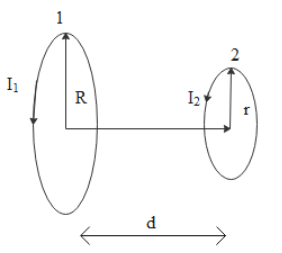
A circular loop of radius 0.3cm lies parallel to a much bigger circular loop of radius 20cm. The centre of the small loop is on the axis of the bigger loop. The distance between their centres is 15cm. If a current of 2.0A flows through the smaller loop, then the flux linked with bigger loop is
$\begin{align}
& (A)6\times {{10}^{-11}}Wb \\
& (B)3.3\times {{10}^{-11}}Wb \\
& (C)6.6\times {{10}^{-9}}Wb \\
& (D)9.1\times {{10}^{-11}}Wb \\
\end{align}$
Answer
 Verified
579.9k+ views
Hint: For calculating the magnetic flux first calculate the total magnetic field. Because magnetic flux is defined as the number of magnetic field lines passing through a given closed surface. Thus magnetic flux is the product of the magnetic field and its area. then by substituting the value of B and A we will get the magnetic flux.
Formula used:
Flux formula, $\Phi =BA$
here, B is the magnetic field and A is the area.
B = $\dfrac{{{\mu }_{_{0}}}I{{R}^{2}}}{2{{(R+x)}^{\dfrac{3}{2}}}}$ and $A=\pi {{r}^{2}}$
Complete Answer:
Circular loop radius, r =0.3cm =$3\times {{10}^{-3}}m$
Bigger circular loop radius, R=20cm=0.2m
Distance, x = 15cm=0.15m
Current flowing, I=2.0A
Here we have to find the flux. For this first we have to calculate B,
B = $\dfrac{{{\mu }_{_{0}}}I{{R}^{2}}}{2{{(R+x)}^{\dfrac{3}{2}}}}$=$\dfrac{4\pi \times {{10}^{-7}}\times 2\times {{0.2}^{2}}}{2{{({{0.2}^{2}}+{{0.15}^{2}})}^{\dfrac{3}{2}}}}=3.22\times {{10}^{-6}}$T
Then,
$\Phi =BA$ = $3.22\times {{10}^{-6}}$ $\times 3.14\times {{(3\times {{10}^{-3}})}^{2}}$ =9.1$\times {{10}^{-11}}Wb$
Thus the option (D) is correct.
Additional information:
Magnetic flux is defined because the amount of magnetic flux the world perpendicular to the magnetic flux’s direction. It’s measurement is taken in Teslas.
Note:
The foremost significant difference between magnetic flux and therefore the magnetic flux is that the magnetic flux is that the region round the magnet where the moving charge experiences a force. Whereas the magnetic flux the strength of the magnetic lines produced by the magnet.
Formula used:
Flux formula, $\Phi =BA$
here, B is the magnetic field and A is the area.
B = $\dfrac{{{\mu }_{_{0}}}I{{R}^{2}}}{2{{(R+x)}^{\dfrac{3}{2}}}}$ and $A=\pi {{r}^{2}}$
Complete Answer:
Circular loop radius, r =0.3cm =$3\times {{10}^{-3}}m$
Bigger circular loop radius, R=20cm=0.2m
Distance, x = 15cm=0.15m
Current flowing, I=2.0A
Here we have to find the flux. For this first we have to calculate B,
B = $\dfrac{{{\mu }_{_{0}}}I{{R}^{2}}}{2{{(R+x)}^{\dfrac{3}{2}}}}$=$\dfrac{4\pi \times {{10}^{-7}}\times 2\times {{0.2}^{2}}}{2{{({{0.2}^{2}}+{{0.15}^{2}})}^{\dfrac{3}{2}}}}=3.22\times {{10}^{-6}}$T
Then,
$\Phi =BA$ = $3.22\times {{10}^{-6}}$ $\times 3.14\times {{(3\times {{10}^{-3}})}^{2}}$ =9.1$\times {{10}^{-11}}Wb$
Thus the option (D) is correct.
Additional information:
Magnetic flux is defined because the amount of magnetic flux the world perpendicular to the magnetic flux’s direction. It’s measurement is taken in Teslas.
Note:
The foremost significant difference between magnetic flux and therefore the magnetic flux is that the magnetic flux is that the region round the magnet where the moving charge experiences a force. Whereas the magnetic flux the strength of the magnetic lines produced by the magnet.
Recently Updated Pages
Master Class 11 Computer Science: Engaging Questions & Answers for Success

Master Class 11 Business Studies: Engaging Questions & Answers for Success
Master Class 11 Economics: Engaging Questions & Answers for Success
Master Class 11 English: Engaging Questions & Answers for Success
Master Class 11 Maths: Engaging Questions & Answers for Success
Master Class 11 Biology: Engaging Questions & Answers for Success
Trending doubts
One Metric ton is equal to kg A 10000 B 1000 C 100 class 11 physics CBSE
There are 720 permutations of the digits 1 2 3 4 5 class 11 maths CBSE
Discuss the various forms of bacteria class 11 biology CBSE
Draw a diagram of a plant cell and label at least eight class 11 biology CBSE
State the laws of reflection of light
Explain zero factorial class 11 maths CBSE