




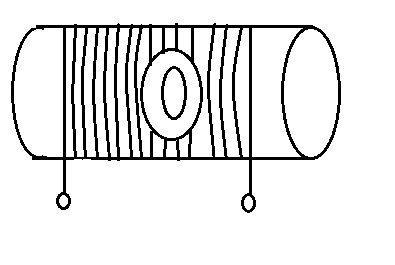
A circular coil with a cross-sectional area of $4c{{m}^{2}}$ has 10 turns. It is placed at the centre of a long solenoid that has 15 turns/cm and a cross-sectional area of $10c{{m}^{2}}$ , as shown in the figure. The axis of the coil coincides with the axis of the solenoid. What is their mutual inductance?
Answer
 Verified
617.4k+ views
Hint: When two coil circuits near each other and current in one of the coils are changing when EMF is induced in the neighbouring coin placed in a manner is called mutual induction. S.I. a unit of mutual induction is Henry denoted by H which is equal to volt second per ampere.
Complete step by step solution:
First, let’s understand what the question wants to understand.
We have a long solenoid on which a coil is wounded with 10 turns only and the coil cross-section area is $4c{{m}^{2}}$. This coil is placed at the centre of the solenoid. A number of turns of a solenoid are 15 per centimetre and the cross-sectional area is $10c{{m}^{2}}$.
Aim: What is mutual inductance between coil and solenoid.
Let, number of turns of coil ${{N}_{1}}=10$, area cross of a section of coil is ${{A}_{1}}=4c{{m}^{2}}=4\times {{10}^{-4}}{{m}^{2}}$
And the number of turns of a solenoid $in=15turns/cm=1500turns/m$, area of cross-section is $10c{{m}^{2}}=10\times {{10}^{-4}}{{m}^{2}};{{A}_{2}}={{10}^{-3}}$
We know that mutual induction is given by,
$\text{Mutual Induction(M)}={{\mu }_{0}}n{{N}_{1}}{{A}_{1}}\cos \alpha $
Where, \[~\propto =\text{angle between }\vec{B} and {{A}_{1}}\]
Therefore, $\text{Mutual Induction(M)}=4\pi \times {{10}^{-7}}\times 1500\times 10\times 4\times {{10}^{-4}}\times \cos 0$
$M=7.54\times {{10}^{-6}}H$
$M=7.54\mu H$
Mutual inductance is given by $M=7.54\mu H$.
Answer is option (A).
Note: Coefficient of mutual induction or mutual inductance of two coils is defined as the ratio of e.m.f. Induced in one coil to the rate of change of current in the other coil. Mutual induction (L) depends upon the shape and size of the coil, number of turns, separation between the coil and angular orientation between the coil and medium between two coins. Note that along with mutual induction, self-induction also takes place.
Complete step by step solution:
First, let’s understand what the question wants to understand.
We have a long solenoid on which a coil is wounded with 10 turns only and the coil cross-section area is $4c{{m}^{2}}$. This coil is placed at the centre of the solenoid. A number of turns of a solenoid are 15 per centimetre and the cross-sectional area is $10c{{m}^{2}}$.
Aim: What is mutual inductance between coil and solenoid.
Let, number of turns of coil ${{N}_{1}}=10$, area cross of a section of coil is ${{A}_{1}}=4c{{m}^{2}}=4\times {{10}^{-4}}{{m}^{2}}$
And the number of turns of a solenoid $in=15turns/cm=1500turns/m$, area of cross-section is $10c{{m}^{2}}=10\times {{10}^{-4}}{{m}^{2}};{{A}_{2}}={{10}^{-3}}$
We know that mutual induction is given by,
$\text{Mutual Induction(M)}={{\mu }_{0}}n{{N}_{1}}{{A}_{1}}\cos \alpha $
Where, \[~\propto =\text{angle between }\vec{B} and {{A}_{1}}\]
Therefore, $\text{Mutual Induction(M)}=4\pi \times {{10}^{-7}}\times 1500\times 10\times 4\times {{10}^{-4}}\times \cos 0$
$M=7.54\times {{10}^{-6}}H$
$M=7.54\mu H$
Mutual inductance is given by $M=7.54\mu H$.
Answer is option (A).
Note: Coefficient of mutual induction or mutual inductance of two coils is defined as the ratio of e.m.f. Induced in one coil to the rate of change of current in the other coil. Mutual induction (L) depends upon the shape and size of the coil, number of turns, separation between the coil and angular orientation between the coil and medium between two coins. Note that along with mutual induction, self-induction also takes place.
Recently Updated Pages
Master Class 11 Social Science: Engaging Questions & Answers for Success

Master Class 11 Physics: Engaging Questions & Answers for Success
Master Class 11 Maths: Engaging Questions & Answers for Success
Master Class 11 Economics: Engaging Questions & Answers for Success
Master Class 11 Computer Science: Engaging Questions & Answers for Success
Master Class 11 Chemistry: Engaging Questions & Answers for Success
Trending doubts
One Metric ton is equal to kg A 10000 B 1000 C 100 class 11 physics CBSE
There are 720 permutations of the digits 1 2 3 4 5 class 11 maths CBSE
1 Quintal is equal to a 110 kg b 10 kg c 100kg d 1000 class 11 physics CBSE
State and prove Bernoullis theorem class 11 physics CBSE
Difference Between Prokaryotic Cells and Eukaryotic Cells
Which among the following are examples of coming together class 11 social science CBSE