




A circuit containing a $20\Omega $ resistor and $0.1\mu F$ capacitor in series is connected to 230V AC supply of angular frequency $100rad{s^{ - 1}}$ The impedance of the circuit is
A. ${10^5}\Omega $
B. ${10^4}\Omega $
C. ${10^6}\Omega $
D. ${10^8}\Omega $
Answer
 Verified
596.4k+ views
Hint: In order to solve this question, we will use the concept of AC circuit analysis. We will begin with finding the reactance of the capacitor where reactance is equal to $\dfrac{1}{{\left( {\omega C} \right)}}$ and then we will substitute the reactance and resistance in the impedance formula and we will get our result.
Complete step-by-step answer:
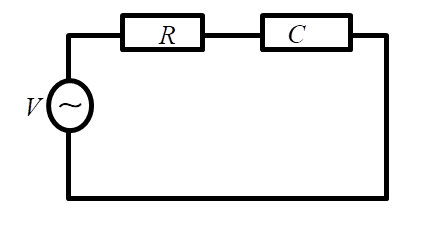
Formula used: for a series RC circuit, the impedance is given as
$Z = \sqrt {{R^2} + \dfrac{1}{{{{\left( {\omega C} \right)}^2}}}} $
R is the resistance
C is the capacitance
$\omega $ is the frequency in radian
Given data
Resistance R = $20\Omega $
Capacitance C =$0.1\mu F$
Voltage V = 230V
Frequency $\omega = 100rad{s^{ - 1}}$
The impedance of the RC circuit is given by
$Z = \sqrt {{R^2} + \dfrac{1}{{{{\left( {\omega C} \right)}^2}}}} $
Substituting the value of resistance, capacitance from the data given in the question
$
Z = \sqrt {{{20}^2} + \dfrac{1}{{{{\left( {100 \times 0.1 \times {{10}^{ - 6}}} \right)}^2}}}} \\
Z = \sqrt {400 + {{10}^{10}}} \\
Z \approx {10^5}\Omega \\
$
Hence, the correct option is A.
Additional Information:
Electrical impedance, measure of the total opposition provided to electric current by a circuit or a part of a circuit. Impedance covers resistance as well as reactance. The component of resistance arises from collisions between the current-carrying charged particles with the conductor's internal structure. The reactance component is an additional opposition to the electrical charge movement that arises from the changing magnetic and electrical fields in alternating current circuits.
Note: In an RC circuit, if the source is DC, the current then decreases from its initial value of I to zero as the voltage of the capacitor reaches the same value as the emf in case of transient period i.e. for a very short time in microseconds. As we know capacitors block the DC current, meaning the circuit will act as an open circuit.
Complete step-by-step answer:
Formula used: for a series RC circuit, the impedance is given as
$Z = \sqrt {{R^2} + \dfrac{1}{{{{\left( {\omega C} \right)}^2}}}} $
R is the resistance
C is the capacitance
$\omega $ is the frequency in radian
Given data
Resistance R = $20\Omega $
Capacitance C =$0.1\mu F$
Voltage V = 230V
Frequency $\omega = 100rad{s^{ - 1}}$
The impedance of the RC circuit is given by
$Z = \sqrt {{R^2} + \dfrac{1}{{{{\left( {\omega C} \right)}^2}}}} $
Substituting the value of resistance, capacitance from the data given in the question
$
Z = \sqrt {{{20}^2} + \dfrac{1}{{{{\left( {100 \times 0.1 \times {{10}^{ - 6}}} \right)}^2}}}} \\
Z = \sqrt {400 + {{10}^{10}}} \\
Z \approx {10^5}\Omega \\
$
Hence, the correct option is A.
Additional Information:
Electrical impedance, measure of the total opposition provided to electric current by a circuit or a part of a circuit. Impedance covers resistance as well as reactance. The component of resistance arises from collisions between the current-carrying charged particles with the conductor's internal structure. The reactance component is an additional opposition to the electrical charge movement that arises from the changing magnetic and electrical fields in alternating current circuits.
Note: In an RC circuit, if the source is DC, the current then decreases from its initial value of I to zero as the voltage of the capacitor reaches the same value as the emf in case of transient period i.e. for a very short time in microseconds. As we know capacitors block the DC current, meaning the circuit will act as an open circuit.
Recently Updated Pages
Master Class 12 Economics: Engaging Questions & Answers for Success

Master Class 12 Physics: Engaging Questions & Answers for Success
Master Class 12 English: Engaging Questions & Answers for Success
Master Class 12 Social Science: Engaging Questions & Answers for Success
Master Class 12 Maths: Engaging Questions & Answers for Success
Master Class 12 Business Studies: Engaging Questions & Answers for Success
Trending doubts
Which are the Top 10 Largest Countries of the World?
What are the major means of transport Explain each class 12 social science CBSE
Draw a labelled sketch of the human eye class 12 physics CBSE
Differentiate between insitu conservation and exsitu class 12 biology CBSE
Draw a neat and well labeled diagram of TS of ovary class 12 biology CBSE
Differentiate between homogeneous and heterogeneous class 12 chemistry CBSE