




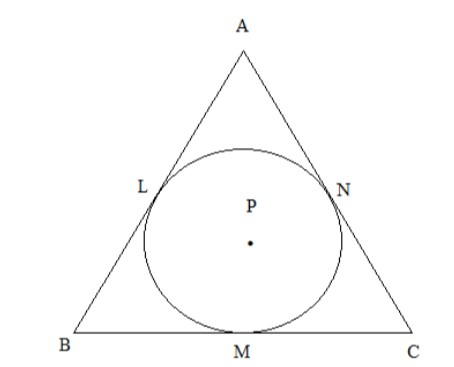
A circle with centre P is inscribed in the $\Delta {\rm{ABC}}$. Side AB, side BC and side AC
touch the circle at points L, M and N respectively. Radius of the circle is $r$
Prove that:${\rm{Area}}\;{\rm{of}}\;\Delta {\rm{ABC}}\;{\rm{ = }}\dfrac{1}{2} \times r\left( {{\rm{AB
+ BC + CA}}} \right)$
Answer
 Verified
584.7k+ views
Hint: In this problem it is given that a circle with centre P is inscribed in the $\Delta
{\rm{ABC}}$. Side AB, side BC and side AC touch the circle at points L, M and N respectively.
Radius of the circle is $r$. We have to prove that${\rm{Area}}\;{\rm{of}}\;\Delta {\rm{ABC}}\;{\rm{ = }}\dfrac{1}{2} \times r\left( {{\rm{AB
+ BC + CA}}} \right)$
. Firstly we draw the lines between PA, PB and
PC and use tangent radius theorem. Then we prove the problem.
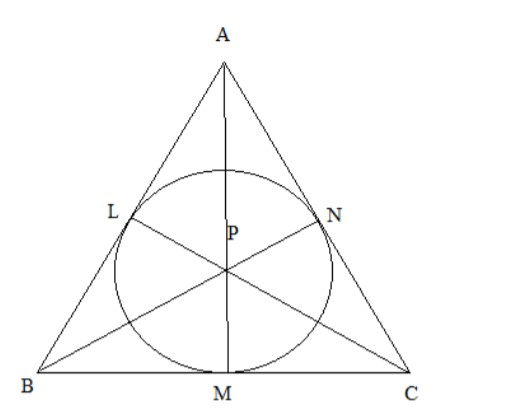
It is given that a circle with centre P is inscribed in the $\Delta {\rm{ABC}}$. Side AB, side BC
and side AC touch the circle at points L, M and N respectively. Radius of the circle is $r$.
We have to prove that ${\rm{Area}}\;{\rm{of}}\;\Delta {\rm{ABC}}\;{\rm{ = }}\dfrac{1}{2} \times r\left( {{\rm{AB
+ BC + CA}}} \right)$
Let,
Draw the lines between PA, PB and PC
AB is the tangent on the circle, touch the circle at the point L, and PL is the radius.
Now, we use the tangent radius theorem.
According to the tangent radius theorem we can easily say that ${\rm{PL}} \bot {\rm{AB}}$
Also, we can prove that ${\rm{PN}} \bot {\rm{AC}}$ and ${\rm{PM}} \bot {\rm{BC}}$.
It is known that the radius of the circle $r = {\rm{PL = PM = PN}}$.
And
$\Delta {\rm{APL,}}\Delta {\rm{APN,}}\Delta {\rm{BPL,}}\Delta {\rm{BPM,}}\Delta
{\rm{CPM}}$ and $\Delta {\rm{CPN}}$ are right angled triangles.
Thus,
Area of $\Delta {\rm{ABC}}\;{\rm{ = }}$ Area of $\Delta {\rm{APL}}$$ + $ Area of $\Delta
{\rm{APN}}$ $ + $ Area of $\Delta {\rm{BPL}}$$ + $ Area of $\Delta {\rm{BPM}}$$ + $
Area of$\Delta {\rm{CPM}}$ $ + $ Area of $\Delta {\rm{CPN}}$
$\begin{array}{l} = \dfrac{1}{2} \times {\rm{PL}} \times {\rm{AL + }}\dfrac{1}{2} \times
{\rm{PN}} \times {\rm{AN + }}\dfrac{1}{2} \times {\rm{PL}} \times {\rm{BL +
}}\dfrac{1}{2} \times {\rm{PM}} \times {\rm{BM + }}\dfrac{1}{2} \times {\rm{PM}} \times
{\rm{CM + }}\dfrac{1}{2} \times {\rm{PN}} \times {\rm{CN}}\\\end{array}$
Substitute $r = {\rm{PL = PM = PN}}$.in the above equation.
${\rm{Area}}\;{\rm{of}}\;\Delta {\rm{ABC}}\;{\rm{ = }}\dfrac{1}{2} \times r\left( {{\rm{AL
+ AN + BL + BM + CM + CN}}} \right)$
Simplify further.
${\rm{Area}}\;{\rm{of}}\;\Delta {\rm{ABC}}\;{\rm{ = }}\dfrac{1}{2} \times r\left( {{\rm{AL
+ AN + BL + BM + CM + CN}}} \right)$
${\rm{Area}}\;{\rm{of}}\;\Delta {\rm{ABC}}\;{\rm{ = }}\dfrac{1}{2} \times r\left( {{\rm{AL
+ BL + BM + CM + CN + AN}}} \right)$
From the figure ${\rm{AB = AL + BL,}}\;{\rm{BC = BM + CM,}}\;{\rm{AC = AN + CN}}$
Substitute ${\rm{AB = AL + BL,}}\;{\rm{BC = BM + CM,}}\;{\rm{AC = AN + CN}}$ in the
above equation.
${\rm{Area}}\;{\rm{of}}\;\Delta {\rm{ABC}}\;{\rm{ = }}\dfrac{1}{2} \times r\left( {{\rm{AB
+ BC + CA}}} \right)$
Hence proved.
Note: Here it is given $\Delta {\rm{ABC}}$ is a triangle with centre is ${\rm{P}}$ and side
AB, side BC and side AC touch the circle at points L, M and N respectively.We apply tangent
radius theory and formula of area triangle. Then simplify the result and we get the answer.
{\rm{ABC}}$. Side AB, side BC and side AC touch the circle at points L, M and N respectively.
Radius of the circle is $r$. We have to prove that${\rm{Area}}\;{\rm{of}}\;\Delta {\rm{ABC}}\;{\rm{ = }}\dfrac{1}{2} \times r\left( {{\rm{AB
+ BC + CA}}} \right)$
. Firstly we draw the lines between PA, PB and
PC and use tangent radius theorem. Then we prove the problem.
It is given that a circle with centre P is inscribed in the $\Delta {\rm{ABC}}$. Side AB, side BC
and side AC touch the circle at points L, M and N respectively. Radius of the circle is $r$.
We have to prove that ${\rm{Area}}\;{\rm{of}}\;\Delta {\rm{ABC}}\;{\rm{ = }}\dfrac{1}{2} \times r\left( {{\rm{AB
+ BC + CA}}} \right)$
Let,
Draw the lines between PA, PB and PC
AB is the tangent on the circle, touch the circle at the point L, and PL is the radius.
Now, we use the tangent radius theorem.
According to the tangent radius theorem we can easily say that ${\rm{PL}} \bot {\rm{AB}}$
Also, we can prove that ${\rm{PN}} \bot {\rm{AC}}$ and ${\rm{PM}} \bot {\rm{BC}}$.
It is known that the radius of the circle $r = {\rm{PL = PM = PN}}$.
And
$\Delta {\rm{APL,}}\Delta {\rm{APN,}}\Delta {\rm{BPL,}}\Delta {\rm{BPM,}}\Delta
{\rm{CPM}}$ and $\Delta {\rm{CPN}}$ are right angled triangles.
Thus,
Area of $\Delta {\rm{ABC}}\;{\rm{ = }}$ Area of $\Delta {\rm{APL}}$$ + $ Area of $\Delta
{\rm{APN}}$ $ + $ Area of $\Delta {\rm{BPL}}$$ + $ Area of $\Delta {\rm{BPM}}$$ + $
Area of$\Delta {\rm{CPM}}$ $ + $ Area of $\Delta {\rm{CPN}}$
$\begin{array}{l} = \dfrac{1}{2} \times {\rm{PL}} \times {\rm{AL + }}\dfrac{1}{2} \times
{\rm{PN}} \times {\rm{AN + }}\dfrac{1}{2} \times {\rm{PL}} \times {\rm{BL +
}}\dfrac{1}{2} \times {\rm{PM}} \times {\rm{BM + }}\dfrac{1}{2} \times {\rm{PM}} \times
{\rm{CM + }}\dfrac{1}{2} \times {\rm{PN}} \times {\rm{CN}}\\\end{array}$
Substitute $r = {\rm{PL = PM = PN}}$.in the above equation.
${\rm{Area}}\;{\rm{of}}\;\Delta {\rm{ABC}}\;{\rm{ = }}\dfrac{1}{2} \times r\left( {{\rm{AL
+ AN + BL + BM + CM + CN}}} \right)$
Simplify further.
${\rm{Area}}\;{\rm{of}}\;\Delta {\rm{ABC}}\;{\rm{ = }}\dfrac{1}{2} \times r\left( {{\rm{AL
+ AN + BL + BM + CM + CN}}} \right)$
${\rm{Area}}\;{\rm{of}}\;\Delta {\rm{ABC}}\;{\rm{ = }}\dfrac{1}{2} \times r\left( {{\rm{AL
+ BL + BM + CM + CN + AN}}} \right)$
From the figure ${\rm{AB = AL + BL,}}\;{\rm{BC = BM + CM,}}\;{\rm{AC = AN + CN}}$
Substitute ${\rm{AB = AL + BL,}}\;{\rm{BC = BM + CM,}}\;{\rm{AC = AN + CN}}$ in the
above equation.
${\rm{Area}}\;{\rm{of}}\;\Delta {\rm{ABC}}\;{\rm{ = }}\dfrac{1}{2} \times r\left( {{\rm{AB
+ BC + CA}}} \right)$
Hence proved.
Note: Here it is given $\Delta {\rm{ABC}}$ is a triangle with centre is ${\rm{P}}$ and side
AB, side BC and side AC touch the circle at points L, M and N respectively.We apply tangent
radius theory and formula of area triangle. Then simplify the result and we get the answer.
Recently Updated Pages
Master Class 10 Computer Science: Engaging Questions & Answers for Success

Master Class 10 General Knowledge: Engaging Questions & Answers for Success
Master Class 10 English: Engaging Questions & Answers for Success
Master Class 10 Social Science: Engaging Questions & Answers for Success
Master Class 10 Maths: Engaging Questions & Answers for Success
Master Class 10 Science: Engaging Questions & Answers for Success
Trending doubts
What is the median of the first 10 natural numbers class 10 maths CBSE
Which women's tennis player has 24 Grand Slam singles titles?
Who is the Brand Ambassador of Incredible India?
Why is there a time difference of about 5 hours between class 10 social science CBSE
Write a letter to the principal requesting him to grant class 10 english CBSE
A moving boat is observed from the top of a 150 m high class 10 maths CBSE