




A circle with centre $\left( 3,4 \right)$ passes through the origin.\[\]
a. What is the radius of the circle?\[\]
b. If a point in the circle is $\left( x,y \right)$ write the relation between $x,y$ ?\[\]
c. Check whether the point $\left( -2,1 \right)$ lie on this circle.\[\]
Answer
 Verified
603.3k+ views
Hint: We put the origin $\left( 0,0 \right)$ and the centre $\left( 3,4 \right)$ in the general equation of circle ${{\left( x-a \right)}^{2}}+{{\left( y-b \right)}^{2}}={{r}^{2}}$. We put only the centre $\left( 3,4 \right)$ to get the relation between $x,y$. We put $\left( -2,1 \right)$ in the relation to check whether $\left( -2,1 \right)$ lie on the circle or not. \[\]
Complete step-by-step solution:
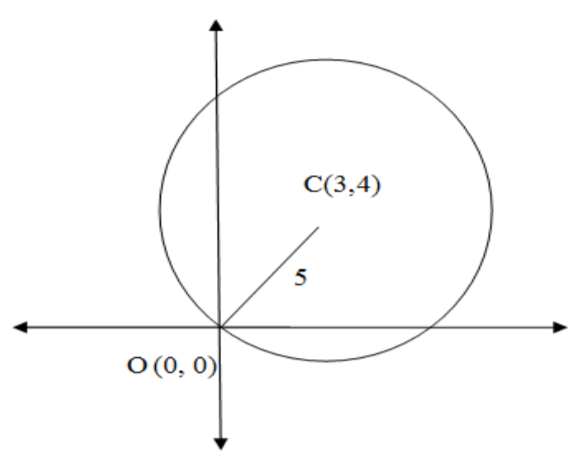
We know that the general equation of circle with centre $\left( a,b \right)$ and radius $r$ is given by
\[{{\left( x-a \right)}^{2}}+{{\left( y-b \right)}^{2}}={{r}^{2}}\]
a) We are given that the centre of the circle is $\left( a,b \right)=\left( 3,4 \right)$ and also the circle passé though the origin whose co-ordinate is $\left( 0,0 \right)$. We put the centre $\left( 3,4 \right)$ and the origin $\left( 0,0 \right)=\left( x,y \right)$ and get,
\[\begin{align}
& {{\left( 0-3 \right)}^{2}}+{{\left( 0-4 \right)}^{2}}={{r}^{2}} \\
& \Rightarrow {{r}^{2}}={{3}^{2}}+{{4}^{2}}=25 \\
& \Rightarrow r=\pm \sqrt{25}=\pm 5 \\
\end{align}\]
So we reject the negative value because distance is positive and conclude the radius as 5 units.\[\]
b)We are given that the circle passes through the point $\left( x,y \right)$ . So we put the point in the equation of circle $\left( x,y \right)=\left( x,y \right)$ , the centre $\left( 3,4 \right)$ and radius $r=5$ from the part(a) . We get ,
\[\begin{align}
& {{\left( x-3 \right)}^{2}}+{{\left( y-4 \right)}^{2}}={{5}^{2}} \\
& \Rightarrow {{x}^{2}}-6x+9+{{y}^{2}}-8y+16=25 \\
& \Rightarrow {{x}^{2}}+{{y}^{2}}-6x-8y=0 \\
\end{align}\]
c) We are asked to check whether the point $\left( -2,1 \right)$ lie on the circle or not . We have obtained in the part(b) the general equation of the given circle centred at $\left( 3,4 \right)$ and passing through the origin as
\[{{x}^{2}}+{{y}^{2}}-6x-8y=0\]
Let us put the point in the left hand side of the equation and check whether it satisfies or not. If it satisfies it lies on the circle otherwise it does not.
\[{{\left( -2 \right)}^{2}}+{{\left( 1 \right)}^{2}}-6\left( -2 \right)-8\left( 1 \right)=17-8=9\ne 0\]
So $\left( -2,1 \right)$ does not lie on the circle. \[\]
Note: The general equation of circle we used is in centre-radius from. The general equation is given by $C\left( x,y \right)={{x}^{2}}+{{y}^{2}}+2gx+2fy+c=0$ which is a special case of quadratic equation in two variables. A point will lie inside if $C\left( x,y \right)<0$, outside if $C\left( x,y \right)>0$ and on the circle if $C\left( x,y \right)=0$.
Complete step-by-step solution:
We know that the general equation of circle with centre $\left( a,b \right)$ and radius $r$ is given by
\[{{\left( x-a \right)}^{2}}+{{\left( y-b \right)}^{2}}={{r}^{2}}\]
a) We are given that the centre of the circle is $\left( a,b \right)=\left( 3,4 \right)$ and also the circle passé though the origin whose co-ordinate is $\left( 0,0 \right)$. We put the centre $\left( 3,4 \right)$ and the origin $\left( 0,0 \right)=\left( x,y \right)$ and get,
\[\begin{align}
& {{\left( 0-3 \right)}^{2}}+{{\left( 0-4 \right)}^{2}}={{r}^{2}} \\
& \Rightarrow {{r}^{2}}={{3}^{2}}+{{4}^{2}}=25 \\
& \Rightarrow r=\pm \sqrt{25}=\pm 5 \\
\end{align}\]
So we reject the negative value because distance is positive and conclude the radius as 5 units.\[\]
b)We are given that the circle passes through the point $\left( x,y \right)$ . So we put the point in the equation of circle $\left( x,y \right)=\left( x,y \right)$ , the centre $\left( 3,4 \right)$ and radius $r=5$ from the part(a) . We get ,
\[\begin{align}
& {{\left( x-3 \right)}^{2}}+{{\left( y-4 \right)}^{2}}={{5}^{2}} \\
& \Rightarrow {{x}^{2}}-6x+9+{{y}^{2}}-8y+16=25 \\
& \Rightarrow {{x}^{2}}+{{y}^{2}}-6x-8y=0 \\
\end{align}\]
c) We are asked to check whether the point $\left( -2,1 \right)$ lie on the circle or not . We have obtained in the part(b) the general equation of the given circle centred at $\left( 3,4 \right)$ and passing through the origin as
\[{{x}^{2}}+{{y}^{2}}-6x-8y=0\]
Let us put the point in the left hand side of the equation and check whether it satisfies or not. If it satisfies it lies on the circle otherwise it does not.
\[{{\left( -2 \right)}^{2}}+{{\left( 1 \right)}^{2}}-6\left( -2 \right)-8\left( 1 \right)=17-8=9\ne 0\]
So $\left( -2,1 \right)$ does not lie on the circle. \[\]
Note: The general equation of circle we used is in centre-radius from. The general equation is given by $C\left( x,y \right)={{x}^{2}}+{{y}^{2}}+2gx+2fy+c=0$ which is a special case of quadratic equation in two variables. A point will lie inside if $C\left( x,y \right)<0$, outside if $C\left( x,y \right)>0$ and on the circle if $C\left( x,y \right)=0$.
Recently Updated Pages
Master Class 10 Social Science: Engaging Questions & Answers for Success

Master Class 10 Science: Engaging Questions & Answers for Success
Master Class 10 Maths: Engaging Questions & Answers for Success
Master Class 10 General Knowledge: Engaging Questions & Answers for Success
Master Class 10 Computer Science: Engaging Questions & Answers for Success
Class 10 Question and Answer - Your Ultimate Solutions Guide
Trending doubts
What is the full form of PNG A Petrol Natural Gas B class 10 chemistry CBSE
Explain the Treaty of Vienna of 1815 class 10 social science CBSE
Why is there a time difference of about 5 hours between class 10 social science CBSE
What is the median of the first 10 natural numbers class 10 maths CBSE
The power of the lens is 2D What is its focal length class 10 physics CBSE
Who Won 36 Oscar Awards? Record Holder Revealed