




A circle touches the y-axis at $ \left( 0,2 \right) $ and has an intercept of 4 units on the positive side of the x-axis. Then find the equation of the circle.
A. \[{{x}^{2}}+{{y}^{2}}-4\left( \sqrt{2}x+y \right)+4=0\]
B. \[{{x}^{2}}+{{y}^{2}}-4\left( x+\sqrt{2}y \right)+4=0\]
C. \[{{x}^{2}}+{{y}^{2}}-2\left( \sqrt{2}x+y \right)+4=0\]
D. none of these
Answer
 Verified
624.6k+ views
Hint:
We first create the general equation of a circle. We use the point on the Y-axis to put on the equation and then use the radius value to find the distance of the centre $ \left( -g,-f \right) $ to the line $ x=0 $ and also the intercept form to find three equations. We solve those equations to find the value of $ g,f,c $ to get the equation of the circle.
Complete step by step answer:
Let’s assume the equation of the circle as $ {{x}^{2}}+{{y}^{2}}+2gx+2fy+c=0 $ . The circle touches the y-axis at $ \left( 0,2 \right) $ which means the point is on the circle. We place the point in the equation and get
$ \begin{align}
& {{\left( 2 \right)}^{2}}+2f\left( 2 \right)+c=0 \\
& \Rightarrow 4f+c+4=0 \\
\end{align} $
We know that for a general equation of circle $ {{x}^{2}}+{{y}^{2}}+2gx+2fy+c=0 $ , the intercept on X-axis is given by $ 2\sqrt{{{g}^{2}}-c} $ which is equal to 4 as the circle has an intercept of 4 units on the positive side of the x-axis. We get
$ \begin{align}
& 2\sqrt{{{g}^{2}}-c}=4 \\
& \Rightarrow {{g}^{2}}-c=4 \\
\end{align} $
The circle touches the y-axis at $ \left( 0,2 \right) $ which means the Y-axis with equation $ x=0 $ is a tangent of the circle. This means the radius of the circle is equal to the distance of the centre $ \left( -g,-f \right) $ to the line $ x=0 $ .
The formula for the general equation also gives the same statement of $ {{f}^{2}}=c $ .
Therefore, we got 3 equations for 3 unknowns which are $ 4f+c+4=0,{{g}^{2}}-c=4,{{f}^{2}}=c $ .
We solve them to get $ {{f}^{2}}+4f+4=0 $ . Solving the equation, we get $ f=-2 $ .
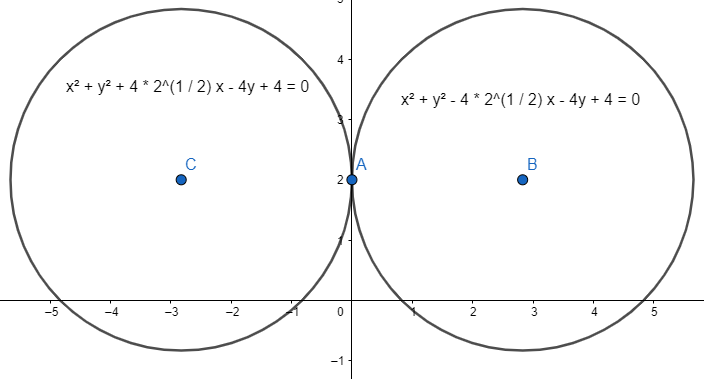
Placing the value, we get $ {{f}^{2}}=c=4 $ and $ {{g}^{2}}=c+4=4+4=8 $ which gives $ g=\pm 2\sqrt{2} $ .
Placing the values, we get the equation of the circles as $ {{x}^{2}}+{{y}^{2}}\pm 4\sqrt{2}x-4y+4=0 $ .
To match the given options, we get the equation as \[{{x}^{2}}+{{y}^{2}}-4\left( \pm \sqrt{2}x+y \right)+4=0\].
The correct option is A.
Note:
We have to remember the equations and the formulas are derived form. We can directly use them to find relations. To match with given options, we eliminated the equation \[{{x}^{2}}+{{y}^{2}}-4\left( -\sqrt{2}x+y \right)+4=0\]. But that equation is also correct as a solution of the problem.
We first create the general equation of a circle. We use the point on the Y-axis to put on the equation and then use the radius value to find the distance of the centre $ \left( -g,-f \right) $ to the line $ x=0 $ and also the intercept form to find three equations. We solve those equations to find the value of $ g,f,c $ to get the equation of the circle.
Complete step by step answer:
Let’s assume the equation of the circle as $ {{x}^{2}}+{{y}^{2}}+2gx+2fy+c=0 $ . The circle touches the y-axis at $ \left( 0,2 \right) $ which means the point is on the circle. We place the point in the equation and get
$ \begin{align}
& {{\left( 2 \right)}^{2}}+2f\left( 2 \right)+c=0 \\
& \Rightarrow 4f+c+4=0 \\
\end{align} $
We know that for a general equation of circle $ {{x}^{2}}+{{y}^{2}}+2gx+2fy+c=0 $ , the intercept on X-axis is given by $ 2\sqrt{{{g}^{2}}-c} $ which is equal to 4 as the circle has an intercept of 4 units on the positive side of the x-axis. We get
$ \begin{align}
& 2\sqrt{{{g}^{2}}-c}=4 \\
& \Rightarrow {{g}^{2}}-c=4 \\
\end{align} $
The circle touches the y-axis at $ \left( 0,2 \right) $ which means the Y-axis with equation $ x=0 $ is a tangent of the circle. This means the radius of the circle is equal to the distance of the centre $ \left( -g,-f \right) $ to the line $ x=0 $ .
The formula for the general equation also gives the same statement of $ {{f}^{2}}=c $ .
Therefore, we got 3 equations for 3 unknowns which are $ 4f+c+4=0,{{g}^{2}}-c=4,{{f}^{2}}=c $ .
We solve them to get $ {{f}^{2}}+4f+4=0 $ . Solving the equation, we get $ f=-2 $ .
Placing the value, we get $ {{f}^{2}}=c=4 $ and $ {{g}^{2}}=c+4=4+4=8 $ which gives $ g=\pm 2\sqrt{2} $ .
Placing the values, we get the equation of the circles as $ {{x}^{2}}+{{y}^{2}}\pm 4\sqrt{2}x-4y+4=0 $ .
To match the given options, we get the equation as \[{{x}^{2}}+{{y}^{2}}-4\left( \pm \sqrt{2}x+y \right)+4=0\].
The correct option is A.
Note:
We have to remember the equations and the formulas are derived form. We can directly use them to find relations. To match with given options, we eliminated the equation \[{{x}^{2}}+{{y}^{2}}-4\left( -\sqrt{2}x+y \right)+4=0\]. But that equation is also correct as a solution of the problem.
Recently Updated Pages
Class 10 Question and Answer - Your Ultimate Solutions Guide

Master Class 10 Computer Science: Engaging Questions & Answers for Success
Master Class 10 General Knowledge: Engaging Questions & Answers for Success
Master Class 12 Economics: Engaging Questions & Answers for Success
Master Class 12 Social Science: Engaging Questions & Answers for Success
Master Class 12 English: Engaging Questions & Answers for Success
Trending doubts
Explain the Treaty of Vienna of 1815 class 10 social science CBSE
The slogan Jai Hind was given by A Lal Bahadur Shastri class 10 social science CBSE
10 examples of evaporation in daily life with explanations
What is the full form of POSCO class 10 social science CBSE
Identify the feminine form of noun nephew a shenephew class 10 english CBSE
CSIR full form?