




A circle is touching the side BC of the triangle ABC at P and touching AB and AC produced at Q and R, respectively. Prove that $AQ=AR=\dfrac{1}{2}\left( \text{Perimeter of }\Delta ABC \right)$ .
Answer
 Verified
554.6k+ views
Hint: Start by drawing a neat diagram followed by using the theorem that the tangents to a circle from a given point outside the circle are equal. Remember that the perimeter of the triangle is equal to the sum of the three sides of the triangle.
Complete step-by-step solution -
First, we will draw a neat diagram of the situation given in the question.
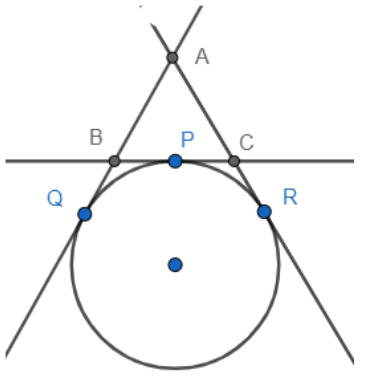
We know that the tangents drawn from a given point to the circle are equal. And it is clear from the figure that AQ and AR are tangents drawn from point A, BP, and BQ are tangents from point B, and CP and CR are tangents from point C.
$\therefore AQ=AR.............(i)$
$\therefore BP=BQ...........(ii)$
$\therefore CR=CP...........(iii)$
Now we know that the perimeter of the triangle is equal to the sum of the three sides of the triangle.
$\therefore \text{Perimeter of }\Delta ABC=AB+BC+CA$
Using the diagram, we can deduce that BC=BP+PC and CA=AR-CR. So, our equation becomes:
$\text{Perimeter of }\Delta ABC=AB+BP+PC+AR-CR$
Now, If we substitute the required values from equation (i), (ii) and (iii), we get
$\text{Perimeter of }\Delta ABC=AB+BQ+PC+AQ-PC$
Again, using the figure, we can say that AB+BQ=AQ.
$\text{Perimeter of }\Delta ABC=AQ+AQ$
$\Rightarrow \text{Perimeter of }\Delta ABC=2AQ$
$\Rightarrow \dfrac{1}{2}\times \text{Perimeter of }\Delta ABC=AQ$
So, using equation (i) and the above result, we can say that we have proved $AQ=AR=\dfrac{1}{2}\left( \text{Perimeter of }\Delta ABC \right)$ .
Note: The circle shown in the diagram of the question is also called the excircle and the center of the excircle is the point of intersection of the interior angle bisector of the opposite angle and the exterior angle bisectors of the other two angles of the triangle.
Complete step-by-step solution -
First, we will draw a neat diagram of the situation given in the question.
We know that the tangents drawn from a given point to the circle are equal. And it is clear from the figure that AQ and AR are tangents drawn from point A, BP, and BQ are tangents from point B, and CP and CR are tangents from point C.
$\therefore AQ=AR.............(i)$
$\therefore BP=BQ...........(ii)$
$\therefore CR=CP...........(iii)$
Now we know that the perimeter of the triangle is equal to the sum of the three sides of the triangle.
$\therefore \text{Perimeter of }\Delta ABC=AB+BC+CA$
Using the diagram, we can deduce that BC=BP+PC and CA=AR-CR. So, our equation becomes:
$\text{Perimeter of }\Delta ABC=AB+BP+PC+AR-CR$
Now, If we substitute the required values from equation (i), (ii) and (iii), we get
$\text{Perimeter of }\Delta ABC=AB+BQ+PC+AQ-PC$
Again, using the figure, we can say that AB+BQ=AQ.
$\text{Perimeter of }\Delta ABC=AQ+AQ$
$\Rightarrow \text{Perimeter of }\Delta ABC=2AQ$
$\Rightarrow \dfrac{1}{2}\times \text{Perimeter of }\Delta ABC=AQ$
So, using equation (i) and the above result, we can say that we have proved $AQ=AR=\dfrac{1}{2}\left( \text{Perimeter of }\Delta ABC \right)$ .
Note: The circle shown in the diagram of the question is also called the excircle and the center of the excircle is the point of intersection of the interior angle bisector of the opposite angle and the exterior angle bisectors of the other two angles of the triangle.
Recently Updated Pages
Master Class 12 Business Studies: Engaging Questions & Answers for Success

Master Class 12 Biology: Engaging Questions & Answers for Success
Master Class 12 Chemistry: Engaging Questions & Answers for Success
Class 12 Question and Answer - Your Ultimate Solutions Guide
Master Class 11 Social Science: Engaging Questions & Answers for Success
Master Class 11 English: Engaging Questions & Answers for Success
Trending doubts
Explain the Treaty of Vienna of 1815 class 10 social science CBSE
Which Indian city is known as the "City of Victory"?
Which instrument is used to measure the Blood Pressure?
Who Won 36 Oscar Awards? Record Holder Revealed
What is the median of the first 10 natural numbers class 10 maths CBSE
Why is it 530 pm in india when it is 1200 afternoon class 10 social science CBSE