



A circle is inscribed in an equilateral triangle of side a. The area of any square inscribed in a circle is:
A) $ \dfrac{{{a^2}}}{4} $
B) $ \dfrac{{{a^2}}}{6} $
C) $ \dfrac{{{a^2}}}{9} $
D) $ \dfrac{{2{a^2}}}{3} $
Answer
 Verified
621.6k+ views
Hint: Draw the diagram according to the question: A circle inside a triangle and a square inside this circle. Then by applying geometry, the side of the square can be found and then its area can be calculated.
Important things to remember:
Area of a square = $ {\left( {side} \right)^2} $
All sides of an equilateral triangle are equal and angles are of measure 60 degrees
$ \tan \theta = \dfrac{P}{B} $
$ \sin \theta = \dfrac{P}{H} $ where,
P = Perpendicular
B = Base
H = Hypotenuse
Complete step-by-step answer:
A circle inscribed in a triangle of side ‘a’ and a square inscribed inside that circle is given as:
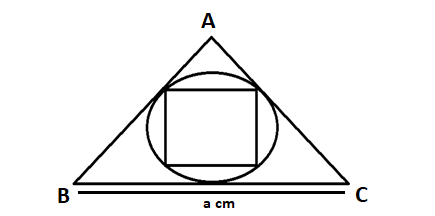
Now, to calculate the area of this square, say PQRS, we need to draw the medians of the triangle.
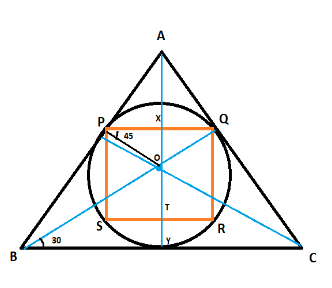
In $ \vartriangle OBY $ :
$ \angle OBY $ = 30°
(Since $ \angle ABY $ = 60°; angle of an equilateral triangle.
$ \angle OBY $ = $ \dfrac{1}{2}\angle ABY $ ; median bisects the angle, so
$ \angle OBY $ = $ \dfrac{1}{2} \times 60 $ = 30° )
BY = $ \dfrac{a}{2} $ (since the median divides BC into half)
Calculating the value of $ \tan \theta $ for this triangle:
$ \tan \theta = \dfrac{P}{B} $ here,
Perpendicular (P) = OY
Base (B) = BY
Substituting:
$
\tan \theta = \dfrac{{OY}}{{BY}} \\
\tan {30^o} = \dfrac{{OY}}{{\dfrac{a}{2}}}\left( {\because \theta = \angle OBC = {{30}^o}} \right) \\
\dfrac{1}{{\sqrt 3 }} = \dfrac{{OY}}{{\dfrac{a}{2}}} \\
\Rightarrow OY = \dfrac{a}{{2\sqrt 3 }} \\
$
Now, OX = OY; radius of the circle:
The side of the square is PQ
$ \angle POQ $ = 45° (As the complete is 90°)
Calculating the value of $ \sin \theta $ for $ \vartriangle POQ $ :
$ \sin \theta = \dfrac{P}{H} $ here,
Perpendicular (P) = PX
Hypotenuse (H) = OX = OY
Substituting:
\[
\Rightarrow \sin \theta = \dfrac{{PX}}{{OY}} \\
\Rightarrow \sin {45^o} = \dfrac{{PX}}{{OY}}\left( {\because \theta = \angle POQ = 45} \right) \\
PX = OY\sin {45^o} \\
\]
Side of square = PQ
PQ = 2 PX (bisected by median)
$ \Rightarrow $ PQ = 2 OY sin 45°
Substituting the value of OY, we get:
$
\Rightarrow PQ = 2OY\sin {45^o} \\
\Rightarrow PQ = 2 \times \dfrac{a}{{2\sqrt 3 \times \sqrt 2 }} \\
\Rightarrow PQ = \dfrac{a}{{\sqrt 6 }} \\
$
This side of the square is $ \dfrac{a}{{\sqrt 6 }} $
Area of the square is given by squaring the side:
$\Rightarrow$ Area = $ {\left( {PQ} \right)^2} $
$\Rightarrow$ Area = $ {\left( {\dfrac{a}{{\sqrt 6 }}} \right)^2} $
$\Rightarrow$ Area = $ \dfrac{{{a^2}}}{6} $
Therefore, the required area of the inscribed square is $ \dfrac{{{a^2}}}{6} $ , thus option (B) is correct
So, the correct answer is “Option B”.
Note: All the median from vertices bisect the angles as well as the edge at which they form an intercept (touch).
The point O where medians from all the vertices meet is called its centroid.
Be careful while performing geometrical calculations
For an angle remember, the edge opposite to it will be its perpendicular.
Important things to remember:
Area of a square = $ {\left( {side} \right)^2} $
All sides of an equilateral triangle are equal and angles are of measure 60 degrees
$ \tan \theta = \dfrac{P}{B} $
$ \sin \theta = \dfrac{P}{H} $ where,
P = Perpendicular
B = Base
H = Hypotenuse
Complete step-by-step answer:
A circle inscribed in a triangle of side ‘a’ and a square inscribed inside that circle is given as:
Now, to calculate the area of this square, say PQRS, we need to draw the medians of the triangle.
In $ \vartriangle OBY $ :
$ \angle OBY $ = 30°
(Since $ \angle ABY $ = 60°; angle of an equilateral triangle.
$ \angle OBY $ = $ \dfrac{1}{2}\angle ABY $ ; median bisects the angle, so
$ \angle OBY $ = $ \dfrac{1}{2} \times 60 $ = 30° )
BY = $ \dfrac{a}{2} $ (since the median divides BC into half)
Calculating the value of $ \tan \theta $ for this triangle:
$ \tan \theta = \dfrac{P}{B} $ here,
Perpendicular (P) = OY
Base (B) = BY
Substituting:
$
\tan \theta = \dfrac{{OY}}{{BY}} \\
\tan {30^o} = \dfrac{{OY}}{{\dfrac{a}{2}}}\left( {\because \theta = \angle OBC = {{30}^o}} \right) \\
\dfrac{1}{{\sqrt 3 }} = \dfrac{{OY}}{{\dfrac{a}{2}}} \\
\Rightarrow OY = \dfrac{a}{{2\sqrt 3 }} \\
$
Now, OX = OY; radius of the circle:
The side of the square is PQ
$ \angle POQ $ = 45° (As the complete is 90°)
Calculating the value of $ \sin \theta $ for $ \vartriangle POQ $ :
$ \sin \theta = \dfrac{P}{H} $ here,
Perpendicular (P) = PX
Hypotenuse (H) = OX = OY
Substituting:
\[
\Rightarrow \sin \theta = \dfrac{{PX}}{{OY}} \\
\Rightarrow \sin {45^o} = \dfrac{{PX}}{{OY}}\left( {\because \theta = \angle POQ = 45} \right) \\
PX = OY\sin {45^o} \\
\]
Side of square = PQ
PQ = 2 PX (bisected by median)
$ \Rightarrow $ PQ = 2 OY sin 45°
Substituting the value of OY, we get:
$
\Rightarrow PQ = 2OY\sin {45^o} \\
\Rightarrow PQ = 2 \times \dfrac{a}{{2\sqrt 3 \times \sqrt 2 }} \\
\Rightarrow PQ = \dfrac{a}{{\sqrt 6 }} \\
$
This side of the square is $ \dfrac{a}{{\sqrt 6 }} $
Area of the square is given by squaring the side:
$\Rightarrow$ Area = $ {\left( {PQ} \right)^2} $
$\Rightarrow$ Area = $ {\left( {\dfrac{a}{{\sqrt 6 }}} \right)^2} $
$\Rightarrow$ Area = $ \dfrac{{{a^2}}}{6} $
Therefore, the required area of the inscribed square is $ \dfrac{{{a^2}}}{6} $ , thus option (B) is correct
So, the correct answer is “Option B”.
Note: All the median from vertices bisect the angles as well as the edge at which they form an intercept (touch).
The point O where medians from all the vertices meet is called its centroid.
Be careful while performing geometrical calculations
For an angle remember, the edge opposite to it will be its perpendicular.
Recently Updated Pages
Master Class 11 English: Engaging Questions & Answers for Success

Master Class 11 Social Science: Engaging Questions & Answers for Success
Master Class 11 Maths: Engaging Questions & Answers for Success
Master Class 11 Biology: Engaging Questions & Answers for Success
Master Class 11 Physics: Engaging Questions & Answers for Success
Master Class 11 Chemistry: Engaging Questions & Answers for Success
Trending doubts