




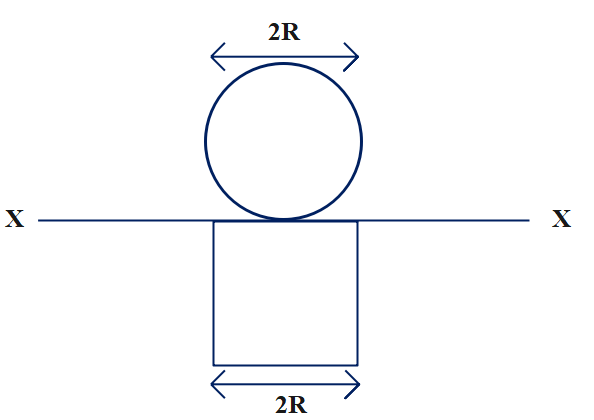
A circle and a square (wire frame) each of mass $m$ are arranged as shown in the diagram. The diameter of the circle and the edge of the square are $2\;R$ each. Find the moment of inertia of this configuration about XX.
$\begin{align}
& A.\dfrac{17m{{R}^{2}}}{6} \\
& B.\dfrac{11m{{R}^{2}}}{6} \\
& C.\dfrac{19m{{R}^{2}}}{6} \\
& D.\dfrac{13m{{R}^{2}}}{6} \\
\end{align}$
Answer
 Verified
550.8k+ views
Hint:Moment of inertia is the property of a body to resist any angular acceleration. It is mathematically given as the sum of the product of the masses of every particle with the square of the distances from the chosen axis of rotation. It is also known as the angular mass or rotational inertia of the given object.
Formula: $I=mk^{2}$
Complete answer:
Moment of inertia is the resistance offered by any object against rotational acceleration. We know that the moment of inertia depends on the density of the given material, the axis of rotation and the dimensions of the given body, i.e. the shape and the size of the body. We also know that, the moment of inertia depends primarily on the mass of the object and its distance from the axis of rotation
Let us consider the given circle of mass of the to be $m$, and $R$ its radius. Similarly, the mass of each rod in the square is $m$ and length $2\;R$
Then the moment of inertia $I$ experienced by the circle during a rotation along its own axis is given by $I=mk^{2}$, where $k$is the radius of gyration. If we consider the component of the inertia along the x and y axis, is given as $I=mR^{2}+mR^{2}$
$ I=\dfrac{mR^{2}}{2}$. Now the inertia at the centre of the circle from the parallel axis theorem $ I_{c}=\dfrac{mR^{2}}{2}+mR^{2}$
Since one of the rod of AD the square lies on the axis it has no inertia, whereas the inertia due to each of the perpendicular rod AB, DC is given a $\dfrac{m(2R)^{2}}{12}$. And the inertia due to the final rod BC is given as $\dfrac{m(2R)^{2}}{4}+0$.
Then the total inertia due to the square is given as $I_{s}=2\times\dfrac{m(2R)^{2}}{12}+mR^{2}$.
Then the total inertia along XX is given as $I=I_{c}+I_{s}=\dfrac{mR^{2}}{2}+mR^{2}+2\times\dfrac{m(2R)^{2}}{12}+mR^{2}$.
$\implies I=\dfrac{mR^{2}}{2}+\dfrac{2mR^{2}}{3}+2mR^{2}$
$\implies I=\dfrac{19mR^{2}}{6}$
Hence the correct answer is option \[C.\dfrac{19m{{R}^{2}}}{6}\]
Note:
The radius of gyration $k$ has a unique value for each object. Thus it is useful to remember the value of $k$ or $I$ for some simple objects. Also the question might look complex, but it can be solved easily, if the formulas and the gyration $k$ are known.
Formula: $I=mk^{2}$
Complete answer:
Moment of inertia is the resistance offered by any object against rotational acceleration. We know that the moment of inertia depends on the density of the given material, the axis of rotation and the dimensions of the given body, i.e. the shape and the size of the body. We also know that, the moment of inertia depends primarily on the mass of the object and its distance from the axis of rotation
Let us consider the given circle of mass of the to be $m$, and $R$ its radius. Similarly, the mass of each rod in the square is $m$ and length $2\;R$
Then the moment of inertia $I$ experienced by the circle during a rotation along its own axis is given by $I=mk^{2}$, where $k$is the radius of gyration. If we consider the component of the inertia along the x and y axis, is given as $I=mR^{2}+mR^{2}$
$ I=\dfrac{mR^{2}}{2}$. Now the inertia at the centre of the circle from the parallel axis theorem $ I_{c}=\dfrac{mR^{2}}{2}+mR^{2}$
Since one of the rod of AD the square lies on the axis it has no inertia, whereas the inertia due to each of the perpendicular rod AB, DC is given a $\dfrac{m(2R)^{2}}{12}$. And the inertia due to the final rod BC is given as $\dfrac{m(2R)^{2}}{4}+0$.
Then the total inertia due to the square is given as $I_{s}=2\times\dfrac{m(2R)^{2}}{12}+mR^{2}$.
Then the total inertia along XX is given as $I=I_{c}+I_{s}=\dfrac{mR^{2}}{2}+mR^{2}+2\times\dfrac{m(2R)^{2}}{12}+mR^{2}$.
$\implies I=\dfrac{mR^{2}}{2}+\dfrac{2mR^{2}}{3}+2mR^{2}$
$\implies I=\dfrac{19mR^{2}}{6}$
Hence the correct answer is option \[C.\dfrac{19m{{R}^{2}}}{6}\]
Note:
The radius of gyration $k$ has a unique value for each object. Thus it is useful to remember the value of $k$ or $I$ for some simple objects. Also the question might look complex, but it can be solved easily, if the formulas and the gyration $k$ are known.
Recently Updated Pages
Master Class 11 Computer Science: Engaging Questions & Answers for Success

Master Class 11 Business Studies: Engaging Questions & Answers for Success
Master Class 11 Economics: Engaging Questions & Answers for Success
Master Class 11 English: Engaging Questions & Answers for Success
Master Class 11 Maths: Engaging Questions & Answers for Success
Master Class 11 Biology: Engaging Questions & Answers for Success
Trending doubts
One Metric ton is equal to kg A 10000 B 1000 C 100 class 11 physics CBSE
There are 720 permutations of the digits 1 2 3 4 5 class 11 maths CBSE
Discuss the various forms of bacteria class 11 biology CBSE
Draw a diagram of a plant cell and label at least eight class 11 biology CBSE
State the laws of reflection of light
Explain zero factorial class 11 maths CBSE