




A child with O blood group cannot have parents with the genotype
(A) $I^O$$I^O$
(B) $I^A$$I^A$
(C) $I^A$$I^O$
(D) $I^B$$I^O$
Answer
 Verified
585.3k+ views
Hint:ABO blood groups in human beings are controlled by the gene I. The gene I has three alleles namely, $I^A$, $I^B$ and $I^O$ (i), which stands as an example of multiple alleles. Since humans are diploid in nature, only two of the three alleles will be found, which is respons$I^B$le for the blood group of the individual.
Complete answer:
ABO blood grouping is discovered by Karl Landsteiner. ABO blood groups in humans are controlled by the gene I. The gene possesses three alleles, $I^A$, $I^B$ and $I^O$ (i). The alleles $I^A$ and $I^B$ produce a slightly different form of the sugar while allele $I^O$ does not produce any sugar. Since humans are diploid in nature, only two of the three alleles will be found.
The genotypes $I^A$$I^A$ and $I^A$$I^O$ give rise to A blood group. The genotype $I^B$$I^B$ and $I^B$$I^O$ gives rise to B blood groups. When both the alleles $I^A$ and $I^B$ are present, the person possesses AB blood group. While, when both the alleles are $I^O$, the blood group of the person is O. So, it is understood that for the child to have O blood group, both of the parents should have at least one $I^O$ allele in their genotype.
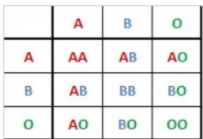
Understanding the options one by one,
(A) $I^O$$I^O$ – Since both the alleles are $I^O$, there are chances of the child to be born with an O blood group. This is not the correct answer.
(B) $I^A$$I^A$ – In this case, one of the parents possess both $I^A$ allele, and so, even if the other parent possesses the allele $I^O$, there are no chances for their child to have O blood group. Hence, this is the correct answer.
(C) $I^A$$I^O$ – Out of two alleles, one is $I^O$. This when combined with the $I^O$ allele of the other parent, there are possibilities for their child to have O blood group. This is not the correct answer.
(D) $I^B$$I^O$ – Since, out of the two alleles, one is $I^O$, there are poss$I^B$ilities for their child to possess O blood group, if the other parent has at least one $I^O$ allele.
Therefore, Option (B) is the correct answer.
Note: It is important to note that ABO blood grouping is an example of multiple alleles. For the child to possess an O blood group, both of the parents should have at least a single $I^O$ allele in their genotype. The child with O blood group is poss$I^B$le even if the parents possess A and B blood groups, given that their genotype should be $I^A$$I^O$ and $I^B$$I^O$ respectively.
Complete answer:
ABO blood grouping is discovered by Karl Landsteiner. ABO blood groups in humans are controlled by the gene I. The gene possesses three alleles, $I^A$, $I^B$ and $I^O$ (i). The alleles $I^A$ and $I^B$ produce a slightly different form of the sugar while allele $I^O$ does not produce any sugar. Since humans are diploid in nature, only two of the three alleles will be found.
The genotypes $I^A$$I^A$ and $I^A$$I^O$ give rise to A blood group. The genotype $I^B$$I^B$ and $I^B$$I^O$ gives rise to B blood groups. When both the alleles $I^A$ and $I^B$ are present, the person possesses AB blood group. While, when both the alleles are $I^O$, the blood group of the person is O. So, it is understood that for the child to have O blood group, both of the parents should have at least one $I^O$ allele in their genotype.
Understanding the options one by one,
(A) $I^O$$I^O$ – Since both the alleles are $I^O$, there are chances of the child to be born with an O blood group. This is not the correct answer.
(B) $I^A$$I^A$ – In this case, one of the parents possess both $I^A$ allele, and so, even if the other parent possesses the allele $I^O$, there are no chances for their child to have O blood group. Hence, this is the correct answer.
(C) $I^A$$I^O$ – Out of two alleles, one is $I^O$. This when combined with the $I^O$ allele of the other parent, there are possibilities for their child to have O blood group. This is not the correct answer.
(D) $I^B$$I^O$ – Since, out of the two alleles, one is $I^O$, there are poss$I^B$ilities for their child to possess O blood group, if the other parent has at least one $I^O$ allele.
Therefore, Option (B) is the correct answer.
Note: It is important to note that ABO blood grouping is an example of multiple alleles. For the child to possess an O blood group, both of the parents should have at least a single $I^O$ allele in their genotype. The child with O blood group is poss$I^B$le even if the parents possess A and B blood groups, given that their genotype should be $I^A$$I^O$ and $I^B$$I^O$ respectively.
Recently Updated Pages
Master Class 11 Social Science: Engaging Questions & Answers for Success

Master Class 11 Physics: Engaging Questions & Answers for Success
Master Class 11 Maths: Engaging Questions & Answers for Success
Master Class 11 Economics: Engaging Questions & Answers for Success
Master Class 11 Computer Science: Engaging Questions & Answers for Success
Master Class 11 Chemistry: Engaging Questions & Answers for Success
Trending doubts
One Metric ton is equal to kg A 10000 B 1000 C 100 class 11 physics CBSE
There are 720 permutations of the digits 1 2 3 4 5 class 11 maths CBSE
1 Quintal is equal to a 110 kg b 10 kg c 100kg d 1000 class 11 physics CBSE
State and prove Bernoullis theorem class 11 physics CBSE
Difference Between Prokaryotic Cells and Eukaryotic Cells
Discuss the various forms of bacteria class 11 biology CBSE