




A child with mass $m$ is standing at the edge of a disc with moment of inertia $I$, radius $R$, and initial angular velocity $\omega $. See the figure given below. The child jumps off the edge of the disc with tangential velocity $v$ with respect to the ground. The new angular velocity of the disc is:
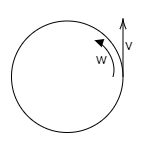
(A) $\sqrt {\dfrac{{I{\omega ^2} - m{v^2}}}{I}} $
(B) $\sqrt {\dfrac{{\left( {I + m{R^2}} \right){\omega ^2} - m{v^2}}}{I}} $
(C) $\dfrac{{I\omega - mvR}}{I}$
(D) $\dfrac{{\left( {I + m{R^2}} \right)\omega - mvR}}{I}$
Answer
 Verified
571.8k+ views
Hint: The new angular velocity can be determined by using the initial angular momentum equation and the final angular momentum equation. By equating the two angular momentum equations, the new angular velocity can be determined.
Complete step by step answer:
Given that,
The mass of the child is given by, $m$,
The moment of inertia of the disc is, $I$,
The radius of the disc is given by, $R$,
The initial angular velocity of the disc is, $\omega $,
The tangential velocity of the disc is, $v$,
Assume the final angular velocity of the disc is, ${\omega'}$.
The angular momentum is equal to the product of the moment of inertia and angular velocity. Here angular momentum is the sum of the angular momentum of the disc and the angular momentum of the child, then
The initial angular momentum is given by, ${L_i} = I\omega + m{R^2}\omega \,................\left( 1 \right)$
Where, ${L_i}$ is the initial angular momentum, $I$ is the moment of inertia, $\omega $ is the angular velocity, $m$ is the mass of the child and $R$ is the radius of the disc.
The final angular momentum is given by, ${L_f} = I{\omega'} + mvR\,................\left( 2 \right)$
Where, ${L_i}$ is the initial angular momentum, $I$ is the moment of inertia, $\omega $ is the angular velocity, $m$ is the mass of the child, $R$ is the radius of the disc and $v$ is the tangential velocity.
By equating the equation (1) and equation (2), then
$I\omega + m{R^2}\omega = I{\omega'} + mvR$
By taking the common terms in the above equation, then
$\left( {I + m{R^2}} \right)\omega = I{\omega'} + mvR$
By rearranging the terms from the above equation, then
$\left( {I + m{R^2}} \right)\omega - mvR = I{\omega'}$
By rearranging the terms from the above equation, then
${\omega'} = \dfrac{{\left( {I + m{R^2}} \right)\omega - mvR}}{I}$
Thus, the above equation shows the new angular velocity of the disc.
Hence, the option (D) is the correct answer.
Note:In the initial angular momentum, it is the sum of the angular momentum of the sum of the disc and the angular momentum of the child. In the final angular momentum, it is the sum of the angular momentum of the disc and the angular momentum when the child jumps with tangential velocity.
Complete step by step answer:
Given that,
The mass of the child is given by, $m$,
The moment of inertia of the disc is, $I$,
The radius of the disc is given by, $R$,
The initial angular velocity of the disc is, $\omega $,
The tangential velocity of the disc is, $v$,
Assume the final angular velocity of the disc is, ${\omega'}$.
The angular momentum is equal to the product of the moment of inertia and angular velocity. Here angular momentum is the sum of the angular momentum of the disc and the angular momentum of the child, then
The initial angular momentum is given by, ${L_i} = I\omega + m{R^2}\omega \,................\left( 1 \right)$
Where, ${L_i}$ is the initial angular momentum, $I$ is the moment of inertia, $\omega $ is the angular velocity, $m$ is the mass of the child and $R$ is the radius of the disc.
The final angular momentum is given by, ${L_f} = I{\omega'} + mvR\,................\left( 2 \right)$
Where, ${L_i}$ is the initial angular momentum, $I$ is the moment of inertia, $\omega $ is the angular velocity, $m$ is the mass of the child, $R$ is the radius of the disc and $v$ is the tangential velocity.
By equating the equation (1) and equation (2), then
$I\omega + m{R^2}\omega = I{\omega'} + mvR$
By taking the common terms in the above equation, then
$\left( {I + m{R^2}} \right)\omega = I{\omega'} + mvR$
By rearranging the terms from the above equation, then
$\left( {I + m{R^2}} \right)\omega - mvR = I{\omega'}$
By rearranging the terms from the above equation, then
${\omega'} = \dfrac{{\left( {I + m{R^2}} \right)\omega - mvR}}{I}$
Thus, the above equation shows the new angular velocity of the disc.
Hence, the option (D) is the correct answer.
Note:In the initial angular momentum, it is the sum of the angular momentum of the sum of the disc and the angular momentum of the child. In the final angular momentum, it is the sum of the angular momentum of the disc and the angular momentum when the child jumps with tangential velocity.
Recently Updated Pages
Master Class 11 Computer Science: Engaging Questions & Answers for Success

Master Class 11 Business Studies: Engaging Questions & Answers for Success
Master Class 11 Economics: Engaging Questions & Answers for Success
Master Class 11 English: Engaging Questions & Answers for Success
Master Class 11 Maths: Engaging Questions & Answers for Success
Master Class 11 Biology: Engaging Questions & Answers for Success
Trending doubts
One Metric ton is equal to kg A 10000 B 1000 C 100 class 11 physics CBSE
There are 720 permutations of the digits 1 2 3 4 5 class 11 maths CBSE
Discuss the various forms of bacteria class 11 biology CBSE
Draw a diagram of a plant cell and label at least eight class 11 biology CBSE
State the laws of reflection of light
Explain zero factorial class 11 maths CBSE