




A child swinging on a swing in sitting position, when she stands up then the time period of the swing will
A) Increase
B) Decrease
C) Remain the same
D) Increase of the child is long and decrease if the child is short
Answer
 Verified
554.8k+ views
Hint:Child swings are the same as a simple pendulum; hence we know in a simple pendulum the time period is directly proportional to the length of the string.
In sinusoidal wave motion, the particle moves about the mean equilibrium or the mean position with passage of time. The particle rises till they reach the highest point and the fall to its lowest point, and this cycle repeats in a uniform pattern. So the total time taken by the particle to complete this cycle is known as time period.
The time period is formulated as \[T = \dfrac{{2\pi }}{\omega }\]
Complete step by step answer:
Given the child initially is sitting on the swing and this swing behaves same as a simple pendulum where the swing reaches to a maximum height ‘A’ and then comes back to the minimum point ‘O’
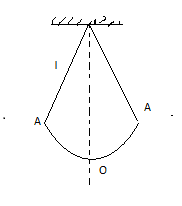
Hence the time period will be equal to\[T = \sqrt {\dfrac{l}{g}} \], where l is the effective length
Therefore we can see \[T \propto \sqrt l \]
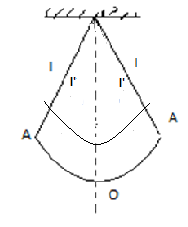
Now it is said that child stands up hence the effective length of the swing decreases and as we know time period is proportional to the length of the swing \[T \propto \sqrt l \], hence when the length of the swing decrease then time period will also decrease
\[T \propto \sqrt {l'} \]
Option (B) is correct.
Note:Students must note that the time period of the simple pendulum does not depend on the mass of the object, but it depends on the length of the string.
In sinusoidal wave motion, the particle moves about the mean equilibrium or the mean position with passage of time. The particle rises till they reach the highest point and the fall to its lowest point, and this cycle repeats in a uniform pattern. So the total time taken by the particle to complete this cycle is known as time period.
The time period is formulated as \[T = \dfrac{{2\pi }}{\omega }\]
Complete step by step answer:
Given the child initially is sitting on the swing and this swing behaves same as a simple pendulum where the swing reaches to a maximum height ‘A’ and then comes back to the minimum point ‘O’
Hence the time period will be equal to\[T = \sqrt {\dfrac{l}{g}} \], where l is the effective length
Therefore we can see \[T \propto \sqrt l \]
Now it is said that child stands up hence the effective length of the swing decreases and as we know time period is proportional to the length of the swing \[T \propto \sqrt l \], hence when the length of the swing decrease then time period will also decrease
\[T \propto \sqrt {l'} \]
Option (B) is correct.
Note:Students must note that the time period of the simple pendulum does not depend on the mass of the object, but it depends on the length of the string.
Recently Updated Pages
Master Class 11 Social Science: Engaging Questions & Answers for Success

Master Class 11 English: Engaging Questions & Answers for Success
Master Class 11 Maths: Engaging Questions & Answers for Success
Master Class 11 Chemistry: Engaging Questions & Answers for Success
Master Class 11 Biology: Engaging Questions & Answers for Success
Master Class 11 Physics: Engaging Questions & Answers for Success
Trending doubts
One Metric ton is equal to kg A 10000 B 1000 C 100 class 11 physics CBSE
Difference Between Prokaryotic Cells and Eukaryotic Cells
How many of the following diseases can be studied with class 11 biology CBSE
Draw a diagram of a plant cell and label at least eight class 11 biology CBSE
Two of the body parts which do not appear in MRI are class 11 biology CBSE
10 examples of friction in our daily life