




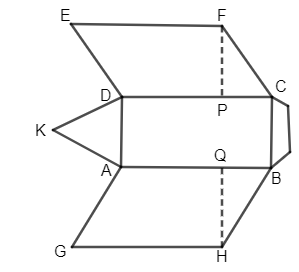
A child draws the figure of an aeroplane as given. Here the wings EDCF and AGHB are parallelograms, the tail ADK is an isosceles triangle, the cockpit BLC is a semicircle and the portion ABCD is a square. Let $FP\bot CD$ and $HQ\bot AB$. $AB=6\ cm$, $KD=5\ cm$, $FP=HQ=2\ cm$. The area of the figure is ,
(a) $98.14\ c{{m}^{2}}$
(b) $87.25\ c{{m}^{2}}$
(c) $86.14\ c{{m}^{2}}$
(d) $91.56\ c{{m}^{2}}$
Answer
 Verified
672.6k+ views
Hint: To find the total area of the aeroplane as per the drawing, we will find the area of parts in which the figure is divided such as, area of square, area of parallelogram, area of semicircle, and area of triangle. Then we will sum up all the areas and we will get the total area.
$\text{Area of triangle}\ =\ \sqrt{s\left( s-a \right)\left( s-b \right)\left( s-c \right)}$ , $\text{Area of square}\ =\ length\times length$ , $\text{Area of semi-circle}\ =\ \dfrac{\pi {{r}^{2}}}{2}$ , $\text{Area of parallelogram}\ =\ breadth\times altitude$ .
Complete step-by-step answer:
In question it is given that a child draws an aeroplane which can be seen in figure below,
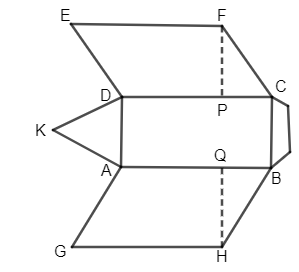
The plane is made by using different shapes such as, square, triangle, parallelogram and semi-circle. And we are asked to find the total area of the figure. So, to find total area we will divide the figure in different shapes as per the figure itself and then we will find the areas such as,
$\text{Area of triangle}\ =\ \sqrt{s\left( s-a \right)\left( s-b \right)\left( s-c \right)}$ ………………..(i)
Where, s is semi perimeter of three sides and a, b and c are the sides of triangle
$\text{Area of square}\ =\ length\times length$……………….(ii)
$\text{Area of parallelogram}\ =\ breadth\times altitude$ …………………(iii)
$\text{Area of semi-circle}\ =\ \dfrac{\pi {{r}^{2}}}{2}$ ………………….(iv)
Now, first of all we will consider the parallelograms, EDCF and AGHB, so the area of parallelograms EDCF and AGHB using the expression (iii) can be given as,
$\text{Area of parallelogram}\ EDCF=\ breadth\times altitude$
Now, parallelograms EDCF and AGHB are same in size so, we can say that \[\text{ }EDCF=AGHB\], so the expression can be written as,
$\text{Area of parallelogram}\ AGHB=\ 2\left( breadth\times altitude \right)$
Now, for parallelogram AGHB breadth is AB and altitude is HQ, and their values are $AB=6\ cm$ and $HQ=2\ cm$, on substituting these values we will get,
$\text{Area of parallelogram}\ AGHB=\ 2\left( 6\times 2 \right)=2\left( 12 \right)$
\[\Rightarrow \text{Area of parallelogram}\ AGHB=24\ c{{m}^{2}}\]
Now, on considering the triangle ADK, the area of triangle can be given by using the formula (i) which can be seen as,
$\text{Area of triangle}\ ADK=\ \sqrt{s\left( s-a \right)\left( s-b \right)\left( s-c \right)}$
Now, s can be given as, $s=\dfrac{AD+DK+AK}{2}$ , where value of DK and AK is same $5\ cm$ as triangle is isosceles and AD is $6\ cm$ as it is also a side of square. So, on substituting these values in expression of s we will get,
$s=\dfrac{6+5+5}{2}=\dfrac{16}{2}=8\ cm$
Now, substituting these values of s in expression of triangle and substituting values of a, b and c, i.e. 6, 5, and 5 we will get,
$\text{Area of triangle}\ ADK=\ \sqrt{8\left( 8-6 \right)\left( 8-5 \right)\left( 8-5 \right)}$
$\Rightarrow \text{Area of triangle}\ ADK=\ \sqrt{8\times 2\times 3\times 3}=\sqrt{144}$
$\Rightarrow \text{Area of triangle}\ ADK=12\ c{{m}^{2}}$
Now, on considering square ABCD, area of square can be given as,
$\text{Area of square}\ ABCD=\ length\times length$
Now, the value of side AB is $6\ cm$ and in square all the sides are same so, the area of square will be,
$\text{Area of square}\ ABCD=\ 6\times 6=36\ c{{m}^{2}}$
Now, on considering semicircle BLC, area of semicircle can be given as,
$\text{Area of semi-circle}\ BC=\ \dfrac{\pi {{r}^{2}}}{2}$
Now, from the figure we can see that the radius of the semicircle is half the length of side BC, so the value of radius will be $r=\dfrac{6}{2}\ =3\ cm$. So, on substituting this value of r in expression we will get,
$\text{Area of semi-circle}\ BC=\ \dfrac{\pi {{\left( 3 \right)}^{2}}}{2}=14.14\ c{{m}^{2}}$
No, total area is summation of all the areas which can be given as,
$\text{Total area}=\text{Area of square}+\text{Area of parallelograms}+\text{Area of triangle}+\text{Area of semi-circle}$
So, substituting all the values we will get,
$\text{Total area}=\ 36+24+12+14.14$
$\Rightarrow \text{Total area}=\ 86.14\ c{{m}^{2}}$
Hence, the total area of figure is $86.14\ c{{m}^{2}}$.
Option (c) is the correct answer.
Note: Students must know all the formulas which are used in this problem. Otherwise the answer will be incorrect. Also, area of triangle can be found out by drawing perpendicular bisector i.e. KM such that triangle KML and KMD will be right angle So, KM and MD will be 3cm. Using Pythagora's theorem, we can find length of KM which will be equal to 4. So, then we have two right angle triangles. So, using the formula $\dfrac{1}{2}\times base\times altitude$ , we can find the area of both triangles. On adding both areas we will get the same answer i.e. $2\left( \dfrac{1}{2}\times 3\times 4 \right)=12c{{m}^{2}}$ .
$\text{Area of triangle}\ =\ \sqrt{s\left( s-a \right)\left( s-b \right)\left( s-c \right)}$ , $\text{Area of square}\ =\ length\times length$ , $\text{Area of semi-circle}\ =\ \dfrac{\pi {{r}^{2}}}{2}$ , $\text{Area of parallelogram}\ =\ breadth\times altitude$ .
Complete step-by-step answer:
In question it is given that a child draws an aeroplane which can be seen in figure below,
The plane is made by using different shapes such as, square, triangle, parallelogram and semi-circle. And we are asked to find the total area of the figure. So, to find total area we will divide the figure in different shapes as per the figure itself and then we will find the areas such as,
$\text{Area of triangle}\ =\ \sqrt{s\left( s-a \right)\left( s-b \right)\left( s-c \right)}$ ………………..(i)
Where, s is semi perimeter of three sides and a, b and c are the sides of triangle
$\text{Area of square}\ =\ length\times length$……………….(ii)
$\text{Area of parallelogram}\ =\ breadth\times altitude$ …………………(iii)
$\text{Area of semi-circle}\ =\ \dfrac{\pi {{r}^{2}}}{2}$ ………………….(iv)
Now, first of all we will consider the parallelograms, EDCF and AGHB, so the area of parallelograms EDCF and AGHB using the expression (iii) can be given as,
$\text{Area of parallelogram}\ EDCF=\ breadth\times altitude$
Now, parallelograms EDCF and AGHB are same in size so, we can say that \[\text{ }EDCF=AGHB\], so the expression can be written as,
$\text{Area of parallelogram}\ AGHB=\ 2\left( breadth\times altitude \right)$
Now, for parallelogram AGHB breadth is AB and altitude is HQ, and their values are $AB=6\ cm$ and $HQ=2\ cm$, on substituting these values we will get,
$\text{Area of parallelogram}\ AGHB=\ 2\left( 6\times 2 \right)=2\left( 12 \right)$
\[\Rightarrow \text{Area of parallelogram}\ AGHB=24\ c{{m}^{2}}\]
Now, on considering the triangle ADK, the area of triangle can be given by using the formula (i) which can be seen as,
$\text{Area of triangle}\ ADK=\ \sqrt{s\left( s-a \right)\left( s-b \right)\left( s-c \right)}$
Now, s can be given as, $s=\dfrac{AD+DK+AK}{2}$ , where value of DK and AK is same $5\ cm$ as triangle is isosceles and AD is $6\ cm$ as it is also a side of square. So, on substituting these values in expression of s we will get,
$s=\dfrac{6+5+5}{2}=\dfrac{16}{2}=8\ cm$
Now, substituting these values of s in expression of triangle and substituting values of a, b and c, i.e. 6, 5, and 5 we will get,
$\text{Area of triangle}\ ADK=\ \sqrt{8\left( 8-6 \right)\left( 8-5 \right)\left( 8-5 \right)}$
$\Rightarrow \text{Area of triangle}\ ADK=\ \sqrt{8\times 2\times 3\times 3}=\sqrt{144}$
$\Rightarrow \text{Area of triangle}\ ADK=12\ c{{m}^{2}}$
Now, on considering square ABCD, area of square can be given as,
$\text{Area of square}\ ABCD=\ length\times length$
Now, the value of side AB is $6\ cm$ and in square all the sides are same so, the area of square will be,
$\text{Area of square}\ ABCD=\ 6\times 6=36\ c{{m}^{2}}$
Now, on considering semicircle BLC, area of semicircle can be given as,
$\text{Area of semi-circle}\ BC=\ \dfrac{\pi {{r}^{2}}}{2}$
Now, from the figure we can see that the radius of the semicircle is half the length of side BC, so the value of radius will be $r=\dfrac{6}{2}\ =3\ cm$. So, on substituting this value of r in expression we will get,
$\text{Area of semi-circle}\ BC=\ \dfrac{\pi {{\left( 3 \right)}^{2}}}{2}=14.14\ c{{m}^{2}}$
No, total area is summation of all the areas which can be given as,
$\text{Total area}=\text{Area of square}+\text{Area of parallelograms}+\text{Area of triangle}+\text{Area of semi-circle}$
So, substituting all the values we will get,
$\text{Total area}=\ 36+24+12+14.14$
$\Rightarrow \text{Total area}=\ 86.14\ c{{m}^{2}}$
Hence, the total area of figure is $86.14\ c{{m}^{2}}$.
Option (c) is the correct answer.
Note: Students must know all the formulas which are used in this problem. Otherwise the answer will be incorrect. Also, area of triangle can be found out by drawing perpendicular bisector i.e. KM such that triangle KML and KMD will be right angle So, KM and MD will be 3cm. Using Pythagora's theorem, we can find length of KM which will be equal to 4. So, then we have two right angle triangles. So, using the formula $\dfrac{1}{2}\times base\times altitude$ , we can find the area of both triangles. On adding both areas we will get the same answer i.e. $2\left( \dfrac{1}{2}\times 3\times 4 \right)=12c{{m}^{2}}$ .
Recently Updated Pages
Master Class 10 Computer Science: Engaging Questions & Answers for Success

Differentiate between voluntary action and reflex class 10 biology CBSE
The uses of bleaching powder are A It is used bleaching class 10 chemistry CBSE
Fill in the blanks with abstract nouns of the words class 10 english CBSE
How many threedigit numbers are there class 10 maths CBSE
What is a reflex arc class 10 biology CBSE
Trending doubts
Explain the Treaty of Vienna of 1815 class 10 social science CBSE
10 examples of evaporation in daily life with explanations
What is the full form of POSCO class 10 social science CBSE
Make a sketch of the human nerve cell What function class 10 biology CBSE
GST is a direct or indirect tax?
The sum of all even numbers between 21 and 51 is a class 10 maths CBSE