




A charged particle enters a uniform magnetic field with a velocity vector at an angle of $45{}^\circ $ with the magnetic field. The pitch of the helical path taken by the particle is $p$. The radius of the helix will be given as
$\begin{align}
& A.\dfrac{p}{\sqrt{2}\pi } \\
& B.\sqrt{2}p \\
& C.\dfrac{p}{2\pi } \\
& D.\dfrac{\sqrt{2}p}{\pi } \\
\end{align}$
Answer
 Verified
581.4k+ views
Hint: Pitch of the helix is given as the product of velocity component along the magnetic field and the time period $T$. This can be found by taking the product of mass, the velocity component along the direction of magnetic field and the constant $2\pi $which is divided by the product of the magnetic field and the charge of the particle. Using this find out the radius of the helix. This will help you to solve this question.
Complete answer:
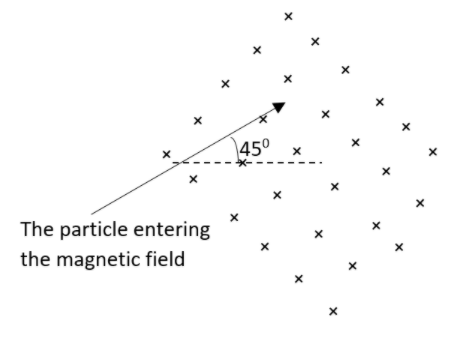
The pitch of a helix is the product of the velocity component and the time period. This can be written as,
$P=\dfrac{2\pi m}{Bq}\left( v\cos 45{}^\circ \right)$
Where \[P\] be the momentum.
As we know, the cosine and the sine of this angle is the same. This can be written as,
\[\cos 45{}^\circ =\sin 45{}^\circ \]
Substituting the sine value instead of cosine value will not make any change in the equation. So this can be written as,
\[P=\dfrac{2\pi m}{Bq}\left( v\sin 45{}^\circ \right)\]
As we already know, the radius of the path of an electron is given by the equation,
\[r=\dfrac{mv}{Bq}\left( \sin 45{}^\circ \right)\]
Let us substitute this in the equation of momentum,
\[P=2\pi \dfrac{\left( mv\sin 45{}^\circ \right)}{Bq}\]
Therefore we can write that,
\[P=2\pi r\]
Rearranging the obtained equation will give the radius of the helix,
\[r=\dfrac{P}{2\pi }\]
Therefore the correct has been obtained.
The answer is given as the option C.
Note: The pitch of a helix is described as the height of one full turn of a helix which is being measured parallel to the axis of the helix. A double helix includes two helices which are typically congruent with the similar axis, only differed by a translation along the axis.
Complete answer:
The pitch of a helix is the product of the velocity component and the time period. This can be written as,
$P=\dfrac{2\pi m}{Bq}\left( v\cos 45{}^\circ \right)$
Where \[P\] be the momentum.
As we know, the cosine and the sine of this angle is the same. This can be written as,
\[\cos 45{}^\circ =\sin 45{}^\circ \]
Substituting the sine value instead of cosine value will not make any change in the equation. So this can be written as,
\[P=\dfrac{2\pi m}{Bq}\left( v\sin 45{}^\circ \right)\]
As we already know, the radius of the path of an electron is given by the equation,
\[r=\dfrac{mv}{Bq}\left( \sin 45{}^\circ \right)\]
Let us substitute this in the equation of momentum,
\[P=2\pi \dfrac{\left( mv\sin 45{}^\circ \right)}{Bq}\]
Therefore we can write that,
\[P=2\pi r\]
Rearranging the obtained equation will give the radius of the helix,
\[r=\dfrac{P}{2\pi }\]
Therefore the correct has been obtained.
The answer is given as the option C.
Note: The pitch of a helix is described as the height of one full turn of a helix which is being measured parallel to the axis of the helix. A double helix includes two helices which are typically congruent with the similar axis, only differed by a translation along the axis.
Recently Updated Pages
Master Class 12 Economics: Engaging Questions & Answers for Success

Master Class 12 Physics: Engaging Questions & Answers for Success
Master Class 12 English: Engaging Questions & Answers for Success
Master Class 12 Social Science: Engaging Questions & Answers for Success
Master Class 12 Maths: Engaging Questions & Answers for Success
Master Class 12 Business Studies: Engaging Questions & Answers for Success
Trending doubts
Which are the Top 10 Largest Countries of the World?
What are the major means of transport Explain each class 12 social science CBSE
Draw a labelled sketch of the human eye class 12 physics CBSE
Differentiate between insitu conservation and exsitu class 12 biology CBSE
Draw a neat and well labeled diagram of TS of ovary class 12 biology CBSE
Give 10 examples of unisexual and bisexual flowers