




A charged glass rod attract a charged plastic straw:
A. True
B. False
C. Ambiguous
D. Data insufficient
Answer
 Verified
628.5k+ views
Hint: When a glass rod is rubbed over some surface, it gains energy due to friction. Friction between the surface and glass rod does some work, which goes in the energy of the electrons of the material of the surface. These electrons after getting a particular amount of energy, called the ionization energy of the surface gets transferred to the rod and hence the rod becomes rich in electrons (charged).
Complete answer:
When a charged rod brought near any lighter material (eg. Bits of paper, parts of straw, etc.), it affects the distribution of electrons over the surface of straw. This disturbance can be electron attracting or electron repelling. When the rod is negatively charged (excess of electrons), it pushes the electron density far from the rod. This results in the separation of positive and negative charges, positive charge being near the negatively charged rod.
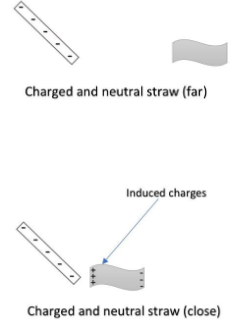
Now, this process is called induction and due to induction, the charges on the straw surface get separated. After that, the opposite charges attract each other and hence we feel that rod is attracting the straw pieces.
Hence the above statement is correct, option A. is correct.
Note:
This is not just valid for negatively charged rods. Even if a positively charged rod is brought near the straw pieces, then also the same phenomenon will appear, difference being that in this case the electron density on the surface of straw will be attracted by the rod, shifting it closer to the rod. Hence in that case also, attraction between opposite charges will appear (positive rod and negative electron density). Students must not think that in the other case (w.r.t question), the straw pieces will be repelled.
Complete answer:
When a charged rod brought near any lighter material (eg. Bits of paper, parts of straw, etc.), it affects the distribution of electrons over the surface of straw. This disturbance can be electron attracting or electron repelling. When the rod is negatively charged (excess of electrons), it pushes the electron density far from the rod. This results in the separation of positive and negative charges, positive charge being near the negatively charged rod.
Now, this process is called induction and due to induction, the charges on the straw surface get separated. After that, the opposite charges attract each other and hence we feel that rod is attracting the straw pieces.
Hence the above statement is correct, option A. is correct.
Note:
This is not just valid for negatively charged rods. Even if a positively charged rod is brought near the straw pieces, then also the same phenomenon will appear, difference being that in this case the electron density on the surface of straw will be attracted by the rod, shifting it closer to the rod. Hence in that case also, attraction between opposite charges will appear (positive rod and negative electron density). Students must not think that in the other case (w.r.t question), the straw pieces will be repelled.
Recently Updated Pages
Master Class 11 English: Engaging Questions & Answers for Success

Master Class 11 Social Science: Engaging Questions & Answers for Success
Master Class 11 Maths: Engaging Questions & Answers for Success
Master Class 11 Biology: Engaging Questions & Answers for Success
Master Class 11 Physics: Engaging Questions & Answers for Success
Master Class 11 Chemistry: Engaging Questions & Answers for Success
Trending doubts
One Metric ton is equal to kg A 10000 B 1000 C 100 class 11 physics CBSE
Difference Between Prokaryotic Cells and Eukaryotic Cells
Find the value of the expression given below sin 30circ class 11 maths CBSE
Difference between physical and chemical change class 11 chemistry CBSE
Two of the body parts which do not appear in MRI are class 11 biology CBSE
Draw a diagram of a plant cell and label at least eight class 11 biology CBSE