




A charge q is released in presence of electric (E) and magnetic field (B) then after some time its velocity is v then:
A. $V$$\propto $ $E$
B. $V$$\propto $$\dfrac{1}{E}$
C. ${{V}^{2}}$$\propto $$E$
D. $V\propto {{B}^{\circ }}$
Answer
 Verified
587.4k+ views
Hint: When a particle is released under the presence of an external electric and magnetic field, the particle starts to move perpendicular to both the fields. The particle experiences force due to both the fields and its direction of motion is influenced by being in these fields. The magnetic field plays a vital role in defining the path of the charged particle.
Complete answer:
According to the question,
A charge q is released in presence of an external electric and magnetic field.
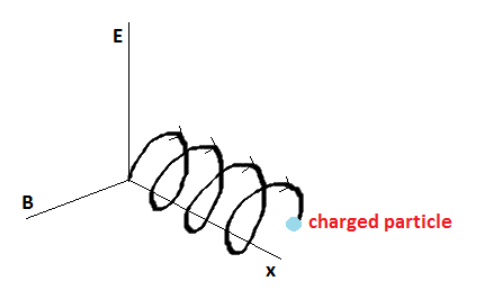
In these situations, the magnetic field, electric field, and motion of the particle are perpendicular to each other. This was given by Lorentz Right-hand rule. According to this rule, if we extend our right hand's thumb, index finger, and middle finger in such a way that they form a right angle between each of them. Then the thumb represents the direction of the force and the middle finger and index finger represents the direction of motion and magnetic field respectively.
The force on the particle due to external electrical force is given by:
$F=qE$
Force on the particle due to external magnetic field when the value of angle between the field lines and the direction of motion of particle is $90{}^\circ $, is given by:
$\begin{align}
& F=Blv\sin \theta \\
& F=Blv \\
\end{align}$
Equating the value of forces experienced by the particle:
\[\begin{align}
& Blv=qE \\
& v=\dfrac{qE}{Bl} \\
& So,\ v\propto E \\
\end{align}\]
Thus, we can conclude that the correct option which satisfies the given question is Option A.
Note:
Being in the influence of both the external fields the particle follows a spiral trajectory of motion. The electric field does not have any influence on the direction of the motion of the particle. The trajectory is formed due to the influence of the external magnetic field.
Complete answer:
According to the question,
A charge q is released in presence of an external electric and magnetic field.
In these situations, the magnetic field, electric field, and motion of the particle are perpendicular to each other. This was given by Lorentz Right-hand rule. According to this rule, if we extend our right hand's thumb, index finger, and middle finger in such a way that they form a right angle between each of them. Then the thumb represents the direction of the force and the middle finger and index finger represents the direction of motion and magnetic field respectively.
The force on the particle due to external electrical force is given by:
$F=qE$
Force on the particle due to external magnetic field when the value of angle between the field lines and the direction of motion of particle is $90{}^\circ $, is given by:
$\begin{align}
& F=Blv\sin \theta \\
& F=Blv \\
\end{align}$
Equating the value of forces experienced by the particle:
\[\begin{align}
& Blv=qE \\
& v=\dfrac{qE}{Bl} \\
& So,\ v\propto E \\
\end{align}\]
Thus, we can conclude that the correct option which satisfies the given question is Option A.
Note:
Being in the influence of both the external fields the particle follows a spiral trajectory of motion. The electric field does not have any influence on the direction of the motion of the particle. The trajectory is formed due to the influence of the external magnetic field.
Recently Updated Pages
Master Class 11 Computer Science: Engaging Questions & Answers for Success

Master Class 11 Business Studies: Engaging Questions & Answers for Success
Master Class 11 Economics: Engaging Questions & Answers for Success
Master Class 11 English: Engaging Questions & Answers for Success
Master Class 11 Maths: Engaging Questions & Answers for Success
Master Class 11 Biology: Engaging Questions & Answers for Success
Trending doubts
One Metric ton is equal to kg A 10000 B 1000 C 100 class 11 physics CBSE
There are 720 permutations of the digits 1 2 3 4 5 class 11 maths CBSE
Discuss the various forms of bacteria class 11 biology CBSE
Draw a diagram of a plant cell and label at least eight class 11 biology CBSE
State the laws of reflection of light
Explain zero factorial class 11 maths CBSE