




A charge of $ + 10$C enters a uniform magnetic field parallel to its direction. What will happen to the charge?
Answer
 Verified
528.6k+ views
Hint:Let us first get some idea about magnetic fields. A magnetic field, which is a vector field, describes the magnetic influence on moving electric charges, electric currents, and magnetic materials. In a magnetic field, a moving charge experiences a force that is perpendicular to both its own velocity and the magnetic field.
Complete step-by-step solution:
A charged particle's magnetic force is orthogonal to the magnetic field, resulting in:
$F = qvB\sin \theta $
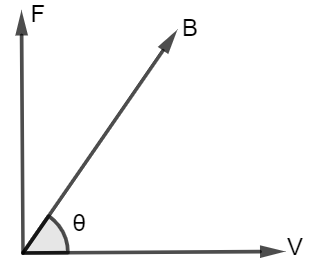
There is no net force and the charged particle goes in a straight line if its velocity is parallel to the magnetic field.
The angle between the velocity vector and the magnetic field vector B determines the force a charged particle “feels” as a result of a magnetic field. Remember that the magnetic force is equal to:
$F = qvB\sin \theta $
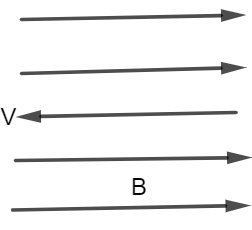
When the magnetic field and velocity are parallel (or antiparallel), \[sin\theta = {\text{ }}0\], and no force exists. In this scenario, even in the presence of a strong magnetic field, a charged particle can continue to move in a straight line. The component of v parallel to B remains unaltered if it is between \[0\] and \[90\] degrees.
Note:In the case of a positive charge, the force exerted by an electric field is parallel to the electric field vector, while in the case of a negative charge, it is antiparallel. It is independent of the particle's velocity.
Complete step-by-step solution:
A charged particle's magnetic force is orthogonal to the magnetic field, resulting in:
$F = qvB\sin \theta $
There is no net force and the charged particle goes in a straight line if its velocity is parallel to the magnetic field.
The angle between the velocity vector and the magnetic field vector B determines the force a charged particle “feels” as a result of a magnetic field. Remember that the magnetic force is equal to:
$F = qvB\sin \theta $
When the magnetic field and velocity are parallel (or antiparallel), \[sin\theta = {\text{ }}0\], and no force exists. In this scenario, even in the presence of a strong magnetic field, a charged particle can continue to move in a straight line. The component of v parallel to B remains unaltered if it is between \[0\] and \[90\] degrees.
Note:In the case of a positive charge, the force exerted by an electric field is parallel to the electric field vector, while in the case of a negative charge, it is antiparallel. It is independent of the particle's velocity.
Recently Updated Pages
Master Class 12 Business Studies: Engaging Questions & Answers for Success

Master Class 12 Biology: Engaging Questions & Answers for Success
Master Class 12 Chemistry: Engaging Questions & Answers for Success
Class 12 Question and Answer - Your Ultimate Solutions Guide
Master Class 11 Social Science: Engaging Questions & Answers for Success
Master Class 11 English: Engaging Questions & Answers for Success
Trending doubts
Which is more stable and why class 12 chemistry CBSE
Which are the Top 10 Largest Countries of the World?
Draw a labelled sketch of the human eye class 12 physics CBSE
Differentiate between homogeneous and heterogeneous class 12 chemistry CBSE
What are the major means of transport Explain each class 12 social science CBSE
Sulphuric acid is known as the king of acids State class 12 chemistry CBSE