




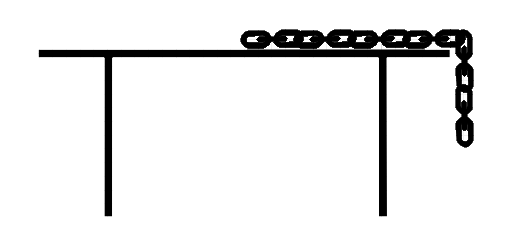
A chain of length L starts sliding down from the horizontal surface of a table. If the hanging length is l, the coefficient of friction between the table and chain is:
A. \[\dfrac{l}{L}\]
B. \[\dfrac{L}{l}\]
C. \[\dfrac{l}{L-l}\]
D. \[\dfrac{L-l}{l}\]
Answer
 Verified
608.7k+ views
Hint: IN this question we have been given that a chain of length L starts sliding down the horizontal surface. We have been asked to calculate the coefficient of friction between the table and chain. Static friction is the limiting frictional force above which the object starts to slide or move on a surface. We know that the maximum static friction will be equal to the weight of the hanging chain. Since the weight of the hanging chain is the force that is opposed by the static friction.
Complete step by step solution:
The total length of the chain is given as L, the length of the chain hanging from the table is given as l as shown in the figure.
Let us assume that the chain has a uniformly distributed mass, say ‘m’. Also, the length of chain on the table will be (L-l).
Therefore,
mass of chain on the table \[=\dfrac{mg(L-l)}{L}\]
Similarly,
mass of chain hanging from the table \[=\dfrac{mgl}{L}\]
Now, we know that
\[F=\mu N\] ……………… (1)
Where, F is the frictional force, N is the normal reaction and \[\mu \]is the coefficient of friction.
We know that
\[N=\dfrac{mg(L-l)}{L}\] ………………… (2)
We also know that, the maximum frictional force is equal to the weight of the hanging chain
Therefore,
\[F=\dfrac{mgl}{L}\] ………………….. (3)
Therefore, from (1), (2) and (3)
We get,
\[\dfrac{mgl}{L}=\mu \dfrac{mg(L-l)}{L}\]
On solving,
We get,
\[\mu =\dfrac{l}{(L-l)}\]
So, the correct answer is “Option C”.
Note: When we try to move an object, we experience a friction force. This force is known as static friction force. The static friction force keeps the object at rest. Therefore, it opposes motion. The friction force experienced when on a moving object is known as dynamic friction force. This force acts opposite to the direction of the motion of the object.
Complete step by step solution:
The total length of the chain is given as L, the length of the chain hanging from the table is given as l as shown in the figure.
Let us assume that the chain has a uniformly distributed mass, say ‘m’. Also, the length of chain on the table will be (L-l).
Therefore,
mass of chain on the table \[=\dfrac{mg(L-l)}{L}\]
Similarly,
mass of chain hanging from the table \[=\dfrac{mgl}{L}\]
Now, we know that
\[F=\mu N\] ……………… (1)
Where, F is the frictional force, N is the normal reaction and \[\mu \]is the coefficient of friction.
We know that
\[N=\dfrac{mg(L-l)}{L}\] ………………… (2)
We also know that, the maximum frictional force is equal to the weight of the hanging chain
Therefore,
\[F=\dfrac{mgl}{L}\] ………………….. (3)
Therefore, from (1), (2) and (3)
We get,
\[\dfrac{mgl}{L}=\mu \dfrac{mg(L-l)}{L}\]
On solving,
We get,
\[\mu =\dfrac{l}{(L-l)}\]
So, the correct answer is “Option C”.
Note: When we try to move an object, we experience a friction force. This force is known as static friction force. The static friction force keeps the object at rest. Therefore, it opposes motion. The friction force experienced when on a moving object is known as dynamic friction force. This force acts opposite to the direction of the motion of the object.
Recently Updated Pages
Master Class 11 English: Engaging Questions & Answers for Success

Master Class 11 Social Science: Engaging Questions & Answers for Success
Master Class 11 Maths: Engaging Questions & Answers for Success
Master Class 11 Chemistry: Engaging Questions & Answers for Success
Master Class 11 Biology: Engaging Questions & Answers for Success
Master Class 11 Physics: Engaging Questions & Answers for Success
Trending doubts
One Metric ton is equal to kg A 10000 B 1000 C 100 class 11 physics CBSE
Difference Between Prokaryotic Cells and Eukaryotic Cells
Find the value of the expression given below sin 30circ class 11 maths CBSE
1 ton equals to A 100 kg B 1000 kg C 10 kg D 10000 class 11 physics CBSE
Two of the body parts which do not appear in MRI are class 11 biology CBSE
What are hard magnetic materials class 11 physics CBSE