



A certain city of $ 15000 $ families, $ 3.5\% $ of families who read $ A $ but not $ B $ look into advertisement, $ 25\% $ of the families who read $ B $ but not $ A $ look into advertising and $ 50\% $ of the families, who read both $ A $ and $ B $ look into advertisements. It is known that $ 8000 $ families read $ A.4000 $ read $ B.1000 $ read both $ A $ and $ B. $
Choose the correct answer
The number of families who look into advertisements
(1) $ 1295 $
(2) $ 1395 $
(3) $ 1495 $
(4) $ 1500 $
Answer
 Verified
581.7k+ views
Hint: Use complete of percentage to calculate the number of families that look into advertisement in only $ A, $ only $ B $ and both in $ A $ and $ B. $ Then use the concept of set theory to calculate the total number of families.
Complete step-by-step answer:
Let the set of all the families be $ U. $
Then, the number of elements in $ U $ will be $ 15000. $
$ \Rightarrow n(U) = 15000 $
It is also given that $ n(A) = 8000,n(B) = 4000n(C) = 1000 $
The families who read $ A $ but not $ B. $
Be $ A - B $
$ n(A - B) = n(A) - n(AnB) = 8000 - 1000 $
$ = 7000 $
$ 3.5\% $ of $ (A - B) $ look into advertisement
i.e., $ \dfrac{{3.5}}{{100}} \times 7000 $ look into advertisement
$ \Rightarrow 3.5 \times 70 $ look into advertisement
$ \Rightarrow 245.0 $ look into advertisement
Let the families when read $ B $ but not $ A $ be $ A - B. $
We know that
$ n(B - A) = n(B) - n(BnA) $
$ \Rightarrow n(B - A) = 4000 - 1000 $
It is given that $ 25\% $ of families read $ B $ but not $ A. $
$ \Rightarrow \dfrac{{25}}{{100}} \times n(B - A) $ read advertisement
$ \Rightarrow \dfrac{{25}}{{100}} \times 3000 $ read advertisement
$ \Rightarrow 25 \times 30 $ read advertisement
$ \Rightarrow 750 $ read advertisement
Let the families who read both $ A $ and $ B $ be $ (AnB). $
It is given that $ n(AnB) = 1000 $
$ 50\% $ of $ AnB $ read advertisements
$ \Rightarrow \dfrac{{50}}{{100}} \times n(AnB) $ read advertisements
$ \Rightarrow \dfrac{1}{2} \times 1000 $ read advertisements
$ \Rightarrow 500 $ read advertisements
Total number of people that read advertisements would be the sum of people that read advertisements in $ A $ but not into $ B, $ but not in $ A, $ in $ A $ and $ B $ both.
Refer the diagram for better understanding
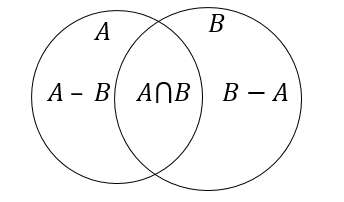
Therefore, the number of families who look into advertisements are.
$ = 245 + 750 + 500 $
$ = 1495 $
Therefore, $ 1495 $ families look into advertisements.
Therefore, from the above explanation the correct option is (3) $ 1495. $
So, the correct answer is “Option 3”.
Note: To solve this question, you read to have a clear idea of let theory.
$ A - B $ is defined as the elements that are in $ A $ but not in $ B. $
Therefore, we get the number of element in $ A - B $ by subtracting the number of elements which are in both $ A $ and $ B, $ from $ A. $
i.e., $ n(A - B) = n(A) - n(AnB) $
$ AUB $ is the collection of elements which are in either $ A $ or $ B $ or both.
Therefore, $ n(AUB) $ is the sum of elements which are in only $ A, $ only $ B $ and both in $ A $ and $ B. $
i.e., $ n(AUB) = n(A - B) + n(B - A) + n(AnB) $
Complete step-by-step answer:
Let the set of all the families be $ U. $
Then, the number of elements in $ U $ will be $ 15000. $
$ \Rightarrow n(U) = 15000 $
It is also given that $ n(A) = 8000,n(B) = 4000n(C) = 1000 $
The families who read $ A $ but not $ B. $
Be $ A - B $
$ n(A - B) = n(A) - n(AnB) = 8000 - 1000 $
$ = 7000 $
$ 3.5\% $ of $ (A - B) $ look into advertisement
i.e., $ \dfrac{{3.5}}{{100}} \times 7000 $ look into advertisement
$ \Rightarrow 3.5 \times 70 $ look into advertisement
$ \Rightarrow 245.0 $ look into advertisement
Let the families when read $ B $ but not $ A $ be $ A - B. $
We know that
$ n(B - A) = n(B) - n(BnA) $
$ \Rightarrow n(B - A) = 4000 - 1000 $
It is given that $ 25\% $ of families read $ B $ but not $ A. $
$ \Rightarrow \dfrac{{25}}{{100}} \times n(B - A) $ read advertisement
$ \Rightarrow \dfrac{{25}}{{100}} \times 3000 $ read advertisement
$ \Rightarrow 25 \times 30 $ read advertisement
$ \Rightarrow 750 $ read advertisement
Let the families who read both $ A $ and $ B $ be $ (AnB). $
It is given that $ n(AnB) = 1000 $
$ 50\% $ of $ AnB $ read advertisements
$ \Rightarrow \dfrac{{50}}{{100}} \times n(AnB) $ read advertisements
$ \Rightarrow \dfrac{1}{2} \times 1000 $ read advertisements
$ \Rightarrow 500 $ read advertisements
Total number of people that read advertisements would be the sum of people that read advertisements in $ A $ but not into $ B, $ but not in $ A, $ in $ A $ and $ B $ both.
Refer the diagram for better understanding
Therefore, the number of families who look into advertisements are.
$ = 245 + 750 + 500 $
$ = 1495 $
Therefore, $ 1495 $ families look into advertisements.
Therefore, from the above explanation the correct option is (3) $ 1495. $
So, the correct answer is “Option 3”.
Note: To solve this question, you read to have a clear idea of let theory.
$ A - B $ is defined as the elements that are in $ A $ but not in $ B. $
Therefore, we get the number of element in $ A - B $ by subtracting the number of elements which are in both $ A $ and $ B, $ from $ A. $
i.e., $ n(A - B) = n(A) - n(AnB) $
$ AUB $ is the collection of elements which are in either $ A $ or $ B $ or both.
Therefore, $ n(AUB) $ is the sum of elements which are in only $ A, $ only $ B $ and both in $ A $ and $ B. $
i.e., $ n(AUB) = n(A - B) + n(B - A) + n(AnB) $
Recently Updated Pages
Master Class 8 Social Science: Engaging Questions & Answers for Success

Master Class 8 English: Engaging Questions & Answers for Success
Class 8 Question and Answer - Your Ultimate Solutions Guide
Master Class 8 Maths: Engaging Questions & Answers for Success
Master Class 8 Science: Engaging Questions & Answers for Success
Master Class 7 English: Engaging Questions & Answers for Success
Trending doubts
Difference Between Plant Cell and Animal Cell
Fill the blanks with the suitable prepositions 1 The class 9 english CBSE
Which places in India experience sunrise first and class 9 social science CBSE
Who is eligible for RTE class 9 social science CBSE
What is pollution? How many types of pollution? Define it
Name 10 Living and Non living things class 9 biology CBSE