




A certain alkene produces the product shown, when subjected to ozonolysis followed by oxidative work-up. What is the structure of alkene?
$ Alkene\xrightarrow[{{H_2}{O_2}}]{{{O_3}}}HOOCC{H_2}C{H_2}COOH + C{H_3}COC{H_3} + HCOOH $
(A)
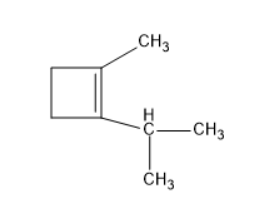
(B) $ {\left( {C{H_3}} \right)_2}C = CHC{H_2}C{H_2}CH = C{H_2} $
(C) $ C{H_3}CH = CHC{H_2}C{H_2}CH = CHC{H_2} $
(D) $ C{H_3}C{H_2}CH = C = CHC{H_2}CH = C{H_2} $
Answer
 Verified
561.9k+ views
Hint: Alkenes consist of double bonded carbon and carbon atoms. When alkenes are subjected to ozonolysis carbonyl compounds will be formed at the double bond positions. Further oxidative work up converts aldehydes into carboxylic compounds, whereas ketones will remain like that.
Complete answer:
Alkenes are unsaturated hydrocarbons consisting of carbon and hydrogen atoms. There will be one or more double bonded carbon atoms in alkenes. When alkenes are subjected to ozonolysis the double bonds will convert into carbonyl compounds which are aldehydes and ketones.
At the position of double bond, the carbonyl compounds will be formed. Aldehydes will convert into carboxylic acid when ozonolysis is followed by oxidation.
In the given option acetone is formed. Thus, the alkenes should consist of an isopropyl group. In the given options, option B has the isopropyl group.
At the position of double bond, the carbonyl compounds will be formed upon ozonolysis.
$ {\left( {C{H_3}} \right)_2}C = CHC{H_2}C{H_2}CH = C{H_2}\xrightarrow{{{O_3}}}C{H_3}COC{H_3} + OHCC{H_2}C{H_2}CHO + HCHO $
The above products were formed upon ozonolysis and oxidative work up of the above products the aldehydes convert into carboxylic acids.
The oxidative work up the reagent is hydrogen peroxide.
$ C{H_3}COC{H_3} + OHCC{H_2}C{H_2}CHO + HCHO\xrightarrow{{{H_2}{O_2}}}C{H_3}COC{H_3} + HOOCC{H_2}C{H_2}COOH + HCOOH $
Thus, the alkene is $ {\left( {C{H_3}} \right)_2}C = CHC{H_2}C{H_2}CH = C{H_2} $
Option B is the correct one.
Note:
Ozonolysis means the addition of ozone molecules to alkenes. Ozonide will be formed in the reaction. Later the oxidative work up means the oxidation takes place. But only aldehydes convert into carboxylic acids. The ketones will not convert into carboxylic acids is an important point.
Complete answer:
Alkenes are unsaturated hydrocarbons consisting of carbon and hydrogen atoms. There will be one or more double bonded carbon atoms in alkenes. When alkenes are subjected to ozonolysis the double bonds will convert into carbonyl compounds which are aldehydes and ketones.
At the position of double bond, the carbonyl compounds will be formed. Aldehydes will convert into carboxylic acid when ozonolysis is followed by oxidation.
In the given option acetone is formed. Thus, the alkenes should consist of an isopropyl group. In the given options, option B has the isopropyl group.
At the position of double bond, the carbonyl compounds will be formed upon ozonolysis.
$ {\left( {C{H_3}} \right)_2}C = CHC{H_2}C{H_2}CH = C{H_2}\xrightarrow{{{O_3}}}C{H_3}COC{H_3} + OHCC{H_2}C{H_2}CHO + HCHO $
The above products were formed upon ozonolysis and oxidative work up of the above products the aldehydes convert into carboxylic acids.
The oxidative work up the reagent is hydrogen peroxide.
$ C{H_3}COC{H_3} + OHCC{H_2}C{H_2}CHO + HCHO\xrightarrow{{{H_2}{O_2}}}C{H_3}COC{H_3} + HOOCC{H_2}C{H_2}COOH + HCOOH $
Thus, the alkene is $ {\left( {C{H_3}} \right)_2}C = CHC{H_2}C{H_2}CH = C{H_2} $
Option B is the correct one.
Note:
Ozonolysis means the addition of ozone molecules to alkenes. Ozonide will be formed in the reaction. Later the oxidative work up means the oxidation takes place. But only aldehydes convert into carboxylic acids. The ketones will not convert into carboxylic acids is an important point.
Recently Updated Pages
If x a + bt + ct2 where x is in meters and t is in class 11 physics CBSE

A car covers the first half distance between two places class 11 physics CBSE
The resultant of two vectors overrightarrow P and overrightarrow class 11 physics CBSE
Find the value of cos 135 class 11 maths CBSE
A mass M is held in place by an applied force F and class 11 physics CBSE
A solution of glucose in water is labelled as 10 dfracwv class 11 chemistry CBSE
Trending doubts
One Metric ton is equal to kg A 10000 B 1000 C 100 class 11 physics CBSE
Find the value of the expression given below sin 30circ class 11 maths CBSE
Draw a diagram of nephron and explain its structur class 11 biology CBSE
10 examples of friction in our daily life
Proton was discovered by A Thomson B Rutherford C Chadwick class 11 chemistry CBSE
Bond order ofO2 O2+ O2 and O22 is in order A O2 langle class 11 chemistry CBSE