




When a cell reproduces, what happens to its DNA? Is it copied and incorporated into offspring?
Answer
 Verified
568.9k+ views
Hint: Cell divides to form new cells and these newly formed cells are the daughter cells or offspring of the parent cell. This division is completed in two major stages - karyokinesis and cytokinesis.
Complete answer:
In the process of cell reproduction, the cells divide to form new cells and each time a cell divides, it forms a copy of all of its chromosomes and evenly distributes to all the newly formed cells. The chromosomes are tightly coiled strands of DNA that contain all the instructions and information for all the life. This can be either by mitosis or meiosis but in both the processes, the complete copy of DNA or a part of parent DNA is transferred to the offspring.
A diagram representing mitosis has been shown below –
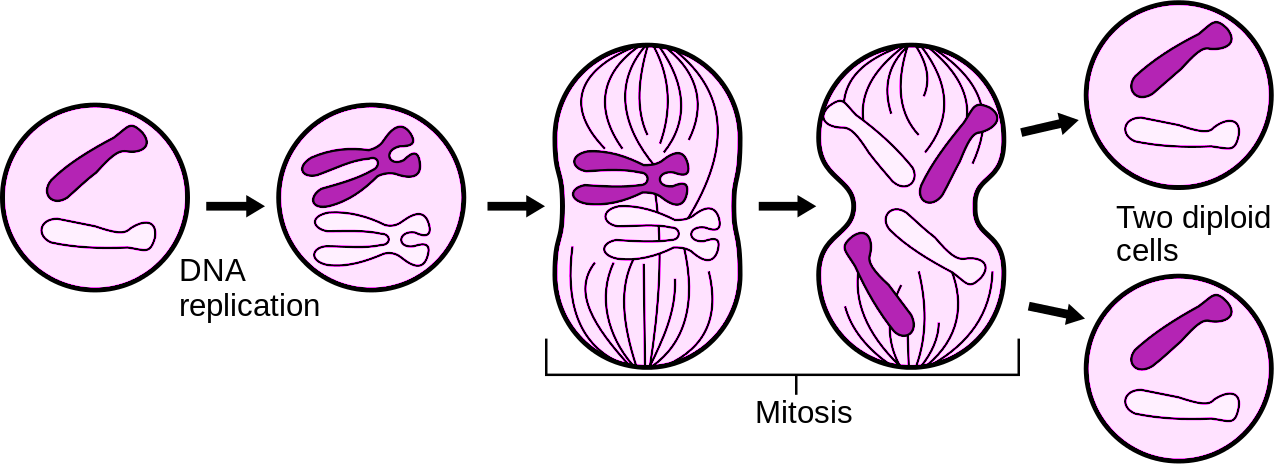
It can be seen in the diagram of how the replicated DNA is distributed between the daughter cells.
Additional information :
The steps that cells take to grow, develop, and reproduce are collectively called a cell cycle and it consists of five stages which have been written below –
1. G1 Phase
2. S Phase
3. G2 Phase
4. M Phase
5. Cytokinesis
Note: It is the S Phase during which DNA replication takes place and the genetic material is prepared to be divided into daughter cells. The actual division takes place in M Phase which is a division of the nucleus of the cell and hence termed as karyokinesis.
This is followed by cytokinesis in which the cytoplasm divides and daughter cells are formed with an equal amount of DNA content.
Complete answer:
In the process of cell reproduction, the cells divide to form new cells and each time a cell divides, it forms a copy of all of its chromosomes and evenly distributes to all the newly formed cells. The chromosomes are tightly coiled strands of DNA that contain all the instructions and information for all the life. This can be either by mitosis or meiosis but in both the processes, the complete copy of DNA or a part of parent DNA is transferred to the offspring.
A diagram representing mitosis has been shown below –
It can be seen in the diagram of how the replicated DNA is distributed between the daughter cells.
Additional information :
The steps that cells take to grow, develop, and reproduce are collectively called a cell cycle and it consists of five stages which have been written below –
1. G1 Phase
2. S Phase
3. G2 Phase
4. M Phase
5. Cytokinesis
Note: It is the S Phase during which DNA replication takes place and the genetic material is prepared to be divided into daughter cells. The actual division takes place in M Phase which is a division of the nucleus of the cell and hence termed as karyokinesis.
This is followed by cytokinesis in which the cytoplasm divides and daughter cells are formed with an equal amount of DNA content.
Recently Updated Pages
Match columnI with columnII and choose the correct class 12 biology NEET_UG

Match columnI with columnII and choose the correct class 12 biology NEET_UG
Match columnI with columnII and choose the correct class 12 biology NEET_UG
Which plant will lose its economic value if its fruits class 12 biology NEET_UG
Human insulin is being commercially produced from a class 12 biology NEET_UG
Match columnI with columnII and choose the correct class 12 biology NEET_UG
Trending doubts
Which are the Top 10 Largest Countries of the World?
The total number of vertebrae in man is a30 b31 c32 class 12 biology CBSE
Draw a labelled sketch of the human eye class 12 physics CBSE
The number of cranial nerves in a frog is A 10 pairs class 12 biology CBSE
Differentiate between homogeneous and heterogeneous class 12 chemistry CBSE
Antibodies present in colostrum which protect the new class 12 biology CBSE