




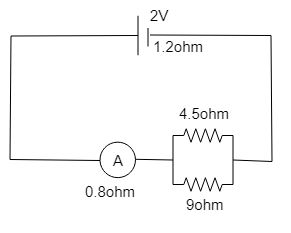
A cell of emf $2V$ and internal resistance of $1.2\Omega $ is connected with an ammeter of resistance $0.8\Omega $ and two resistors of $4.5\Omega $ and $9\Omega $ as shown in the diagram:
(i) What would be the reading on the Ammeter?
(ii) What is the potential difference across the terminals of the cell?
Answer
 Verified
521.7k+ views
Hint:First we need to find the value of the equivalent resistance in order to solve this question. The two resistors of $4.5\Omega $ and $9\Omega $ are in a parallel combination and their resultant is in series with the resistance of $0.8\Omega $. By applying this concept, we are able to solve this question.
Complete step by step answer:
Given, EMF of this circuit $E = 2V$. Internal resistance of the cell $r = 1.2\Omega $. Let us consider the external resistance to be $R$. Since two resistors of $4.5\Omega $ and $9\Omega $ are connected in a parallel circuit. So, the equivalent resistance of these two resistors is,
$\dfrac{1}{{{R_p}}} = \dfrac{1}{{4.5}} + \dfrac{1}{9}$
On taking the LCM,
$\dfrac{1}{{{R_p}}} = \dfrac{{2 + 1}}{9}$
$\Rightarrow \dfrac{1}{{{R_p}}} = \dfrac{3}{9}$
On further simplifying, we get,
$\dfrac{1}{{{R_p}}} = \dfrac{1}{3}$
$\Rightarrow {R_p} = 3\Omega $
Now, the resistance of $0.8\Omega $ and ${R_p} = 3\Omega $ are in series combination. So,
$R = 3 + 0.8$
$\Rightarrow R = 3.8\Omega $
(i) The value of the current in the resistance of $0.8\Omega $ is given by,
$I = \dfrac{E}{{R + r}}$
On putting the required values, we get,
$I = \dfrac{2}{{3.8 + 1.2}}$
$\Rightarrow I = \dfrac{2}{5}$
$\Rightarrow I = 0.4A$
So, the value of the current in the resistance of $0.8\Omega $ is $I = 0.4\,A$.
(ii) The potential difference across the terminals of the cell is,
$V = E - Ir$
On putting the required values, we get,
$V = 2 - (0.4 \times 1.2)$
$\Rightarrow V = 2 - 0.48$
$\therefore V = 1.52V$
So, the potential difference across the terminals of the cell is $V = 1.52\,V$.
Note:Internal Resistance is defined as the resistance which acts in the battery. This resistance resists the current flow when the battery is connected to a circuit. The reason that the batteries have an internal resistance is because the elements that make a battery are not perfect conductors. An ideal batter must have no resistance but an ideal battery is hypothetical.
Complete step by step answer:
Given, EMF of this circuit $E = 2V$. Internal resistance of the cell $r = 1.2\Omega $. Let us consider the external resistance to be $R$. Since two resistors of $4.5\Omega $ and $9\Omega $ are connected in a parallel circuit. So, the equivalent resistance of these two resistors is,
$\dfrac{1}{{{R_p}}} = \dfrac{1}{{4.5}} + \dfrac{1}{9}$
On taking the LCM,
$\dfrac{1}{{{R_p}}} = \dfrac{{2 + 1}}{9}$
$\Rightarrow \dfrac{1}{{{R_p}}} = \dfrac{3}{9}$
On further simplifying, we get,
$\dfrac{1}{{{R_p}}} = \dfrac{1}{3}$
$\Rightarrow {R_p} = 3\Omega $
Now, the resistance of $0.8\Omega $ and ${R_p} = 3\Omega $ are in series combination. So,
$R = 3 + 0.8$
$\Rightarrow R = 3.8\Omega $
(i) The value of the current in the resistance of $0.8\Omega $ is given by,
$I = \dfrac{E}{{R + r}}$
On putting the required values, we get,
$I = \dfrac{2}{{3.8 + 1.2}}$
$\Rightarrow I = \dfrac{2}{5}$
$\Rightarrow I = 0.4A$
So, the value of the current in the resistance of $0.8\Omega $ is $I = 0.4\,A$.
(ii) The potential difference across the terminals of the cell is,
$V = E - Ir$
On putting the required values, we get,
$V = 2 - (0.4 \times 1.2)$
$\Rightarrow V = 2 - 0.48$
$\therefore V = 1.52V$
So, the potential difference across the terminals of the cell is $V = 1.52\,V$.
Note:Internal Resistance is defined as the resistance which acts in the battery. This resistance resists the current flow when the battery is connected to a circuit. The reason that the batteries have an internal resistance is because the elements that make a battery are not perfect conductors. An ideal batter must have no resistance but an ideal battery is hypothetical.
Recently Updated Pages
Master Class 12 Economics: Engaging Questions & Answers for Success

Master Class 12 English: Engaging Questions & Answers for Success
Master Class 12 Social Science: Engaging Questions & Answers for Success
Master Class 12 Maths: Engaging Questions & Answers for Success
Master Class 12 Physics: Engaging Questions & Answers for Success
Master Class 10 English: Engaging Questions & Answers for Success
Trending doubts
Explain the Treaty of Vienna of 1815 class 10 social science CBSE
Who Won 36 Oscar Awards? Record Holder Revealed
Why is it 530 pm in india when it is 1200 afternoon class 10 social science CBSE
Make a sketch of the human nerve cell What function class 10 biology CBSE
What is the full form of POSCO class 10 social science CBSE
Define Potential, Developed, Stock and Reserved resources